Why a Brand-Specific Cement Calculator Beats Generic Volume Tools
Discover why brand-specific cement calculators outperform generic volume tools by accounting for SKU-specific yields, waste, and polymer densities.
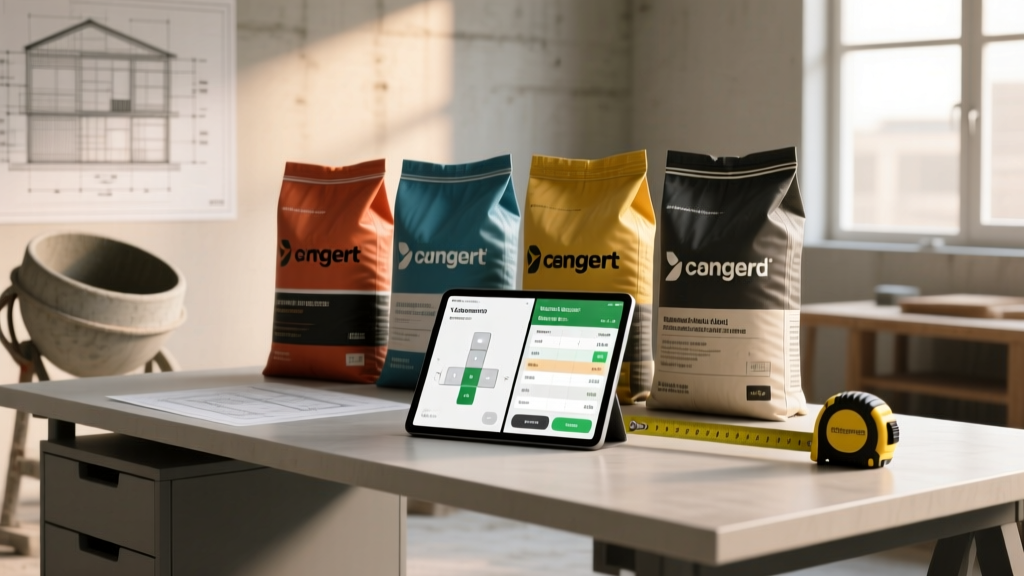
The Fundamental Flaw in Generic Volume Calculators
When estimating material for a concrete slab, footings, or post-setting, most contractors and DIYers default to generic web calculators. These tools rely on a basic geometric formula: Length × Width × Depth, divided by 27 to convert cubic feet to cubic yards, or divided by the nominal yield of a standard 80-pound bag (0.60 cubic feet). While mathematically sound for a perfect vacuum, this approach fails in real-world application because it assumes uniform material density and zero placement loss.
Generic calculators treat all cementitious products as identical. They do not distinguish between a standard Portland cement blend and a polymer-modified overlay. According to the Portland Cement Association, the specific gravity and aggregate gradation of a mix directly dictate its volumetric yield. A generic calculator will tell you that 100 square feet of surface at a 2-inch depth requires 16.6 cubic feet of material, equating to exactly 28 standard 80-pound bags. However, if you are using a specialty fast-setting mix or a lightweight repair mortar, that same volume will require a drastically different number of bags due to variations in aggregate size, air-entrainment, and proprietary admixtures.
How Proprietary Algorithms Adjust for Product-Specific Yields
Brand-specific cement calculators—such as those integrated into the Quikrete, Sakrete, and CEMEX digital ecosystems—are programmed with the exact technical data sheets (TDS) of their individual SKUs. Instead of relying on a universal density constant, these tools pull the precise yield-per-pound for the exact product selected.
Technical Insight: The Density Discrepancy
Standard concrete mix (like Quikrete No. 1101) has a higher aggregate-to-cement ratio, yielding exactly 0.60 cubic feet per 80-pound bag. Conversely, a polymer-modified resurfacer (like Sakrete Top 'N Bond No. 1203) contains finer sands and bonding agents. A 40-pound bag of Top 'N Bond yields 0.36 cubic feet. If you use a generic calculator and input a 1/2-inch overlay depth, the tool will divide your total cubic feet by 0.60 (the standard bag yield), resulting in a massive material shortage. The brand calculator automatically applies the 0.36 cubic feet divisor for that specific SKU.
Yield Comparison: Standard vs. Specialty Product SKUs
To understand how brand calculators prevent job-site shortages, examine the adjusted yields below. These figures account for the nominal yield plus a built-in 5% algorithmic buffer for subgrade settling and formwork deflection, which brand tools automatically apply to thin-pour applications.
| Product & SKU | Bag Size | Nominal Yield | Calculator-Adjusted Yield |
|---|---|---|---|
| Quikrete Concrete Mix (No. 1101) | 80 lb | 0.60 cu ft | 0.57 cu ft (5% waste buffer) |
| Quikrete Fast-Setting (No. 1004) | 50 lb | 0.375 cu ft | 0.35 cu ft (placement speed buffer) |
| Sakrete High Strength (No. 1010) | 60 lb | 0.45 cu ft | 0.42 cu ft (5% waste buffer) |
| Sakrete Top 'N Bond (No. 1203) | 40 lb | 0.36 cu ft | 0.34 cu ft (fine-aggregate buffer) |
Commercial Bulk Calculators: CEMEX and Holcim Digital Tools
For commercial pours requiring ready-mix trucks rather than bagged goods, brand-specific calculators shift from bag-counts to cubic yard optimization, factoring in transit time and slump retention. The National Ready Mixed Concrete Association emphasizes that yield in ready-mix is heavily influenced by air content and water-to-cement ratios adjusted on-site.
Holcim’s digital ordering platforms, for instance, feature specialized calculators for their ECOPact line of low-carbon concrete. These tools do not just calculate volume; they calculate the exact carbon footprint reduction based on the specified compressive strength (e.g., 3,000 psi vs. 5,000 psi) and the specific supplementary cementitious materials (SCMs) like slag or fly ash used in the regional batch plant. A generic calculator cannot account for the fact that a high-slag mix may have a slightly different unit weight (typically 145-150 lbs/cu ft) compared to standard Portland mixes, which affects the total tonnage required for structural load calculations.
Step-by-Step: Calibrating Inputs for Polymer-Modified Overlays
When using a brand-specific calculator for thin resurfacing projects, the inputs require precise calibration to avoid catastrophic material runouts. Follow this framework when inputting data into tools like the Quikrete Resurfacer Calculator:
- Measure the True Surface Area, Not the Perimeter: Overlays feather out at the edges. Calculate the exact square footage of the coverage zone, excluding expansion joints. Brand calculators will ask for joint linear footage to subtract from the total volume.
- Input Decimal Thicknesses Accurately: Generic calculators often round to the nearest half-inch. Brand overlay calculators accept inputs down to 1/8-inch (0.125). A 400 sq ft driveway at 1/4-inch requires 8.3 cubic feet of material; at 1/2-inch, it requires 16.6 cubic feet. Rounding errors here double your material cost.
- Select the Primer/Admixture Toggle: Many brand calculators include a secondary output for liquid bonding agents or primers required for the specific overlay SKU. Ensure this is toggled on, as polymer-modified cements require specific substrate preparation to meet ASTM C881 bonding standards.
- Factor in the 'Pot Life' Batch Size: Advanced brand calculators will output not just the total bags needed, but the maximum batch size per mixing cycle based on the product's pot life (e.g., 20 minutes for fast-setting overlays). This prevents you from mixing 5 bags at once and losing 3 to premature hydration.
Subgrade Tolerance and Formwork Deflection Variables
One of the most valuable, yet overlooked, features of premium brand calculators is the subgrade condition modifier. When pouring a slab-on-grade, the earth beneath the vapor barrier is rarely perfectly level. A generic calculator assumes a flawless 4-inch depth across the entire 500-square-foot pad. In reality, minor subgrade undulations can increase the actual volume required by 7% to 12%.
Brand-specific tools often include a 'Subgrade Condition' dropdown (e.g., 'Compacted & Level', 'Moderately Uneven', 'Unexcavated Fill'). Selecting 'Moderately Uneven' automatically applies an 8% volumetric multiplier to the final bag count. Similarly, for suspended decks or footing forms, the calculators apply a deflection multiplier to account for wooden forms bowing outward under the hydrostatic pressure of wet concrete, which typically adds 2% to 4% to the final width of the pour.
Frequently Asked Questions: Calculator Edge Cases
Why does the brand calculator recommend more bags of fast-setting concrete than standard mix for the same hole?
Fast-setting concrete (like Quikrete No. 1004) is designed to be poured dry or semi-dry directly into post holes, relying on ambient ground moisture. Because it is not fully mixed in a wheelbarrow to achieve maximum compaction and air-release, the in-situ yield is lower. Brand calculators account for this 'fluff factor' by increasing the recommended bag count by 10-15% for direct-pour post-setting applications.
Can I use a brand calculator for a competitor's product?
No. The specific gravity, sand-to-gravel ratio, and cement content vary significantly between manufacturers. Using the Sakrete calculator to estimate Quikrete High-Strength mix will result in an inaccurate yield, as the 60-pound bag yields and hydration shrinkage rates are proprietary and mathematically distinct.
How do brand calculators handle fiber-reinforced concrete mixes?
Fiber-reinforced mixes (containing micro-synthetic or steel fibers) have a slightly lower unit density due to the air voids trapped by the fiber matrix. Brand calculators for products like Quikrete Crack-Resistant Concrete automatically adjust the yield divisor down by approximately 0.02 cubic feet per bag to compensate for this volumetric displacement.