Durability Analysis: Custom Building Products Gray Thin-Set Mortar
Analyze the lifespan and durability of Custom Building Products gray thin-set mortar. Compare VersaBond, FlexBond, and failure modes for lasting installs.
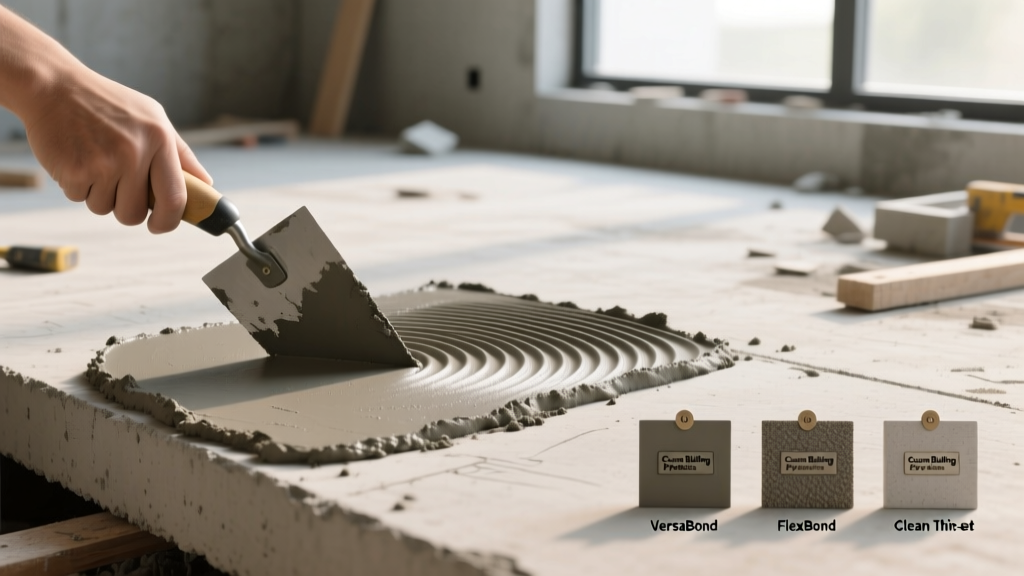
The Chemistry of Longevity: Why Gray Outlasts White
When specifying adhesives for demanding tile and stone installations, the debate between gray and white mortar often centers on aesthetics. However, from a structural durability and lifespan perspective, gray thin-set mortar holds distinct chemical advantages. The core binder in Custom Building Products gray thin-set mortar is standard Type I/II gray Portland cement. Unlike white Portland cement, which is manufactured with low-iron raw materials and fired at different temperatures to achieve its color, gray cement retains a higher iron oxide content. This results in a denser calcium silicate hydrate (C-S-H) gel matrix upon hydration, yielding marginally higher ultimate compressive strength and superior resistance to long-term moisture degradation.
For unglazed porcelain, slate, quarry tile, and exterior applications where color bleed-through is impossible, gray mortar is the default choice for structural longevity. A properly mixed and cured polymer-modified gray thin-set does not merely 'hold' the tile; it fuses with the substrate and the tile body to create a monolithic cementitious assembly. Under optimal conditions, this assembly boasts a functional lifespan of 50 to 100 years, frequently outlasting the tile itself.
Product-Specific Lifespan Matrix: VersaBond vs. FlexBond vs. MegaLite
Custom Building Products (CBP) engineers its thin-set lines with varying levels of redispersible polymer powders (such as ethylene vinyl acetate or acrylics). These polymers form a co-matrix with the cement hydrates, drastically altering the mortar's flexibility, shear strength, and ultimate lifespan under environmental stress. Below is a durability and performance breakdown of their primary gray offerings as of 2026.
| Product Name | ANSI Standard | Polymer Modification | Expected Lifespan & Use Case | 2026 Avg. Cost (50lb) |
|---|---|---|---|---|
| VersaBond | A118.4 / A118.11 | Moderate (Standard Modified) | 40-50 years. Interior floors/walls, standard porcelain, ceramic. | $19 - $22 |
| FlexBond | A118.4 / A118.15 | High (Crack-Prevention) | 50-75 years. High-deflection substrates, exterior, freeze-thaw zones. | $26 - $30 |
| MegaLite | A118.4 / A118.15 | Extreme (Lightweight/High-Polymer) | 75+ years. Large format tile (LFT), extreme shear stress, sound-reduction mats. | $38 - $44 (40lb) |
While VersaBond is the industry workhorse for standard residential interiors, specifying FlexBond or MegaLite for large-format tile (LFT) or exterior applications is non-negotiable for maximizing lifespan. The ANSI A118.15 standard for 'Improved Modified Dry-Set Cement Mortar' requires the mortar to maintain high shear strength even after prolonged water immersion and freeze-thaw cycling, a benchmark that standard modified mortars like VersaBond do not meet.
Environmental Stressors and Failure Modes
Thin-set mortar rarely degrades from chemical breakdown in a standard indoor environment. When a tile installation fails at year 10 or 20, the failure is almost never the mortar losing its inherent bond strength. Instead, failure is driven by environmental stressors exceeding the mortar's shear and tensile limits.
Hydrostatic Pressure and Efflorescence
In below-grade installations or exterior patios, hydrostatic pressure forces moisture through the concrete slab. As water migrates through the gray thin-set matrix, it dissolves soluble calcium hydroxide (a byproduct of cement hydration). When this water reaches the surface and evaporates, it leaves behind calcium carbonate, known as efflorescence. While efflorescence itself is primarily a cosmetic issue, the continuous cycle of water migration and crystallization can create internal osmotic pressure, eventually spalling the mortar bond. For these environments, a hydrostatic moisture mitigation system must be applied to the slab before the thin-set.
Thermal Expansion and Freeze-Thaw Cycling
Exterior installations face brutal thermal cycling. Porcelain tile has a near-zero coefficient of thermal expansion (CTE), while the concrete substrate expands and contracts with temperature fluctuations. If the thin-set lacks sufficient polymer modification to absorb this differential movement, the bond will shear. This is why FlexBond's high-polymer formulation is critical for exterior use; the acrylic co-matrix acts as a microscopic shock absorber, maintaining the bond through thousands of freeze-thaw cycles.
Never install standard unmodified gray thin-set over a liquid-applied or sheet anti-fracture membrane. The membrane blocks moisture absorption into the substrate, which starves the unmodified cement of the water it needs to hydrate fully. Always use a premium polymer-modified mortar (like FlexBond) over membranes to ensure the mortar cures via its own internal water-retention agents (cellulose ethers).
Subfloor Deflection: The Hidden Lifespan Killer
The most common cause of premature thin-set failure is excessive subfloor deflection. The Tile Council of North America (TCNA) mandates strict deflection limits to ensure the longevity of the cementitious bond.
'For ceramic and porcelain tile, the maximum allowable deflection of the floor assembly under a 300-pound concentrated load is L/360. For natural stone, the requirement is strictly L/720.' — Tile Council of North America (TCNA) Handbook
If a wooden subfloor deflects beyond L/360 when a heavy appliance is rolled across it, the rigid gray thin-set matrix will experience tensile stress it was never designed to handle. Cementitious mortars have immense compressive strength but very low tensile strength. The mortar will micro-fracture, leading to hollow-sounding tiles and eventual delamination. Upgrading the subfloor with a second layer of exterior-grade plywood or utilizing an uncoupling membrane is required to protect the thin-set's structural integrity.
Maximizing the 50-Year Bond: Application Protocols
Even the most advanced custom building products gray thin-set mortar will fail prematurely if mixed or applied incorrectly. The following protocols are essential for ensuring the chemical hydration process reaches its maximum potential.
- Precise Water Ratios: Never eyeball the water. Adding excess water to make the mortar 'spread easier' increases the water-to-cement ratio, resulting in a porous, weak matrix with drastically reduced shear strength. Use a calibrated bucket and follow the exact fluid ounce requirements on the bag.
- The Slaking Period: After initial mixing, let the mortar rest (slake) for 5 to 10 minutes. This allows the cellulose ethers to fully dissolve and the Portland cement particles to begin absorbing water. Remix briefly without adding water before application.
- Never Re-Temper: Once the mortar begins to stiffen in the bucket (losing its plasticity), it has entered its initial set phase. Adding water and remixing at this stage breaks the forming C-S-H gel bonds, permanently destroying the mortar's ultimate strength. Discard stiffened mortar immediately.
- Directional Troweling: For tiles larger than 12x12 inches, trowel the mortar in straight, parallel lines. This allows air to escape from the ridges as the tile is embedded, preventing voids that compromise the bond and lead to cracking under point-loads.
- Back-Buttering LFT: Large format tiles require a flat back-buttering (keying in) of mortar on the tile itself, in addition to the notched mortar on the substrate. This ensures 95%+ mortar coverage, which is the manufacturer's requirement for warranty validation and long-term durability in wet areas.
By respecting the chemical limitations of Portland cement and leveraging the specific polymer modifications engineered into products like FlexBond and MegaLite, contractors and homeowners can ensure their tile installations remain structurally sound for generations.