Cement Backer Board Taxonomy: How to Select the Right Underlayment
Compare cement backer board types, thicknesses, and brands. Learn how to select the right tile underlayment for showers, floors, and walls.
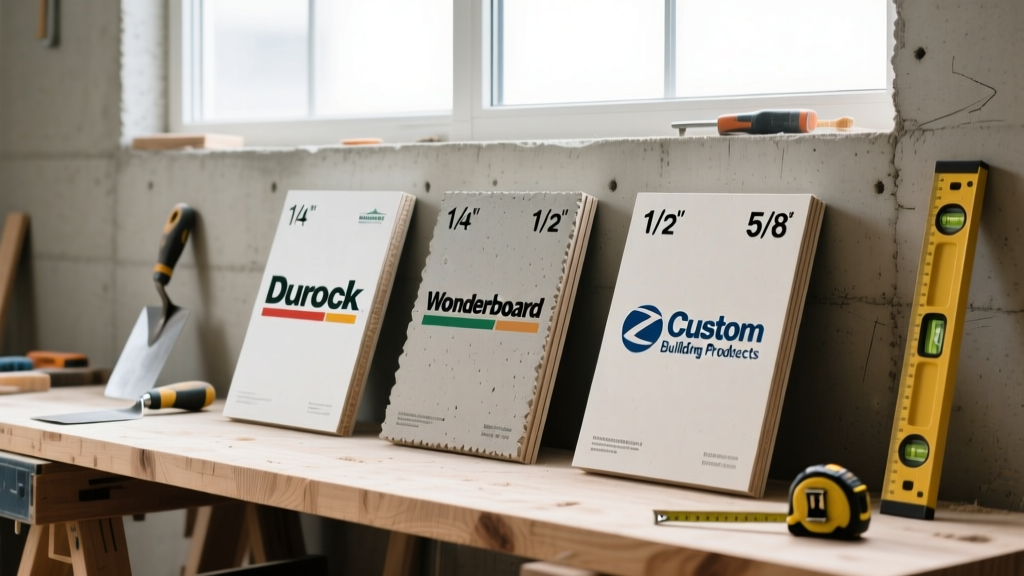
The Core Taxonomy: True Cement vs. Fiber-Cement
When sourcing tile underlayment, the term "cement backer board" is frequently used as a catch-all, but the material science dictates two distinct categories. Understanding the difference between true Portland cement boards and fiber-cement matrices is critical for predicting weight, cutability, and fastener retention.
Portland Cement Core (Glass Mesh Reinforced)
True cement boards, such as USG Durock Next Gen or National Gypsum PermaBase, utilize a Portland cement core reinforced with a polymer-coated fiberglass mesh on both faces.
- Weight: Lighter than fiber-cement (approx. 2.0 lbs per sq. ft. for 1/2-inch).
- Cutability: Can be scored and snapped, though the glass mesh requires a utility knife to cut through the backing.
- Surface Texture: Rough and porous, providing excellent mechanical key for unmodified thinset mortars.
Fiber-Cement Matrix
Fiber-cement boards, most notably James Hardie HardieBacker 500, replace the glass mesh with a dense matrix of Portland cement, silica sand, and cellulose fibers.
- Weight: Significantly denser and heavier (approx. 2.5 lbs per sq. ft. for 1/2-inch).
- Cutability: Harder to score and snap; often requires carbide-tipped scoring tools or wet saws for clean edges.
- Surface Texture: Smooth and dense. Requires a modified thinset or a primer coat to ensure adequate bond strength with large-format porcelain tiles.
Thickness Selection Framework: 1/4-Inch vs. 1/2-Inch
Selecting the wrong thickness is the most common framing and transition error in residential tile work. The rule of thumb is dictated by the substrate and the need for structural rigidity versus height matching.
| Application | Required Thickness | Substrate / Framing Requirement | Why This Thickness? |
|---|---|---|---|
| Floor Over Wood Subfloor | 1/4-inch | Minimum 1-1/8" exterior grade plywood or OSB (stiff subfloor) | Minimizes height transition to adjacent hardwood or carpet. The plywood provides the structural deflection rating (L/360), not the backer board. |
| Floor Over Concrete Slab | 1/4-inch | Fully cured, crack-isolated concrete slab | Provides a uniform, clean bonding surface over potentially sealed or contaminated concrete. |
| Walls (Standard Stud Framing) | 1/2-inch | Wood or metal studs spaced maximum 16" on center | Matches the thickness of standard 1/2" drywall for flush transitions. Provides necessary rigidity to prevent grout cracking from stud deflection. |
| Shower Ceilings | 1/2-inch | Ceiling joists spaced maximum 16" on center | Prevents sagging between joists when wet with thinset and tile weight. |
Brand-Specific Performance Breakdown
Not all boards perform identically in the field. Here is how the top three market leaders compare for professional installation:
1. USG Durock Next Gen (1/2")
The Next Gen formulation reduced the board's weight by 20% compared to legacy cement boards. It features a tapered edge, which is highly advantageous when taping seams with thinset, resulting in a flatter substrate for large-format tiles. It is highly friable, meaning it cuts easily with a carbide scorer, but the edges can crumble if handled roughly.
2. James Hardie HardieBacker 500 (1/2")
HardieBacker is the densest option on the market. It is virtually impervious to edge crumbling and holds screws exceptionally well. However, its density makes it difficult to cut; scoring requires multiple passes and significant pressure. It also features a recessed "EZ Grid" pattern on the face, which helps with screw placement but requires extra thinset to fill the recesses when applying surface waterproofing membranes.
3. National Gypsum PermaBase (1/2")
PermaBase utilizes a unique edge technology called "EdgeTech"—a tapered, wrapped edge that allows for closer fastener placement (down to 3/8" from the edge) without the board blowing out or crumbling. This makes it the superior choice for complex shower niches and tight corner detailing where fasteners must be placed near the board's perimeter.
Cutting Protocols and Silica Mitigation
Cutting cement backer board generates respirable crystalline silica (RCS), a known carcinogen regulated by OSHA. The method you choose impacts both job site safety and edge quality.
- Score and Snap (Low Dust): Use a heavy-duty carbide-tipped scoring tool (not a standard drywall utility knife, which will dull in three cuts). Score deeply through the fiberglass mesh, snap over a straight edge, and cut the back mesh. Best for straight, full-sheet cuts.
- Shears (Zero Dust): Aviation snips or specialized cement board shears can cut curves and notches without generating dust. Best for plumbing penetrations and niche cutouts, though it leaves a ragged edge.
- Angle Grinder (High Dust - Restricted): Using a diamond blade on a grinder produces massive amounts of RCS. If this method is required for complex cuts, OSHA mandates the use of a shroud attached to a HEPA-filtered dust extractor (e.g., Bosch VAC090A). Never dry-cut cement board indoors without engineered extraction.
Fastener Specifications: Avoiding the Corrosion Failure
The alkaline environment of Portland cement will rapidly corrode standard zinc-plated drywall screws, leading to rust stains bleeding through grout and eventual fastener failure in wet zones.
You must use fasteners specifically coated for alkaline resistance. Look for screws with a ceramic or polymer coating rated for cementitious materials.
- Gauge: #8 or #9 gauge.
- Length: 1-1/4" for floors (to avoid penetrating floor joists or plumbing); 1-5/8" for walls (to penetrate wood studs by at least 1 inch).
- Head Type: Serrated flat head (bugle head) designed to countersink cleanly without tearing the fiberglass mesh face.
- Approved Models: Buildex Rock-On, Backer-On, or Simpson Strong-Tie cement board screws.
Waterproofing: The Most Misunderstood Property
A pervasive myth in residential construction is that cement backer board is waterproof. It is not. Cement board is water-resistant—meaning it will not rot, degrade, or lose structural integrity when saturated. However, water will pass directly through it.
According to the Tile Council of North America (TCNA) Handbook, any cement board used in a wet area (shower surround, steam room) must be paired with a dedicated waterproofing system. This is achieved via:
- Liquid Applied Membranes: Products like Custom Building Products RedGard or Laticrete Hydro Ban, rolled directly over the taped and cured backer board seams to a specific mil thickness (usually 30-40 wet mils).
- Bonded Sheet Membranes: Fleece-backed polyethylene sheets (like Schluter Kerdi) bonded to the cement board using unmodified thinset mortar.
The Un-Taped Seam Catastrophe
If you apply a liquid waterproofing membrane over un-taped cement board seams, the natural expansion and contraction of the house framing will crack the dried membrane exactly at the seam. You must embed alkali-resistant fiberglass mesh tape (such as FibaTape Cement Board Tape) into a layer of thinset mortar over all seams and corners, let it cure completely, and then apply your liquid waterproofing. Skipping the tape step voids the warranty of almost every liquid membrane manufacturer on the market.