Concrete Anchors Lifespan: Durability Analysis and Failure Modes
Analyze the lifespan and durability of concrete anchors. Compare mechanical, chemical, and cast-in-place failure modes and environmental degradation.
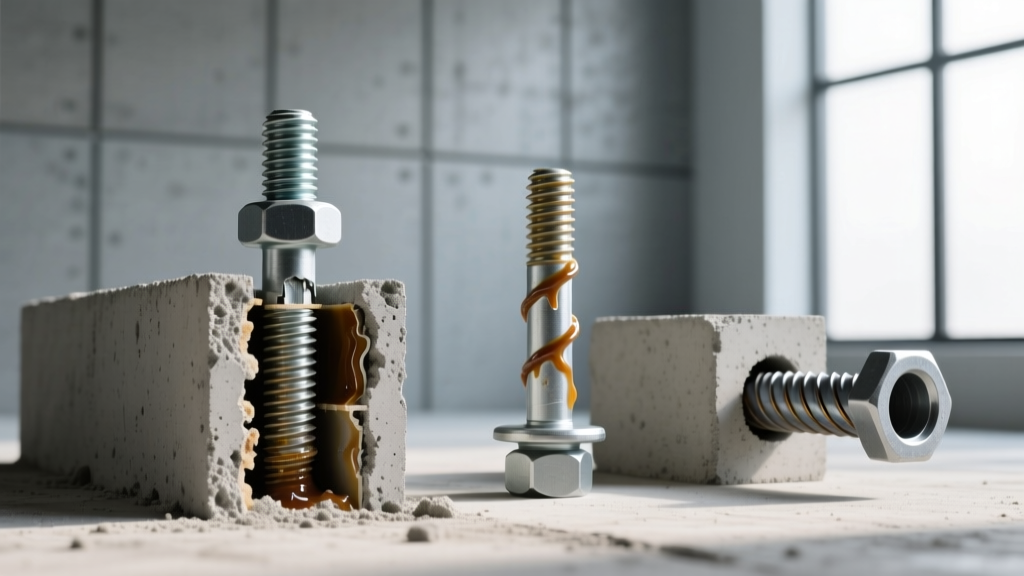
The Physics of Anchor Degradation
The structural integrity of post-installed and cast-in-place fastening systems relies on a complex interplay between metallurgy, resin chemistry, and concrete matrix stability. When evaluating concrete anchors for critical infrastructure, commercial facades, or heavy machinery, specifying based solely on initial pull-out strength is a critical engineering error. Long-term durability is governed by sustained load creep, environmental stress corrosion, and cyclic fatigue. Understanding the precise degradation vectors of different anchor families is mandatory for predicting service life and preventing catastrophic concrete breakout failures.
The Durability Hierarchy of Concrete Anchors
Not all anchoring systems age at the same rate. The expected lifespan below assumes proper installation torque, correct edge distances, and standard indoor or mild outdoor exposure. In aggressive environments, these baselines shift dramatically based on material specifications.
| Anchor Type | Expected Lifespan (Sustained Load) | Primary Degradation Vector | Optimal Material Specification |
|---|---|---|---|
| Cast-in-Place (Headed Studs) | 75–100+ Years | Concrete cover carbonation | ASTM A307 Grade A / Hot-Dip Galvanized |
| Undercut Mechanical | 50–75 Years | Vibrational loosening / SCC | 316 Stainless Steel (A4-80) |
| Epoxy Chemical Adhesive | 40–60 Years | Thermal creep above Tg | High-modulus, high-Tg pure epoxy |
| Wedge Mechanical | 20–40 Years | Stress Corrosion Cracking (SCC) | Hot-Dip Galvanized (45µm min) |
| Vinylester Chemical | 15–25 Years | Moisture-induced hydrolysis | Standard Vinylester resin |
| Polyester Chemical | <10 Years (Sustained) | Severe long-term creep | Only for light, non-structural loads |
Environmental Degradation Vectors
The concrete matrix is inherently alkaline (pH 12.5–13.5), which creates a passive oxide layer on embedded carbon steel. When this environment changes, the anchor becomes vulnerable to rapid deterioration.
Chloride-Induced Stress Corrosion Cracking (SCC)
In coastal environments or areas where de-icing salts are used, chloride ions penetrate the concrete pore structure. When chlorides reach the anchor body, they destroy the passivation layer. For mechanical anchors under high tensile preload (such as torque-controlled wedge anchors), this localized pitting rapidly escalates into Stress Corrosion Cracking. SCC causes sudden, brittle fracture of the anchor steel without visible plastic deformation. To mitigate this in high-chloride zones, engineers must specify 316 stainless steel (A4-80 grade) or titanium-alloyed anchors, avoiding standard 304 stainless which remains highly susceptible to chloride pitting.
Alkalinity Loss and Carbonation
Over decades, atmospheric CO2 reacts with calcium hydroxide in the concrete, lowering the pH to below 9. This carbonation front advances at roughly 1mm to 3mm per year, depending on concrete porosity and humidity. Once the carbonation front reaches the depth of the anchor's bearing zone, the steel loses its passivation. For cast-in-place anchors, maintaining a minimum concrete cover of 50mm to 75mm is critical to delay carbonation-induced corrosion beyond the structure's 50-year design life.
Never mix carbon steel attachment fixtures with stainless steel concrete anchors in damp environments. The carbon steel acts as a sacrificial anode, accelerating its own corrosion. Conversely, using a stainless steel fixture on a carbon steel anchor will cause rapid, catastrophic failure of the anchor rod at the concrete surface interface.
Chemical Resin Creep and Fatigue Limits
Chemical anchors transfer loads through the shear strength of the resin-to-concrete bond. Under sustained tensile loads, all polymers exhibit 'creep'—a slow, continuous deformation over time. The rate of creep is dictated by the resin chemistry and the ambient temperature relative to the resin's Glass Transition Temperature (Tg).
- Pure Epoxy Resins: Exhibit the highest resistance to creep. High-performance structural epoxies have a Tg exceeding 120°F (49°C) when fully cured. According to testing protocols outlined by ASTM International (specifically ASTM E1512 for adhesive bond performance), premium epoxies maintain bond integrity under 100% sustained load for 50+ years in interior environments.
- Vinylester Resins: Offer faster cure times and better tolerance to damp hole conditions than epoxy. However, their long-term creep resistance is inferior. Vinylesters are typically derated by 30% to 40% for sustained load applications compared to their ultimate short-term pull-out strength.
- Polyester Resins: Highly susceptible to creep and alkaline hydrolysis. They should never be specified for overhead sustained loads, life-safety structures, or heavy machinery subject to dynamic vibration.
Real-World Failure Modes and Edge Cases
Designing for durability requires anticipating how anchors fail when real-world conditions deviate from ideal laboratory parameters. The American Concrete Institute (ACI) addresses these through strength reduction factors ($\phi$) in ACI 318-19 Chapter 17, but field failures often stem from specific edge cases.
- Edge Distance Blowout (Side-Face Blowout): When an anchor is placed too close to the edge of a concrete member, the concrete breakout cone intersects the free edge. Over time, freeze-thaw cycles widen the micro-cracks at the edge, drastically reducing the concrete's confinement pressure. Minimum edge distances (c_min) must be strictly enforced, typically 1.5 times the effective embedment depth (h_ef).
- Vibrational Loosening of Torque-Controlled Anchors: Wedge and sleeve anchors rely on friction and mechanical interlock generated by installation torque. In environments with high-frequency vibration (e.g., stamping presses, rail beds), the expansion clip can slowly migrate down the stud, relieving the clamping force. Undercut anchors, which rely on a positive mechanical interlock at the base of the hole rather than radial friction, are immune to vibrational loosening.
- Resin Shrinkage in Oversized Holes: If a hammer drill bit wanders and creates a hole 2mm larger than specified, the chemical resin layer becomes too thick. Thick resin layers experience higher volumetric shrinkage during curing, generating internal micro-cracks that compromise long-term bond durability and moisture resistance.
Predictive Lifespan Modeling Framework
Engineers utilize the European Organisation for Technical Assessments (EOTA) guidelines, specifically EAD 330499-01-0601, to model the long-term performance of post-installed anchors. The predictive framework requires analyzing three distinct limit states:
The 3-Limit State Durability Check
1. Steel Capacity Limit: Calculated using the ultimate tensile strength of the anchor material, derated for environmental corrosion loss over the design life (e.g., assuming a 0.1mm/year corrosion rate for unprotected carbon steel in moderate environments).
2. Concrete Breakout Limit: Modeled using the Concrete Capacity Design (CCD) method. Durability modeling requires reducing the concrete compressive strength (f'c) by 15-20% to account for long-term micro-cracking and fatigue.
3. Bond/Pullout Limit: For chemical and grouted anchors, the characteristic bond stress is multiplied by a long-term reduction factor ($\alpha_{creep}$) derived from 10,000-hour sustained load extrapolation tests.
Frequently Asked Questions
Can zinc-plated concrete anchors be used in exterior applications?
Standard electro-galvanized (zinc-plated) anchors feature a coating thickness of only 3µm to 5µm. This provides virtually no long-term protection in exterior environments and will begin to rust within 1 to 3 years. For exterior applications, specify Hot-Dip Galvanized (HDG) anchors with a minimum coating thickness of 45µm, or transition to 304/316 stainless steel.
How does UV exposure affect chemical concrete anchors?
Ultraviolet light degrades the surface layer of exposed chemical resins, causing chalking and micro-crazing. However, because the anchor is embedded within the concrete, UV only affects the top 2mm of the resin at the surface interface. This surface degradation does not impact the structural bond depth, provided the fixture plate fully covers and seals the resin surface from moisture ingress.
What is the lifespan of an anchor in cracked concrete?
Anchors in cracked concrete experience a 30% to 50% reduction in ultimate pull-out capacity compared to uncracked concrete. Mechanical undercut anchors and premium structural epoxies are specifically tested and certified for use in cracked concrete (often denoted by an ETA Option 1 certification). If the concrete is expected to remain in a permanently cracked state due to tensile loading, the anchor's service life is dictated by the crack width; dynamic crack cycling (opening and closing) will rapidly fatigue mechanical expansion clips, necessitating the use of chemical or cast-in-place solutions.