Proper Concrete Blankets Installation for Cold Weather Curing
Learn the exact installation procedures for concrete blankets in cold weather. Discover R-value requirements, overlapping techniques, and curing times.
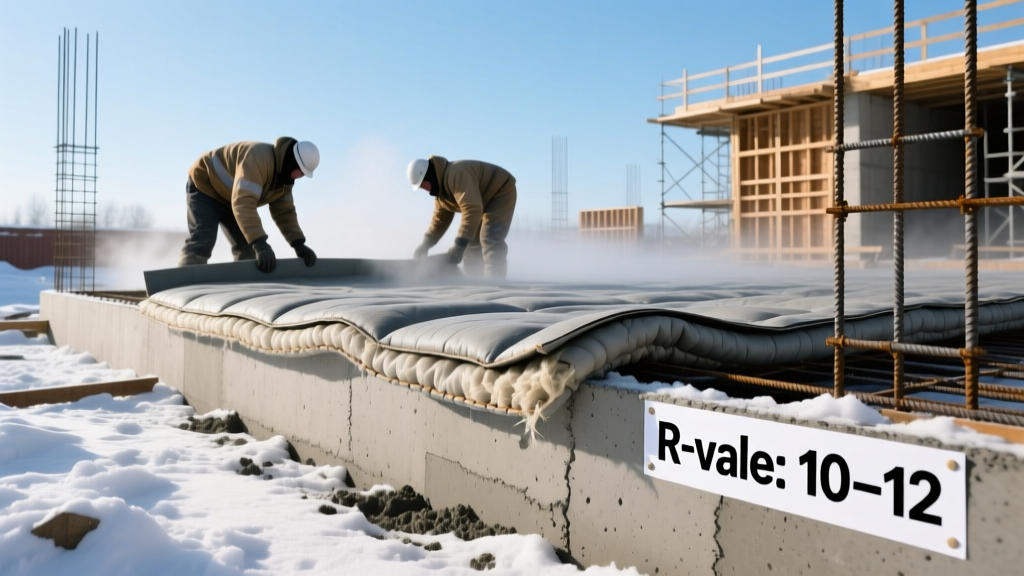
Temperature Thresholds and R-Value Selection
When ambient temperatures drop below 40°F (4°C), the hydration process of Portland cement slows significantly, and if the internal temperature of the concrete falls below 32°F (0°C) before reaching 500 psi compressive strength, the free water inside the matrix freezes. This expansion causes micro-cracking and permanent structural degradation. According to the American Concrete Institute (ACI 306R), maintaining the concrete surface temperature above 50°F during the initial curing period is mandatory. Concrete blankets are the primary passive insulation method used to trap the heat of hydration generated by the exothermic cement reaction.
Selecting the correct thermal resistance (R-value) for your concrete blankets depends on the anticipated minimum ambient temperature and the thickness of the slab. Using an under-insulated blanket will result in thermal loss, while over-insulating can cause excessive heat buildup in mass concrete pours, leading to thermal cracking.
| Anticipated Min Temp (°F) | Required R-Value | Typical Blanket Thickness | Core Material Composition |
|---|---|---|---|
| 32°F to 25°F | R-3 to R-5 | 1/4 inch to 3/8 inch | Closed-cell polyethylene foam |
| 24°F to 15°F | R-7 to R-10 | 1/2 inch to 3/4 inch | Fiberglass batting with poly cover |
| 14°F to 0°F | R-12 to R-15 | 1 inch to 1.5 inches | Multi-layer closed-cell foam / aerogel |
| Below 0°F | R-15+ (Plus active heating) | 1.5 inches+ | Insulated tarp over hydronic heaters |
Pre-Installation Site Preparation
Installing concrete blankets over a poorly prepared site guarantees heat loss through the subgrade and formwork. Before the pour begins, execute the following conditioning steps:
- Subgrade Thawing: Never pour concrete on frozen ground. The subgrade must be thawed and maintained above 32°F. If the ground is frozen, use ground thawing blankets for 24-48 hours prior to the pour.
- Formwork Insulation: Wood forms provide an R-value of roughly 1 per inch. For metal or plastic forms, attach rigid foam board (XPS or EPS) to the exterior to prevent lateral heat loss.
- Surface Debris Clearance: Ensure the finishing tools and work area are clear. Once the final trowel pass is complete, blankets must be deployed immediately. Any delay allows the surface temperature to plummet.
Step-by-Step Concrete Blankets Installation Procedure
Proper deployment requires a systematic approach to eliminate thermal bridges and wind intrusion. Follow this sequence immediately after the final concrete finishing pass.
1. Unrolling and Positioning
Deploy the blankets in the same direction as the prevailing wind. This prevents wind from catching the leading edge and peeling the blanket back. Unroll the material smoothly to avoid trapping large pockets of cold air between the concrete surface and the insulation core.
2. Overlapping Seams
Never butt the edges of two blankets together. Overlap adjacent blankets by a minimum of 6 inches for mild conditions (R-3 to R-5) and 12 inches for severe cold (R-10+). Stagger the transverse seams (the ends of the rolls) so they do not form a continuous straight line, which creates a structural weak point for heat escape.
3. Sealing and Taping
Once overlapped, seal the seams using heavy-duty, cold-weather HVAC foil tape or specialized concrete blanket seam tape. Standard duct tape loses its adhesive properties below 40°F and will fail overnight. The goal is to create a continuous, monolithic vapor and thermal barrier.
4. Anchoring the Perimeter
The perimeter is the most vulnerable area for wind infiltration. Weigh down the edges using sandbags, cinder blocks, or specialized blanket anchor pins driven into the soil. For elevated slabs, use spring clamps or bungee cords to secure the blanket edges tightly to the formwork.
Curing Duration and Safe Removal Protocols
The Portland Cement Association (PCA) dictates that concrete must be maintained above the minimum required temperature until it achieves sufficient strength to resist freezing and thermal shock. The duration the blankets must remain in place depends on the mix design and ambient conditions.
| Concrete Mix Type | Ambient Temp Range | Minimum Blanket Retention | Target Compressive Strength |
|---|---|---|---|
| Standard Portland (Type I) | 25°F to 40°F | 4 to 6 Days | 500 psi (to prevent freeze damage) |
| High-Early Strength (Type III) | 25°F to 40°F | 2 to 3 Days | 500 psi |
| Standard with Accelerators | Below 25°F | 6 to 8 Days | 3,500 psi (for structural loading) |
Avoiding Thermal Shock During Removal
Removing concrete blankets too abruptly exposes the hot concrete surface to freezing air, causing a rapid temperature differential between the surface and the core. This thermal shock induces surface crazing and micro-cracking. The National Ready Mixed Concrete Association (NRMCA) recommends that the concrete surface temperature must not drop more than 40°F in the first 24 hours after blanket removal. If the ambient air is significantly colder than the concrete, gradually peel back the blankets over a 12-hour period or transition to a lighter insulating layer to acclimate the slab.
Common Installation Failures and Edge Cases
Even experienced crews make errors during winter pours that compromise the curing environment. Watch for these specific failure modes:
- The 'Tenting' Effect: If the blanket is pulled too tightly across a gap or uneven formwork, it creates an air gap between the concrete and the insulation. Air is a poor conductor, but a large, uninsulated gap allows convective heat loss. Ensure the blanket drapes flat and maintains direct contact with the slab.
- Moisture Saturation: If it rains or snows and the blanket seams are unsealed, water infiltrates the core. Wet insulation loses up to 80% of its R-value. Always inspect blankets for tears before deployment and patch them with poly repair tape.
- Ignoring the Edges: The edges of a slab cure faster than the center due to two-dimensional heat loss (top and sides). Double up the blanket layers or add rigid foam board along the perimeter edges to compensate for this accelerated thermal loss.
Cost Breakdown for Winter Curing Materials
Budgeting for cold weather concreting requires factoring in both material acquisition and the labor required for deployment and removal. Below are the average market rates for commercial-grade concrete blankets in 2026.
| Item / Service | Unit | Average Cost Range |
|---|---|---|
| R-5 Closed-Cell Foam Blanket (4x25 ft) | Per Roll | $140 - $180 |
| R-10 Fiberglass Core Blanket (4x25 ft) | Per Roll | $280 - $350 |
| Cold-Weather Seam Tape (3-inch x 100 ft) | Per Roll | $25 - $40 |
| Labor: Deployment and Anchoring | Per Sq. Ft. | $0.15 - $0.25 |
| Blanket Rental (for short-term projects) | Per Sq. Ft. / Week | $0.10 - $0.18 |
By strictly adhering to these installation protocols, monitoring the R-value requirements, and managing the removal process to prevent thermal shock, contractors can ensure structural integrity and avoid the massive costs associated with tearing out and replacing frozen, compromised concrete.