Concrete Block vs Cinder Block: Structural Specs & Ratings
Compare concrete block vs cinder block performance ratings, ASTM compressive strength specs, weight, fire ratings, and modern code compliance.
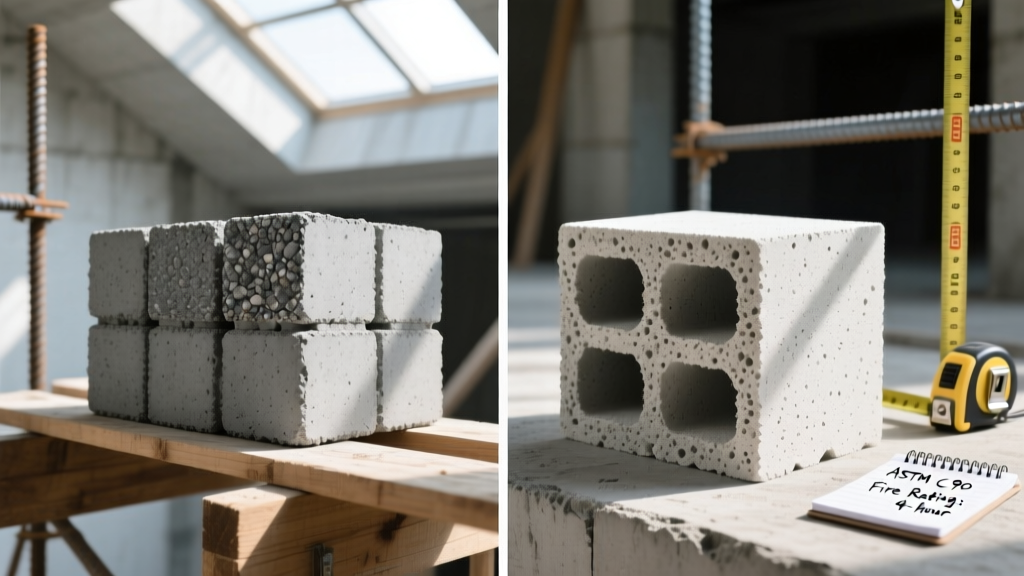
The Aggregate Divide: Normal Weight vs. Lightweight CMU
In commercial and residential masonry, the terms concrete block and cinder block are frequently used interchangeably by the general public, but they represent distinct material classifications with divergent structural performance ratings. To specify masonry correctly on blueprints and ensure code compliance, architects and contractors must understand the fundamental differences in aggregate composition, density, and load-bearing capacity between normal weight concrete blocks and lightweight blocks (the modern equivalent of the cinder block).
True cinder blocks, manufactured using coal cinders and ash as the primary aggregate, are largely obsolete in modern structural applications due to inconsistent compressive strength and high sulfur content that corrodes steel reinforcement. Today, when contractors refer to a 'cinder block,' they are actually specifying a Lightweight Concrete Masonry Unit (CMU) manufactured with expanded shale, clay, slate, or volcanic pumice. Normal weight concrete blocks, conversely, utilize dense aggregates like crushed limestone, granite, or quartz.
Compressive Strength Ratings (ASTM C90 Specifications)
The structural viability of any masonry unit is governed by its net area compressive strength. Both normal weight concrete blocks and modern lightweight 'cinder' blocks must meet the rigorous testing protocols outlined in ASTM C90 (Standard Specification for Loadbearing Concrete Masonry Units). However, the achievable strength ceilings differ significantly based on the aggregate used.
Standard vs. High-Strength Performance Matrix
| Performance Metric | Normal Weight Concrete Block | Lightweight 'Cinder' Block |
|---|---|---|
| ASTM Standard | ASTM C90 (Dense Aggregate) | ASTM C90 (Lightweight Aggregate) |
| Minimum Avg. Compressive Strength | 2,800 psi (19.3 MPa) | 2,800 psi (19.3 MPa) |
| High-Strength Availability | Readily available up to 8,000 psi | Typically maxes out at 4,800 psi |
| Typical Density (Oven-Dry) | 125 – 140 lb/ft³ | 85 – 105 lb/ft³ |
| Unit Weight (Standard 8x8x16) | 38 – 42 lbs | 24 – 28 lbs |
While both block types easily meet the 2,800 psi baseline required for standard load-bearing walls, normal weight concrete blocks are the mandatory choice for high-rise masonry, retaining walls, and heavily reinforced shear walls where engineers specify 4,800 psi to 8,000 psi concrete. Lightweight blocks struggle to achieve compressive strengths above 4,800 psi without compromising their porous, lightweight aggregate structure.
Structural Weight and Masonry Labor Efficiency
The decision between concrete block and cinder block heavily influences project labor costs and mason fatigue. A standard 8x8x16-inch normal weight concrete block weighs approximately 40 pounds. Over a 10-hour shift, a mason laying 150 blocks is moving 6,000 pounds of material.
Lightweight 'cinder' blocks weigh between 24 and 28 pounds for the same nominal dimensions. This 30% to 40% reduction in unit weight yields measurable impacts on job site productivity:
- Laying Speed: Masons typically lay 15% to 20% more lightweight CMUs per hour compared to normal weight units due to reduced physical strain and easier handling.
- Scaffolding & Dead Load: Lightweight blocks reduce the overall dead load of the masonry veneer or structural wall, allowing structural engineers to specify lighter, less expensive steel lintels and foundation footings.
- Cutting and Coring: Lightweight blocks are significantly easier to score, snap, and core with standard masonry saws, reducing blade wear and cutting time by nearly half.
Fire Resistance and Thermal Mass Specifications
When evaluating performance ratings for fire separation walls and exterior thermal envelopes, the concrete block vs cinder block debate hinges on the physics of thermal conductivity and mass.
Fire Resistance Ratings (ASTM E119)
Masonry inherently provides excellent fire resistance. According to data published by the National Concrete Masonry Association (NCMA), the fire rating of a CMU wall is dictated by its thickness and the type of aggregate used. Counterintuitively, lightweight 'cinder' blocks often achieve equivalent fire ratings with less material thickness than normal weight blocks.
An 8-inch normal weight concrete block wall provides a 4-hour fire rating. However, an 8-inch lightweight CMU wall also provides a 4-hour rating, and a 6-inch lightweight CMU can achieve a 3-hour rating, whereas a 6-inch normal weight block may only achieve 2 hours. The expanded air pockets in lightweight aggregates act as superior thermal insulators against extreme heat transfer.
Thermal Mass vs. Insulation (R-Value)
Normal weight concrete blocks possess high thermal mass, meaning they absorb and store heat energy slowly, which is highly effective in passive solar building designs in arid climates with high diurnal temperature swings. However, their actual R-value is remarkably low (approximately R-0.08 per inch of thickness).
Lightweight cinder blocks offer a higher inherent R-value (approximately R-0.15 to R-0.20 per inch) due to the porous nature of the expanded shale or pumice aggregate. While neither block type meets modern energy codes without supplemental continuous insulation (ci) or core-fill foam, lightweight blocks provide a superior baseline thermal break, reducing the risk of interior condensation and thermal bridging at the mortar joints.
Moisture Absorption and Freeze-Thaw Durability
Moisture management is the primary driver of masonry degradation. ASTM C90 strictly limits the maximum moisture absorption of load-bearing CMUs to prevent spalling during freeze-thaw cycles.
Freeze-Thaw Vulnerability
Lightweight 'cinder' blocks are inherently more porous than dense concrete blocks. If left exposed to the elements without a breathable silane/siloxane water repellent or an exterior veneer, lightweight CMUs will absorb moisture rapidly. When this trapped moisture freezes, the expansion causes the face shell to spall and delaminate. Normal weight concrete blocks, particularly those manufactured with a low water-to-cement ratio and dense limestone aggregate, exhibit superior natural resistance to moisture penetration and freeze-thaw degradation.
For below-grade applications, such as retaining walls or foundation walls, normal weight concrete blocks are universally specified. The high density resists hydrostatic pressure and soil moisture ingress far better than lightweight units. If lightweight blocks must be used below grade due to structural weight constraints, they require heavy-duty fluid-applied waterproofing membranes and rigorous drainage matting.
Specification Guide: What to Write on Your Blueprints
To eliminate procurement errors and ensure the structural performance of your masonry assembly, avoid colloquial terms in your project manuals. Use the following specification framework:
- For Load-Bearing Exterior Walls (Above Grade): Specify 'ASTM C90, Lightweight Concrete Masonry Units, Minimum 2,800 psi, Max Absorption per ASTM C140.' This provides the fire rating and labor efficiency of a 'cinder block' while ensuring structural code compliance.
- For Foundation and Retaining Walls: Specify 'ASTM C90, Normal Weight Concrete Masonry Units, Minimum 3,750 psi (or higher based on soil loads), Density 125-140 lb/ft³.' This ensures the dense, moisture-resistant properties of a true concrete block.
- For Non-Load-Bearing Partitions: Specify 'ASTM C129 (Standard Specification for Nonloadbearing Concrete Masonry Units).' This allows suppliers to provide the lightest, most cost-effective units available without over-engineering for compressive strength.
By understanding the precise ASTM standards, density metrics, and compressive ceilings that separate normal weight concrete blocks from modern lightweight 'cinder' blocks, specifiers can optimize structural integrity, labor budgets, and thermal performance without relying on outdated industry myths.