Choosing the Right Concrete Bonding Agent for Overlays and Repairs
Match the right concrete bonding agent to your repair scenario. Compare PVA, acrylic, and epoxy chemistries for overlays and structural patches.
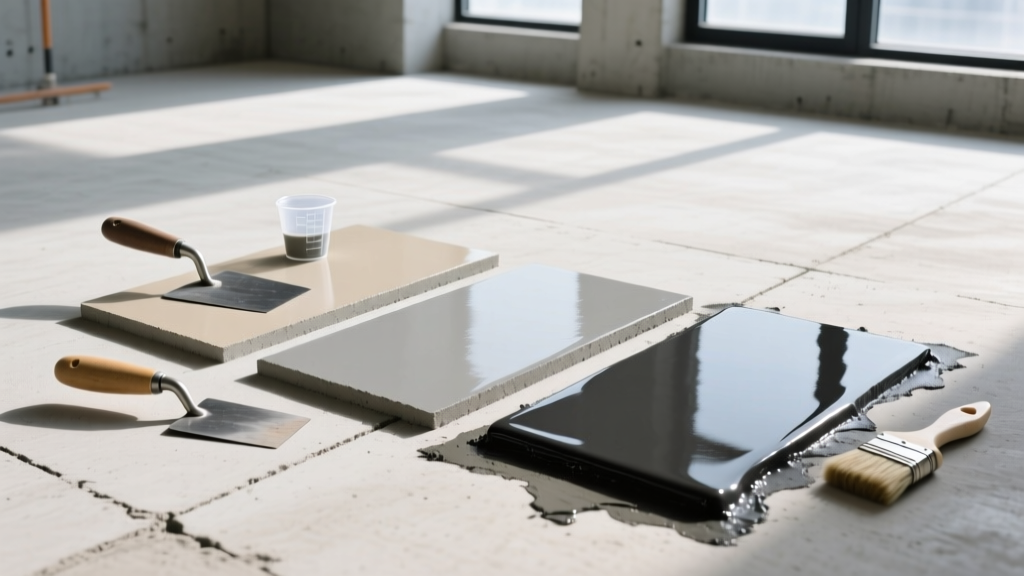
The Chemistry of Adhesion: PVA vs. Acrylic vs. Epoxy
When restoring deteriorated concrete or pouring new overlays over existing slabs, mechanical interlock alone is rarely sufficient to prevent delamination. A chemical bridge is required. However, selecting the wrong concrete bonding agent for a specific environment is one of the most common causes of overlay failure in modern construction. To make the correct selection, contractors and DIYers must understand the three primary chemical families governed by industry standards.
Quick Chemistry Matrix
- PVA (Polyvinyl Acetate): ASTM C1059 Type II (Redispersible). Water-soluble before and after curing. Strictly for interior, dry environments.
- Acrylic / SBR Latex: ASTM C1059 Type I (Non-redispersible). Water-resistant once fully cured. UV stable. Ideal for exterior and damp areas.
- Epoxy (100% Solids): ASTM C881 Type II or IV. High-modulus, structural-grade. Impervious to moisture post-cure. Used for heavy load-bearing patches.
Scenario Matching: Aligning Agent to Application
The efficacy of a bonding agent is entirely dependent on the physical stresses, moisture exposure, and thickness of the new concrete or mortar being applied. Below is a scenario-based framework for matching the chemistry to the job.
Scenario 1: Thin Interior Overlays (Feather-edge to 1/2 inch)
For interior residential floors, basement leveling, or commercial interior skim coats, PVA-based bonding agents are the most cost-effective choice. PVA penetrates the porous substrate and dries to form a tacky, continuous film. When the new cementitious overlay is placed, the alkalinity and moisture of the new concrete reactivate the PVA, creating a monolithic bond.
Critical Limitation: PVA is redispersible. If the slab is exposed to standing water, hydrostatic pressure, or high humidity before the overlay fully cures and seals it, the PVA will revert to a liquid state, causing catastrophic delamination. Never use PVA in garages, bathrooms, or exterior patios.
Scenario 2: Exterior Driveway Resurfacing & Pool Decks
Exterior slabs face UV radiation, freeze-thaw cycles, and direct water exposure. Here, you must specify an Acrylic or SBR (Styrene Butadiene Rubber) latex bonding agent. Unlike PVA, these non-redispersible polymers undergo a permanent cross-linking reaction as they dry. Once cured, they will not re-emulsify in water.
Acrylics also offer superior UV resistance, which is vital if the bonding agent is applied and left exposed to sunlight for a few hours before the overlay is poured. They provide excellent flexural strength, allowing thin exterior overlays to withstand minor thermal expansion without cracking at the bond line.
Scenario 3: Structural Column, Beam, and Heavy-Duty Patches
When repairing load-bearing structural elements, vertical spalls, or industrial floors subjected to heavy forklift traffic, polymer-modified mortars and latex agents lack the necessary shear strength. Epoxy bonding agents (specifically ASTM C881 Grade 2 or 3) are mandatory. Epoxies provide a tensile bond strength that frequently exceeds the internal tensile strength of the concrete itself (often pulling 400–600 PSI in direct tension).
Because epoxy cures to a hard, glass-like finish, new concrete will not mechanically grip it. For deep structural pours, the epoxy must be applied and immediately broadcast with clean, dry silica sand (16-30 mesh) while still tacky. This creates an aggressive mechanical profile for the new structural concrete to lock into.
Substrate Moisture Tolerance & Cure Times
Moisture in the existing slab dictates which products can be used and how long you must wait before pouring. The International Concrete Repair Institute (ICRI) emphasizes that moisture mismanagement is the leading cause of bond-line blistering.
| Agent Type | Substrate Moisture Tolerance | Dry-to-Tack Time (70°F) | Max Open Time Before Pour |
|---|---|---|---|
| PVA Latex | Dry (Max 4% CM or 75% RH) | 1 to 2 hours | Pour while visibly tacky (do not let dry completely) |
| Acrylic / SBR | Damp (SSD - Saturated Surface Dry) | 1 to 3 hours | Up to 24-48 hours (can be reactivated with water) |
| Epoxy (100% Solids) | Strictly Dry (Max 4% CM) | 4 to 8 hours | Varies by formulation; sand-broadcast if fully cured |
Critical Failure Modes and Edge Cases
Warning: The 'Dusty Substrate' Trap
No concrete bonding agent, regardless of chemistry or cost, will adhere to laitance, dust, or curing compounds. According to guidelines from American Concrete Institute (ACI) Committee 546, the substrate must be prepared to a specific Concrete Surface Profile (CSP). For latex and acrylic agents, a CSP 2 to 3 (achieved via light shot blasting or coarse diamond grinding) is required. Epoxy systems demand a CSP 4 to 5. If you apply a bonding agent over a broom-swept but unprofiled slab, you are merely gluing the new overlay to a layer of dust.
Edge Case: Hydrostatic Pressure. If an exterior slab-on-grade lacks a functioning vapor barrier and exhibits hydrostatic pressure, no film-forming bonding agent will hold. The vapor pressure will blister the acrylic or epoxy film from below. In these scenarios, you must abandon chemical bonding agents and instead use a mechanical keyway system, or apply a breathable, penetrating silane/siloxane sealer on the underside of the slab if accessible.
Step-by-Step Application Protocol for Maximum Shear Strength
Follow this sequence to ensure optimal chemical cross-linking and mechanical interlock, aligning with Federal Highway Administration (FHWA) preservation standards for concrete restoration:
- Mechanical Preparation: Remove all existing sealers, paints, and laitance using a planetary diamond grinder equipped with 16-grit metal-bond diamonds to achieve the target CSP.
- Substrate Saturation (For Latex/Acrylic only): Soak the substrate with clean water 12 hours prior to application. Before applying the bonding agent, remove all standing water. The slab should be Damp (Saturated Surface Dry - SSD), not wet. This prevents the dry, porous old concrete from instantly sucking the moisture out of the bonding agent, which would cause it to flash-dry and fail to penetrate.
- Agitation: Stir the bonding agent mechanically. Do not shake, as introducing air bubbles will create pinholes in the bond film.
- Application: Apply using a coarse nylon masonry brush or a 3/8-inch nap roller. Scrub the material aggressively into the pores rather than just painting the surface.
- Timing the Pour: Schedule your concrete or mortar placement so it occurs while the bonding agent is in its 'tacky' phase. If an acrylic agent dries completely, it can typically be reactivated by misting with clean water, but PVA and Epoxy cannot be easily reactivated once fully cured without mechanical scarification.
2026 Cost and Coverage Estimates
Budgeting for concrete restoration requires factoring in both the material cost and the coverage rate, which varies heavily based on the porosity of the existing slab. Highly weathered, open-pore concrete will absorb up to 30% more bonding agent than a hard-troweled, dense substrate.
| Bonding Agent Chemistry | Average Cost per Gallon (2026) | Estimated Coverage (per Gallon) | Cost per Sq. Ft. |
|---|---|---|---|
| PVA (Interior) | $18.00 - $28.00 | 250 - 350 sq. ft. | $0.06 - $0.09 |
| Acrylic / SBR (Exterior) | $45.00 - $65.00 | 150 - 250 sq. ft. | $0.22 - $0.35 |
| Epoxy (Structural 2-Part) | $130.00 - $180.00 | 100 - 150 sq. ft. | $1.00 - $1.50 |
By matching the specific chemical properties of the bonding agent to the environmental and structural demands of your scenario, you eliminate the risk of delamination and ensure a monolithic, long-lasting concrete repair.