Concrete Caulk Performance Ratings: ASTM Specs & Selection Guide
Master concrete caulk performance ratings. Compare ASTM C920 specs, movement capabilities, and polyurethane vs. silicone sealants for durable joints.
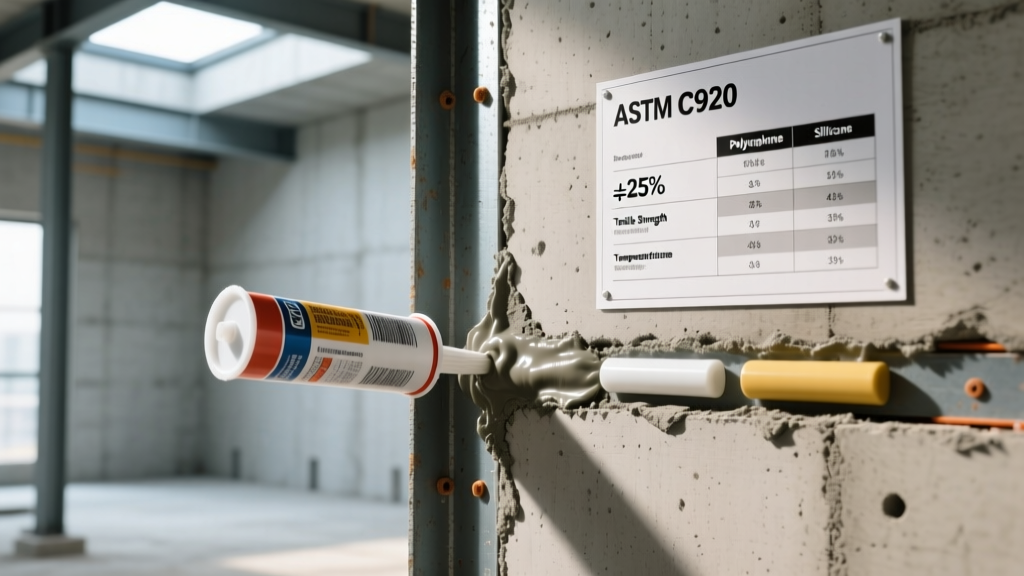
Decoding ASTM C920: The Benchmark for Concrete Caulk
Concrete slabs expand, contract, and deflect under thermal and structural loads. Without correctly specified joint sealants, water infiltrates the subgrade, leading to frost heave, subgrade erosion, pumping, and eventual spalling at the joint edges. Selecting the right concrete caulk requires moving beyond generic hardware store options and specifying materials based on rigorous ASTM C920 Standard Specifications. This standard defines the exact performance thresholds a sealant must meet before it can be trusted in commercial, industrial, or heavy-duty residential applications.
ASTM C920 categorizes concrete caulk across four critical vectors: Type, Grade, Class, and Use. Understanding these designations is the first step in preventing premature joint failure.
Key ASTM C920 Terminology
- Type: Type S (single-component, moisture-curing) vs. Type M (multi-component, chemically cured). Type S is standard for most slab-on-grade applications due to ease of application.
- Grade: NS (non-sag, for vertical joints), P (pourable), and SL (self-leveling, for horizontal joints up to 6% slope). SL grades are mandatory for driveways, warehouse floors, and pool decks.
- Class: Indicates movement capability. Class 12.5 (±12.5%), Class 20 (±20%), Class 25 (±25%), Class 35 (±35%), and Class 50 (±50%). Exterior concrete slabs typically require a minimum of Class 25.
- Use: Defines the substrate and exposure. NT (non-traffic), T (traffic), M (immersion), and A (alkaline, critical for fresh concrete).
Material Chemistry: Polyurethane, Silicone, and Hybrid Polymers
The chemical backbone of the concrete caulk dictates its tensile strength, UV stability, and abrasion resistance. While acrylics and latexes exist, they lack the elastomeric properties required for structural concrete joints. The industry relies on three primary chemistries.
Polyurethane (PU) Sealants
Polyurethane is the workhorse of horizontal concrete joints. Products like Sikaflex-1a and Tremco Vulkem 116 offer high tensile strength and excellent puncture resistance. PU sealants typically exhibit a Shore A hardness between 30 and 40, making them highly resistant to foot and light vehicular traffic. They are also paintable, which is a critical requirement for architectural concrete where color matching is necessary. However, standard PUs degrade under prolonged UV exposure unless top-coated or specifically formulated with UV inhibitors.
Silicone Sealants
Silicone offers unparalleled UV stability and extreme temperature tolerance, maintaining flexibility from -60°F to 300°F. High-modulus silicones are often used in tilt-up wall panels and vertical expansion joints. The primary drawback of silicone in horizontal concrete applications is its low puncture resistance and poor traffic rating. Furthermore, silicone is strictly unpaintable; any attempt to paint over it will result in peeling. For horizontal traffic joints, silicone is generally avoided unless specified in a specialized, high-durometer formulation.
Hybrid Polymers (MS Polymers / Silyl-Modified Polyethers)
Hybrid sealants, such as SikaHyflex-160, bridge the gap between PU and silicone. They offer the toughness, abrasion resistance, and paintability of polyurethane, combined with the UV stability and primerless adhesion of silicone. Hybrids are increasingly specified in 2026 for high-end commercial plazas and architectural hardscapes where long-term aesthetic retention and traffic resistance are both mandatory.
Performance Matrix: Concrete Caulk Specifications
| Chemistry | ASTM Class | Movement Capability | Shore A Hardness | Traffic Rated | Paintable | Primary Application |
|---|---|---|---|---|---|---|
| Polyurethane (Standard) | Class 25 | ±25% | 30 - 40 | Yes | Yes | Driveways, warehouse floors, sidewalks |
| Silicone (High Modulus) | Class 50 | ±50% | 20 - 30 | No | No | Tilt-up walls, vertical expansion joints |
| Hybrid Polymer (MS) | Class 35 | ±35% | 25 - 35 | Yes (Light) | Yes | Architectural hardscapes, pool coping |
| Self-Leveling PU | Class 25 | ±25% | 15 - 25 | Yes (Heavy) | Yes | Highway joints, airport aprons, loading docks |
Joint Geometry and Width-to-Depth Specifications
Even the highest-rated concrete caulk will fail if the joint geometry is incorrectly designed. The Portland Cement Association mandates strict width-to-depth ratios to ensure the sealant experiences pure extension and compression, rather than shear stress.
- Horizontal Joints: Maintain a 2:1 width-to-depth ratio. A 1/2-inch wide saw-cut joint requires a 1/4-inch depth of sealant.
- Vertical Joints: Maintain a 1:1 width-to-depth ratio, up to a maximum depth of 1/2 inch.
- Maximum Depth: Never exceed 1/2 inch of sealant depth. Deeper joints waste material and create excessive internal stress during curing.
Critical Alert: Preventing 3-Point Adhesion
Concrete caulk must only adhere to the two vertical sides of the joint. If the sealant bonds to the bottom of the joint or the backer rod, it creates "3-point adhesion." When the joint expands, the sealant will tear down the middle. Always use a closed-cell polyethylene backer rod that is 25% larger than the joint width to ensure a tight friction fit, and apply a bond-breaker tape to the bottom of the joint if a backer rod cannot be seated deeply enough.
Substrate Preparation and Priming Protocols
Adhesion failure accounts for over 70% of concrete caulk warranty claims. Concrete is a highly porous, alkaline, and often dusty substrate. Proper preparation is non-negotiable.
Moisture and Temperature Thresholds
Most single-component polyurethanes require a moisture-curing process, but applying them to saturated concrete traps vapor, leading to bubbling and blistering. Substrate moisture content should be below 5% (verifiable via a calcium chloride test or electronic moisture meter). Application temperatures should strictly remain between 40°F and 100°F. Applying sealant below 40°F severely retards the curing skin-over time, leaving the joint vulnerable to dust contamination and wash-off from unexpected rain.
Priming Porous Substrates
While some modern hybrids claim "primerless" adhesion, best practices for heavy-duty traffic joints dictate the use of a dedicated primer. Products like Sika Primer-207 or Tremco Vulkem Primer penetrate the concrete pores, consolidating the surface dust and creating a chemical bridge to the sealant. Apply the primer with a clean brush, allow it to flash off (typically 15 to 45 minutes, depending on ambient humidity), and apply the caulk within the primer's open time window—usually no more than 4 hours.
"Specifying a Class 25 polyurethane with the correct primer and a closed-cell backer rod yields a joint life expectancy of 15 to 20 years in moderate climates. Skipping the backer rod reduces that lifespan to under 3 years." — Sealant, Waterproofing and Restoration Institute (SWRI) Field Guidelines
Diagnosing Common Specification Failures
When concrete caulk fails, the failure mode usually points directly to a specification or installation error:
- Hourglassing (Cohesive Tear): The sealant thins out in the center and tears. Cause: Incorrect width-to-depth ratio (too deep) or 3-point adhesion.
- Adhesive Failure (Peeling): The sealant pulls cleanly away from the concrete edge. Cause: Lack of primer, failure to grind/sandblast the joint edges, or application over curing compounds and form release agents.
- Surface Cracking (Alligatoring): The top surface develops micro-fissures while the core remains soft. Cause: Applying a non-UV-stable polyurethane in direct, high-altitude sunlight without a protective topcoat, or applying the joint too wide, exceeding the material's elongation limits.
By strictly adhering to ASTM C920 classifications, respecting joint geometry ratios, and enforcing rigorous substrate preparation protocols, specifiers and contractors can ensure concrete joints remain watertight and structurally sound for decades.