Concrete Cost Per Yard in 2026: Full Installation Breakdown
Discover the true concrete cost per yard in 2026. We break down material prices, short-load fees, pump truck rates, and installation labor costs.
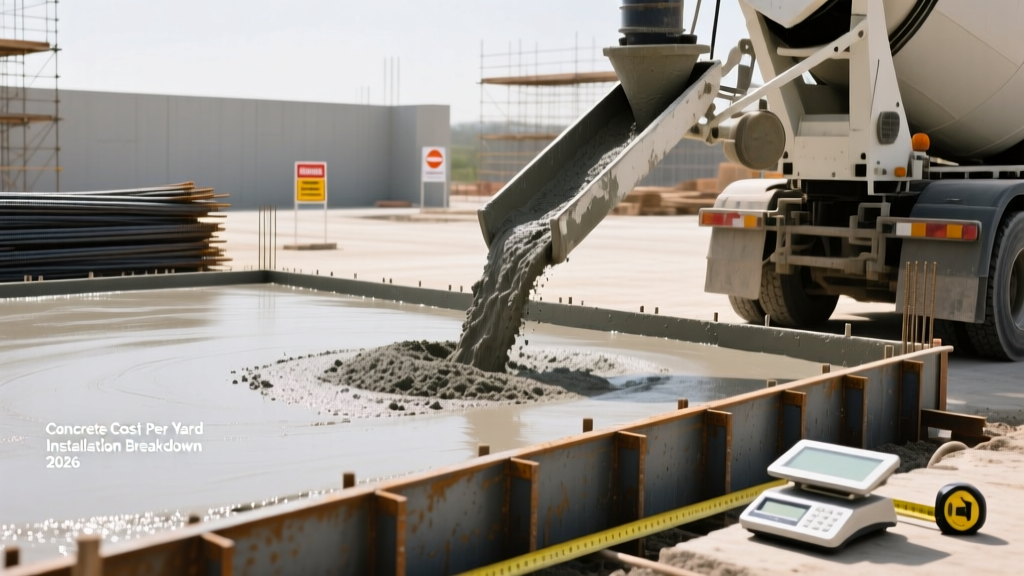
The Real Concrete Cost Per Yard: 2026 Material Baselines
Quoting a concrete project based solely on the base material rate is the most common budgeting mistake in residential and light commercial construction. The advertised concrete cost per yard only covers the raw ready-mix delivered to the curb. To accurately forecast your 2026 project expenses, you must understand how compressive strength (PSI), admixtures, and regional aggregate availability dictate the baseline price.
As of 2026, the national average base cost for ready-mix concrete ranges from $135 to $175 per cubic yard, according to industry pricing data tracked by HomeGuide. However, this fluctuates based on the specific mix design required for your application:
- 3,000 PSI (Standard Flatwork): $135 – $145 per yard. Ideal for sidewalks, patios, and light-duty residential driveways.
- 4,000 PSI (Heavy-Duty Driveways & Garage Floors): $145 – $155 per yard. The industry standard for vehicle traffic and structural slabs requiring higher tensile strength.
- 5,000+ PSI (Structural Columns & Commercial Pads): $155 – $175+ per yard. Requires specialized cementitious blends and tighter water-cement ratios.
Beyond the Base Rate: Hidden Fees That Inflate Your Yardage Cost
Ready-mix suppliers operate on tight logistical margins. If your project deviates from a standard full-truckload delivery, your effective concrete cost per yard will increase significantly due to operational surcharges. Review the fee matrix below to identify potential budget traps before ordering.
| Fee Type | Trigger Condition | Estimated 2026 Cost |
|---|---|---|
| Short Load Fee | Ordering less than 7–10 cubic yards (a standard truck holds 10-11 yards) | $50 – $100 per unused yard |
| Wait Time / Demurrage | Truck is on-site longer than 90 minutes | $75 – $125 per additional hour |
| Fuel & Environmental Surcharge | Standard addition to offset diesel volatility | 3% – 6% of total material cost |
| Weekend / After-Hours Delivery | Pouring scheduled on Saturday or Sunday | $150 – $250 flat dispatch fee |
| Concrete Pump Truck | Chute cannot reach the forms; requires boom pump | $200 base + $25 per yard pumped |
Installation Procedures: Where Labor Costs Multiply
Material costs represent only 40% to 50% of a finished concrete slab's total price. The installation and application procedures dictate the remainder. According to Forbes Home, professional concrete labor averages between $3.00 and $6.00 per square foot, but this varies wildly based on site prep and finishing techniques.
Subgrade Preparation and Formwork
A slab is only as stable as the earth beneath it. Proper installation requires excavating to a depth of 6 to 8 inches, followed by laying a 4-inch base of compacted gravel. The subgrade must be compacted to a minimum 95% Standard Proctor density to prevent differential settling and subsequent slab cracking. Formwork is typically constructed using straight 2x4 or 2x6 dimensional lumber, staked every 3 feet. For a standard 400-square-foot patio, expect site prep and forming labor to account for $800 to $1,200 of your budget.
Reinforcement: Rebar vs. Wire Mesh
For driveways and structural pads, reinforcement is non-negotiable.
- Welded Wire Mesh (WWM): Placed in the upper third of the slab. Cost: $0.15 – $0.25 per sq. ft. Best for preventing shrinkage cracks in light-duty flatwork.
- #4 Rebar (1/2-inch) Grid: Tied on 18-inch or 24-inch centers and elevated on plastic chairs. Cost: $0.40 – $0.70 per sq. ft. Mandatory for heavy vehicle loads and expansive soil regions.
Finishing Techniques and Labor Multipliers
The application procedure changes drastically once the concrete begins to set. The chosen finish directly impacts your labor cost per square foot:
- Standard Broom Finish: $3.00 – $4.00 / sq. ft. The most common exterior application, providing essential slip resistance.
- Smooth Steel Trowel: $4.00 – $5.50 / sq. ft. Used for interior garage floors or basements. Requires multiple passes as the bleed water evaporates.
- Exposed Aggregate: $6.00 – $9.00 / sq. ft. Requires spraying a chemical retarder on the surface and washing away the top paste layer to reveal the stone.
- Stamped / Decorative: $10.00 – $18.00+ / sq. ft. Involves broadcasting color hardeners, applying release agents, and pressing polyurethane mats into the setting concrete.
Calculating Total Project Cost: A Step-by-Step Framework
To determine your true out-the-door price, follow this calculation sequence rather than relying on simple online calculators that ignore regional logistics.
- Calculate Raw Volume: Multiply Length (ft) x Width (ft) x Depth (ft). Divide by 27 to convert cubic feet to cubic yards. (Example: 20x20 driveway at 4 inches thick = 400 sq ft x 0.33 ft = 132 cu ft / 27 = 4.88 yards).
- Add Overage: Multiply your raw yardage by 1.10 to account for 10% waste, spillage, and subgrade inconsistencies.
- Factor Short Load Fees: If your adjusted yardage is under your supplier's minimum (usually 7 yards), add the short load penalty to the material subtotal.
- Add Equipment & Pump Fees: Include the flat rate for a pump truck if wheelbarrowing is not viable.
- Calculate Labor: Multiply total square footage by your chosen finish's labor rate.
Expert Strategies to Optimize Your Ready-Mix Order
Never instruct the truck driver to add extra water to the drum to make the concrete 'flow easier' into the forms. According to guidelines published by the American Concrete Institute (ACI), adding just one gallon of water per cubic yard to a properly designed mix can reduce the final compressive strength by up to 200 PSI and increase shrinkage cracking. If the mix is too stiff, request a certified superplasticizer (water-reducer) from the batch plant, not tap water.
The 'Cleanout' Strategy: When ordering a pump truck, the crew will need a designated area to wash out the hopper and lines at the end of the pour. This washout contains highly alkaline cementitious slurry. Designate a 4x4 foot sacrificial pit or rent a washout bin to avoid environmental fines and permanent damage to your landscaping.
Batch Plant Proximity: Ready-mix concrete has a strict shelf life. Once water is introduced to the cement at the batch plant, you typically have 90 to 120 minutes to discharge the load before it begins to lose slump and workability. Ensure your site is within 45 minutes of the batch plant; otherwise, the supplier will mandate the use of chemical retarders, adding to your per-yard cost.
Frequently Asked Questions
Is it cheaper to mix bagged concrete or order ready-mix?
For projects requiring less than 1 cubic yard (roughly 12 bags of 80lb Quikrete), bagged concrete is more cost-effective at roughly $180 to $220 per yard equivalent. However, for anything over 2 yards, ready-mix is vastly cheaper per yard and guarantees a consistent, machine-calibrated water-cement ratio that bagged mixes cannot achieve manually.
How does weather impact the concrete cost per yard?
Pouring in extreme temperatures requires chemical admixtures and thermal blankets. In winter (below 40°F), you must pay for calcium chloride accelerators and insulated curing blankets. In peak summer (above 90°F), you may need to pay the batch plant to chill the mixing water with liquid nitrogen or add retarders, adding $10 to $25 per yard to the base material cost.