Concrete Estimator Guide: Mix Performance & Yield Specs 2026
Master concrete estimator specifications for 2026. Calculate real-world yield, ASTM performance ratings, and admixture costs for accurate structural bids.
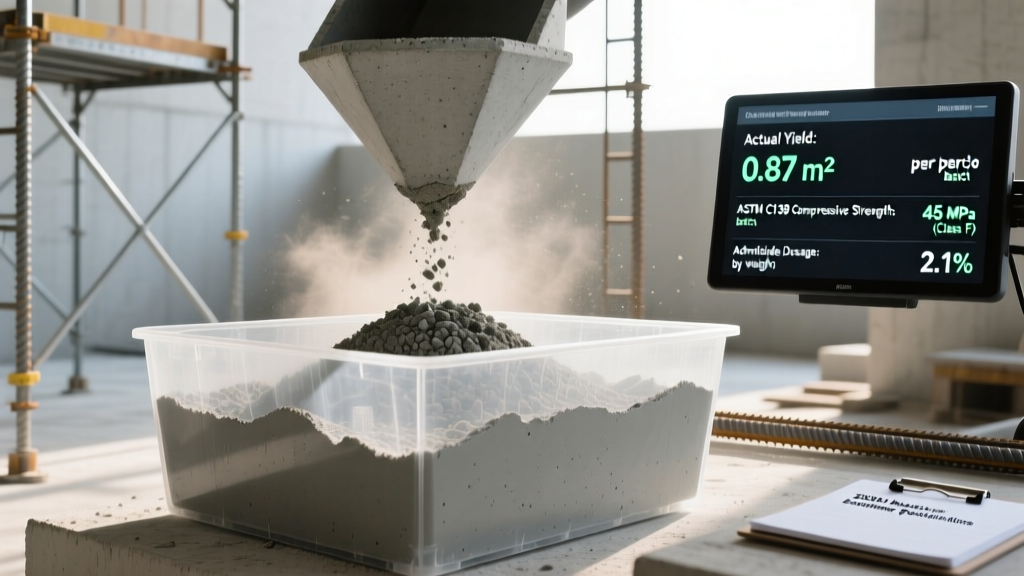
Core Performance Metrics for Mix Proportioning
The role of the modern concrete estimator has evolved far beyond simple volumetric calculations (length × width × depth). In 2026, accurate bidding requires a deep understanding of material science, specifically how performance ratings and mix specifications impact both material costs and field yield. When a structural engineer specifies a 5,000 PSI mix with a maximum water-cement (w/c) ratio of 0.40, the estimator must translate those performance requirements into precise batch proportions, admixture costs, and realistic placement timelines.
According to the American Concrete Institute (ACI), mix proportioning is the process of selecting the suitable ingredients and determining their relative proportions to achieve the required strength, durability, and workability. For an estimator, tracking the following ASTM performance metrics is non-negotiable for accurate cost forecasting:
- Compressive Strength (ASTM C39): The baseline performance rating (e.g., 3,000, 4,000, or 5,000 PSI at 28 days). Higher PSI requirements necessitate lower w/c ratios, increasing cement content and unit costs.
- Slump and Workability (ASTM C143): Dictates the ease of placement. A standard 4-inch slump is typical for footings, but suspended decks or heavily reinforced walls may require a 6-inch to 8-inch slump, necessitating High-Range Water Reducers (HRWR).
- Air Entrainment (ASTM C231): Critical for freeze-thaw durability in exterior flatwork. Target air content is typically 5% to 8%. However, every 1% of entrained air represents a 1% loss in billable yield, a factor frequently overlooked in baseline estimates.
- Unit Weight (ASTM C138): Used to verify the theoretical yield of the batched mix against the actual field yield. Normal weight concrete ranges from 140 to 150 lbs/cu ft.
Yield Calculations: Theoretical Volume vs. Field Reality
The most common point of profit erosion in concrete estimating is the discrepancy between theoretical volume and actual field yield. Theoretical yield assumes perfect formwork, zero subgrade deviation, and no spillage. Field reality dictates otherwise.
The Yield Formula
Estimators must calculate the theoretical yield using the batch ticket data provided by the ready-mix supplier. The formula is:
Yield (cubic feet) = Total Weight of All Materials in Batch / Unit Weight of Concrete (ASTM C138)
To convert to cubic yards, divide the result by 27. If the calculated yield is consistently lower than the batched volume, the estimator must apply a yield adjustment factor to future bids for that specific mix design.
Application-Specific Waste Factors
Beyond the batch yield, estimators must apply empirical waste factors based on the structural element being poured. The National Ready Mixed Concrete Association (NRMCA) provides technical guidance on field variations that impact volume. Below are the standard 2026 waste and overbreak factors used by top-tier commercial estimators:
| Structural Element | Base Waste Factor | Primary Cause of Volume Loss |
|---|---|---|
| Slab-on-Grade (Interior) | 3% - 5% | Spillage, minor subgrade high spots, pump hose priming. |
| Slab-on-Grade (Exterior) | 5% - 8% | Edge form deflection, subgrade settling, screed rail variations. |
| Continuous Footings | 10% - 15% | Soil overbreak during trenching, uneven trench bottoms. |
| Suspended Decks | 4% - 7% | Camber of shoring/decking, deflection under wet load. |
| Vertical Walls | 5% - 10% | Formwork bowing under hydrostatic pressure, pour stops. |
Admixture Specifications and Unit Cost Adjustments
Performance specifications frequently mandate chemical and mineral admixtures that drastically alter the base price per cubic yard (CY). An estimator must maintain an updated 2026 pricing matrix for these additives, as they are rarely included in the base 'per-CY' quote from ready-mix suppliers.
Chemical Admixtures
- Superplasticizers (HRWR - ASTM C494 Type F): Required for high-strength mixes (5,000+ PSI) or self-consolidating concrete (SCC). Adds approximately $12.00 to $18.00 per CY. Reduces water demand by 15-25% without sacrificing slump.
- Accelerators (ASTM C494 Type C): Used for cold-weather concreting or fast-track tilt-up panels to achieve early stripping strengths. Adds $15.00 to $25.00 per CY. Note: Calcium chloride-based accelerators are strictly prohibited in reinforced concrete due to corrosion risks; estimators must specify non-chloride alternatives, which carry a 20% price premium.
- Air-Entraining Agents (AEA - ASTM C260): Standard for exterior flatwork in freezing climates. Adds $4.00 to $7.00 per CY.
Reinforcement Admixtures
Macro-synthetic fibers (e.g., Forta-Ferro or MasterFiber) are increasingly specified to replace welded wire mesh (WWM) in slab-on-grade applications to control plastic shrinkage cracking. Estimators should budget $20.00 to $35.00 per CY for macro-synthetic fibers at standard dosages (3 to 5 lbs per CY). While this increases the material cost of the concrete, it eliminates the labor cost of placing and tying WWM, often resulting in a net savings of $0.40 to $0.70 per square foot.
Decision Matrix: Matching Mix Performance to Site Conditions
When reviewing structural drawings, estimators must verify that the specified mix design aligns with the actual site conditions and placement methods. If a specification is ambiguous or mismatched, the estimator must issue a Request for Information (RFI) before finalizing the bid. Use the following decision framework to validate mix performance ratings:
| Application Scenario | Required Performance Specs | Estimator Action / Cost Adjustment |
|---|---|---|
| Mass Concrete (Footings > 4ft thick) | Max temperature differential 35°F; Low heat of hydration. | Specify Type II cement or fly ash replacement (20-30%). Add $10/CY for thermal monitoring sensors. |
| Pumped Suspended Deck | 5,000 PSI; 6-inch slump; 3/4-inch max aggregate size. | Verify pumpability. Add $15/CY for HRWR. Ensure 1/2-inch aggregate is specified to prevent line blockages. |
| Exterior Warehouse Apron | 4,000 PSI; 6% Air; Max w/c 0.45. | Add $8/CY for AEA. Budget for 5-day curing blankets and evaporation retarders if pouring in high wind/heat. |
| Architectural Tilt-Up Panels | 6,000 PSI at 12 hours (early lift strength); SCC mix. | High-cost mix. Add $45/CY for specialized SCC admixture package and accelerated curing compounds. |
Software Integration for Performance Estimating
In 2026, manual spreadsheet estimating is obsolete for commercial concrete bids. Advanced estimating platforms (such as ProEst, HeavyBid, and specialized concrete modules in Bluebeam) now integrate directly with regional ready-mix pricing databases. However, the software is only as accurate as the variables the estimator inputs.
Critical Software Configuration Settings
To ensure your estimating software accurately reflects performance specifications, configure the following parameters in your concrete assembly database:
- Batch Ticket Yield Adjustment: Set a global default yield factor of 0.98 (accounting for 2% average air-entrainment loss) for all exterior mixes, and 0.99 for interior non-air mixes.
- Pump vs. Direct Chute Labor Rates: Software often defaults to direct chute placement. Ensure your assembly includes a conditional trigger that adds 0.015 labor hours per CY and a $1,500 base mobilization fee when the pour elevation exceeds 12 feet or requires a boom pump.
- Curing and Protection Assemblies: Link specific curing methods to the mix performance. If the mix specifies a w/c ratio below 0.40, the software should automatically append a wet-curing or membrane-forming curing compound assembly, as low w/c mixes are highly susceptible to early-age plastic shrinkage and autogenous shrinkage.
By treating the concrete estimator role as a hybrid of material science and cost accounting, contractors can eliminate the hidden margin leaks caused by yield miscalculations, unpriced admixtures, and mismatched placement methods. Accurate performance-based estimating is the definitive competitive advantage in the 2026 commercial bidding landscape.