Concrete Expansion Joint Cost & Quantity Calculator 2026
Calculate concrete expansion joint costs and material quantities for 2026. Compare fiberboard, foam, and rubber pricing per linear foot with expert formulas.
The Core Formula: Calculating Linear Footage for Expansion Joints
Accurately estimating a concrete expansion joint requires more than just measuring the perimeter of a slab. According to guidelines established by the American Concrete Institute (ACI), interior control and expansion joints must be spaced at intervals equal to 24 to 36 times the slab thickness. For a standard 4-inch residential driveway, joints must be placed every 8 to 12 feet. For a 6-inch commercial pad, spacing increases to 12 to 18 feet.
Total LF = (Perimeter LF) + (Interior Grid LF) + (10% Waste Factor)
Example: A 20x40 ft slab (4 inches thick) with joints spaced at 10 ft intervals.
Perimeter = 120 LF. Interior = (3 longitudinal joints @ 40 ft) + (1 transverse joint @ 20 ft) = 140 LF.
Base Total = 260 LF. Add 10% waste = 286 Linear Feet.
2026 Material Cost Matrix: Fiberboard vs. Foam vs. Pre-Formed
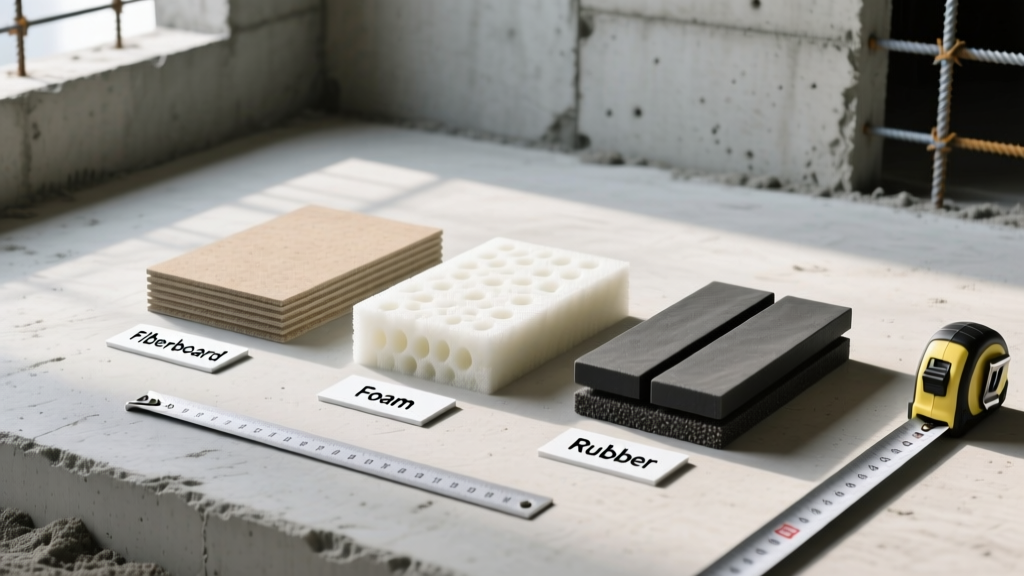
The material you select drastically alters both the upfront cost and the long-term maintenance cycle. Below is the current 2026 pricing matrix for the three primary expansion joint fillers used in modern construction.
| Material Type | Product Example | Unit Cost (2026) | Cost Per Linear Foot | Best Application |
|---|---|---|---|---|
| Asphalt-Impregnated Fiberboard | Sealtight 1/2" x 4" x 10' | $14.50 / board | $1.45 / LF | Foundations, retaining walls, heavy commercial |
| Closed-Cell Polyethylene Foam | Sika SikaSeal 1/2" x 50' Roll | $38.00 / roll | $0.76 / LF | Driveways, sidewalks, pool decks (requires sealant) |
| Pre-Formed Rubber/PVC | Trim-A-Slab 1" x 1" x 10' | $52.00 / strip | $5.20 / LF | DIY retrofits, high-traffic driveways (no sealant needed) |
Sealant & Backer Rod Quantity Estimators
If you are using foam or fiberboard, you must cap the joint with a high-quality polyurethane or polysulfide sealant. The Federal Highway Administration (FHWA) and pavement engineers universally mandate a specific depth-to-width ratio to prevent cohesive failure of the sealant under thermal expansion.
For joints under 1 inch wide, the sealant depth must be exactly half the width. A 1/2-inch wide joint requires a 1/4-inch deep sealant bead. You must use a closed-cell backer rod to fill the void below the sealant to enforce this ratio and prevent the sealant from bonding to the bottom of the joint.
Calculating Sealant Tube Yield
To estimate how many tubes of sealant you need, calculate the volume of the joint. Sika Group Technical Data Sheets list the yield of a standard 10.1 oz (300 ml) cartridge of Sikaflex-1A at approximately 18.4 cubic inches.
- Joint Size: 1/2" wide x 1/4" deep (using backer rod) = 0.125 square inches of cross-section.
- Volume per Linear Foot: 0.125 sq in x 12 inches = 1.5 cubic inches per LF.
- Theoretical Yield: 18.4 cu in / 1.5 cu in = 12.2 LF per tube.
- Real-World Yield (with 15% waste/overfill): 10.5 LF per tube.
Estimator Shortcut: Divide your total linear footage by 10 to get the exact number of 10.1 oz tubes required for a standard 1/2-inch joint.
Step-by-Step Driveway Estimation Workflow
Let's apply this to a real-world scenario: pouring a new 20x50 foot residential driveway (1,000 sq ft) with a 5-inch thickness.
- Determine Joint Spacing: 5-inch slab x 24 = 120 inches (10 feet). We will space joints every 10 feet.
- Calculate Perimeter: (20 + 50) x 2 = 140 LF. (Note: If the driveway abuts a garage or existing sidewalk, subtract that shared edge. Assume 20 LF abuts the garage. Perimeter = 120 LF).
- Calculate Interior Grid: A 20 ft width requires one center joint (50 LF). A 50 ft length requires four transverse joints at 10 ft intervals (4 x 20 = 80 LF). Total interior = 130 LF.
- Sum and Add Waste: 120 LF + 130 LF = 250 LF. Add 10% waste = 275 LF total.
- Material Takeoff (Closed-Cell Foam + Sealant):
- Foam (1/2" x 50' rolls): 275 / 50 = 5.5 rolls -> Order 6 rolls ($228.00)
- Sikaflex-1A Sealant: 275 / 10.5 = 26.1 tubes -> Order 28 tubes ($294.00)
- Backer Rod (1/2" x 20' sticks): 275 / 20 = 13.7 sticks -> Order 15 sticks ($67.50)
- Bond Breaker Tape (1" x 100' rolls): 275 / 100 = 2.75 rolls -> Order 3 rolls ($54.00)
- Total Material Cost: $643.50 (Approx. $2.34 per linear foot installed).
Critical Installation Failures That Destroy ROI
Miscalculating quantities is only half the battle; improper material selection or installation leads to catastrophic slab failure. Avoid these three common edge cases:
- Three-Point Adhesion Failure: If sealant bonds to the left side, right side, AND the bottom of the joint, it will tear itself apart when the concrete expands. You must use a backer rod or apply a specialized bond-breaker tape to the bottom of the joint to ensure the sealant only adheres to the two vertical sidewalls.
- Under-Sizing Joint Width: A common mistake is cutting joints too narrow (e.g., 1/8 inch) with a standard worm-drive saw. During peak summer heat, a 50-foot run of concrete can expand up to 1/4 inch. If the joint is only 1/8 inch wide, the concrete will spall and crush the edges. Always use a 1/4-inch or 1/2-inch width for exterior slabs.
- Using Sand as a Filler: Some contractors attempt to save money by packing dry sand into the joint before sealing. Sand shifts, washes out, and creates a rigid base that violates the depth-to-width ratio, leading to immediate sealant failure. Always use closed-cell polyethylene backer rods.
Expert FAQs on Joint Quantities
Do I need expansion joints or just control joints?
Control joints (saw-cut or tooled grooves) are meant to induce cracking in a straight line as the concrete shrinks during curing. Concrete expansion joints are physical gaps filled with compressible material designed to absorb thermal expansion. You need control joints every 10 feet, but true expansion joints (with foam/rubber) are only strictly required where the new slab meets an existing rigid structure (like a house foundation, garage apron, or existing sidewalk).
Can I use Trim-A-Slab for a brand new pour?
Trim-A-Slab and similar pre-formed rubber extrusions are primarily designed for retrofitting existing, deteriorated joints. For a brand new pour, it is much more cost-effective and structurally sound to use closed-cell foam as a form liner or saw-cut the joints after curing and fill them with polyurethane sealant. Pre-formed rubber costs roughly $5.20/LF, whereas foam and sealant cost roughly $2.34/LF.
How deep should I saw-cut a control joint?
The industry standard depth for a saw-cut control joint is exactly 25% (one-quarter) of the total slab thickness. For a 4-inch slab, cut exactly 1 inch deep. For a 6-inch slab, cut 1.5 inches deep. Cutting too shallow will result in random, uncontrolled cracking; cutting too deep compromises the structural load transfer between the panels.