Structural Specs and Load Ratings for Concrete Fence Posts
Analyze structural specs, compressive strength, and wind load ratings for concrete fence posts to ensure long-term durability and code compliance.
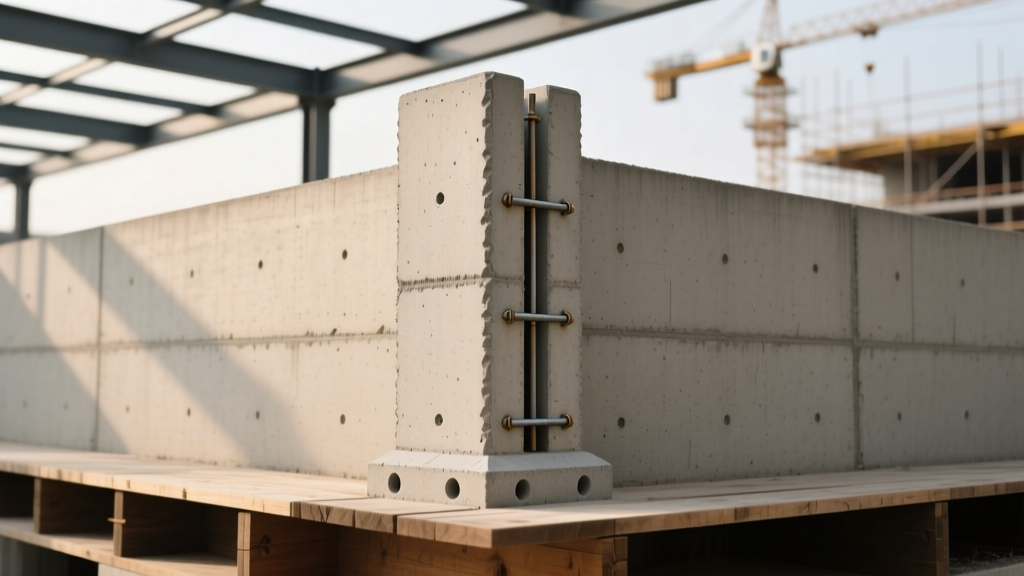
Core Performance Specifications
- Compressive Strength: 4,000 to 5,000 psi (ASTM C39)
- Water-Cement Ratio: ≤ 0.45 for low permeability
- Air Entrainment: 5% to 7% (ASTM C231) for freeze-thaw zones
- Reinforcement: ASTM A615 Grade 60 continuous rebar
- Concrete Cover: Minimum 1.5 inches over rebar to prevent corrosion
Concrete fence posts outlast timber and steel in ground-contact applications, but their structural viability hinges on precise mix designs, reinforcement layouts, and dimensional tolerances. Unlike structural columns that bear vertical axial loads, fence posts primarily resist lateral bending moments generated by wind pressure on the fence panels. Evaluating concrete fence posts requires looking past basic dimensions to analyze the engineering specifications that dictate their performance under extreme environmental and mechanical stress.
Compressive Strength vs. Tensile Demands
Standard precast concrete fence posts are manufactured to achieve a compressive strength of 4,000 to 5,000 psi. While this high compressive rating is necessary to prevent crushing at the ground-line fulcrum—the exact point where the post transitions from buried to above-ground and experiences maximum bending stress—it does not tell the whole story.
Concrete is inherently weak in tension, possessing a tensile strength roughly 10% of its compressive strength. When wind strikes a solid privacy fence, the leeward side of the concrete post experiences immense tensile stress. Without adequate internal steel reinforcement, a 5,000 psi concrete post will snap cleanly at the ground line under moderate wind loads. Therefore, the tensile capacity of the post, dictated by the rebar size and placement, is the true limiting factor in its structural rating.
The Ground-Line Fulcrum
The ground line acts as a lever fulcrum. For a 6-foot-tall fence, the center of wind pressure is approximately 3 feet above grade. This creates a moment arm that multiplies the wind force at the base. High-performance concrete posts utilize a low water-cement (w/c) ratio of 0.45 or less. This dense matrix not only achieves the target 4,000+ psi compressive strength but also severely limits moisture ingress, protecting the internal steel reinforcement from the chlorides and sulfates present in soil.
Wind Load Ratings and Embedment Depth
According to the International Building Code (IBC) Chapter 16 structural design provisions, fences must be engineered to withstand local basic wind speeds, which can exceed 115 mph in coastal or high-plains regions. A solid 6-foot wood privacy fence exerts approximately 15 to 22 pounds per square foot (psf) of lateral pressure at 90 mph wind speeds. The concrete post itself will not fail under this pressure; the failure occurs via base rotation if the embedment depth and backfill friction are insufficient.
| Fence Height | Design Wind Speed | Min. Post Size | Min. Embedment Depth | Required Backfill |
|---|---|---|---|---|
| 5 ft (Solid) | 90 mph | 4x4 in. | 24 in. | Crushed 3/4 in. gravel |
| 6 ft (Solid) | 90 mph | 4x4 in. or 5x5 in. | 30 in. | Crushed 3/4 in. gravel |
| 6 ft (Solid) | 115+ mph | 5x5 in. or 6x6 in. | 36 in. | Crushed 3/4 in. gravel + concrete collar |
| 8 ft (Solid) | 90 mph | 6x6 in. | 42 in. | Crushed 3/4 in. gravel + concrete collar |
Backfill Specification Note: Never use round pea gravel or native soil for backfilling concrete fence posts. Round stones roll against each other under lateral load, offering minimal frictional resistance. Specify 3/4-inch crushed angular aggregate, compacted in 6-inch lifts, to mechanically lock the post in place and distribute the lateral forces into the surrounding soil matrix.
Freeze-Thaw Durability and Entrained Air
In northern climates, compressive strength is irrelevant if the concrete lacks proper air entrainment. When water trapped in the concrete's capillary pores freezes, it expands by approximately 9%. Without microscopic air voids to relieve this hydraulic pressure, the concrete will spall, scale, and eventually disintegrate from the outside in.
Critical Durability Spec: For any region experiencing more than 30 freeze-thaw cycles annually, concrete fence posts must be manufactured with an air-entraining admixture (AEA) targeting 5% to 7% total air content, tested per Portland Cement Association (PCA) durability guidelines and ASTM C231. The air voids must be properly sized (10 to 1,000 micrometers) and evenly distributed to act as expansion chambers for freezing water.
When sourcing precast posts, request the manufacturer's batch test reports confirming air content. Posts cast with standard non-air-entrained bagged concrete will typically suffer severe surface scaling within three to five winters in freezing climates.
Sizing and Reinforcement Matrix
Unlike dimensional lumber, where a nominal 4x4 is actually 3.5 x 3.5 inches, precast concrete fence posts are typically true-dimension (exactly 4.0 x 4.0 inches). This slight increase in cross-sectional area significantly boosts the post's moment of inertia, making it exponentially stiffer against lateral bending. The reinforcement layout must scale with the post dimensions and intended load.
| Post Dimension | Application | Rebar Specification | Rebar Layout |
|---|---|---|---|
| 4x4 in. | Line posts (5-6 ft fence) | Two #4 (1/2 in.) Grade 60 | Diagonal or parallel, 1.5 in. cover |
| 5x5 in. | Line/Gate posts (6 ft fence) | Four #4 (1/2 in.) Grade 60 | Square pattern, 1.5 in. cover |
| 6x6 in. | Corner/Gate posts (6-8 ft) | Four #5 (5/8 in.) Grade 60 | Square pattern, 2.0 in. cover |
For corner and gate posts, the structural demands shift from pure lateral wind resistance to handling the torsional stress and continuous tension of the fence line. Upgrading to #5 rebar and increasing the concrete cover to 2.0 inches in 6x6 posts ensures the steel remains protected while providing the necessary tensile yield strength to prevent permanent deflection.
Common Failure Modes and Prevention
Understanding how concrete fence posts fail allows for proactive specification and installation adjustments. The three primary failure modes are:
- Ground-Line Snapping (Tensile Failure): Cause: Inadequate rebar sizing or rebar that does not extend continuously through the entire length of the post. Prevention: Specify continuous longitudinal rebar that extends at least 6 inches above the finished grade and down to the bottom of the embedment depth. Avoid posts with discontinuous rebar cages.
- Base Rotation (Geotechnical Failure): Cause: Shallow embedment depth or the use of non-angular backfill, allowing the post to pivot in the soil under wind load. Prevention: Adhere strictly to the 1/3 buried to 2/3 above-ground ratio (e.g., 36 inches buried for a 72-inch above-ground fence) and use compacted angular gravel.
- Rebar Corrosion and Spalling (Chemical Failure): Cause: Insufficient concrete cover (less than 1.5 inches) over the rebar, or a high w/c ratio that allows soil moisture and chlorides to reach the steel. As the rebar rusts, it expands up to 6 times its original volume, cracking the concrete from the inside. Prevention: Mandate a minimum 1.5-inch concrete cover and a dense mix design (w/c ≤ 0.45) with integral corrosion inhibitors if installing in highly acidic or saline soils.
By prioritizing tensile reinforcement, precise air entrainment, and geotechnical backfill specifications over basic compressive strength numbers, contractors and homeowners can ensure concrete fence posts deliver multi-decade service life without structural degradation.