Concrete Forms Cost Calculator & Material Estimator 2026
Calculate concrete forms costs for 2026. Learn to estimate plywood, snap ties, form oil, and labor rates per square foot of contact area (SFCA).
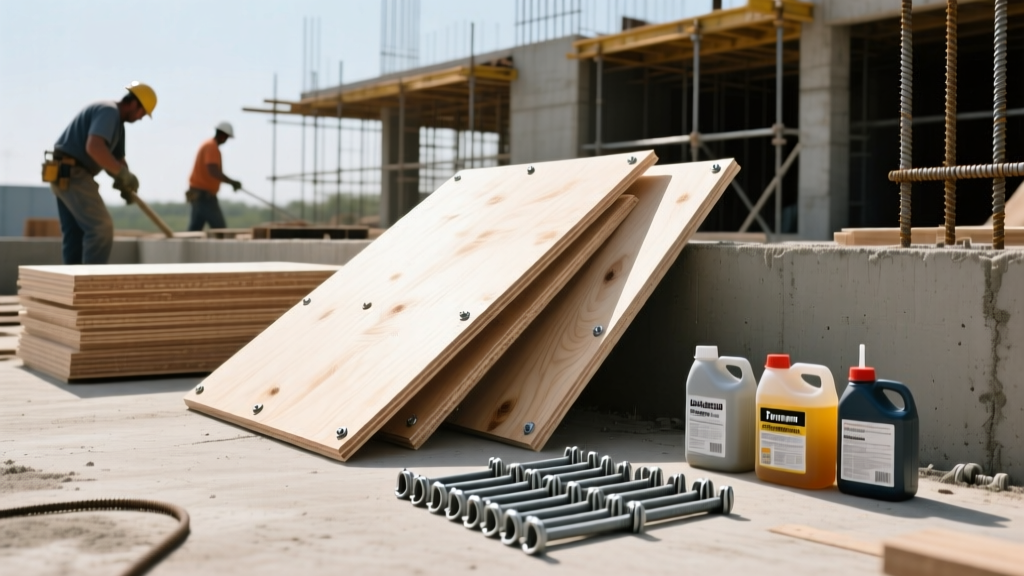
The Economics of Formwork: Why SFCA Dictates Your Budget
When estimating concrete projects, novices focus on the cost per cubic yard of the wet mix. Professional estimators know that the American Concrete Institute (ACI) identifies formwork as the most significant variable in concrete construction, often accounting for 35% to 60% of the total in-place concrete cost. To accurately price this, you must abandon cubic yard calculations and adopt the industry standard metric: Square Feet of Contact Area (SFCA).
2026 Material Cost Matrix: Plywood, Ties, and Release Agents
Selecting the right form-facing material dictates both your immediate material spend and your long-term cost-per-use. In 2026, supply chain stabilization has normalized plywood prices, but premium overlays still command a significant premium over bare sheathing.
| Material | Specification | 2026 Unit Cost | Expected Reuses | Cost Per Use |
|---|---|---|---|---|
| HDO Plywood | 3/4" High-Density Overlay, B-B | $95 - $125 / sheet | 15 - 20 | $4.75 - $8.33 |
| MDO Plywood | 3/4" Medium-Density Overlay | $75 - $95 / sheet | 5 - 10 | $7.50 - $19.00 |
| Standard CDX | 3/4" CDX Sheathing | $45 - $60 / sheet | 1 - 3 | $15.00 - $60.00 |
| Snap Ties | 5/8" x 4" w/ 1" Breakback | $0.40 - $0.65 / ea | 1 (Consumable) | $0.40 - $0.65 |
| Form Release Agent | Bio-based Oil, 5-Gallon Pail | $90 - $140 / pail | Covers ~1500 sq ft | $0.06 - $0.09 / SFCA |
Plywood Selection: The False Economy of CDX
While standard CDX plywood costs nearly half as much as HDO (High-Density Overlay) upfront, it is a false economy for any contractor planning multiple pours. CDX lacks a resin-treated overlay, meaning the wood grain absorbs moisture from the concrete slurry. After a single pour, the face veneer delaminates, leaving a rough, textured finish on the cured concrete that requires expensive patching and grinding. HDO plywood features a thermosetting resin overlay that creates a chemical barrier, yielding a smooth architectural finish and surviving up to 20 reuses if cleaned and oiled properly.
Step-by-Step Quantity Calculation Framework
To build an accurate estimate, follow this sequential framework to calculate your exact material requirements, factoring in standard waste and structural bracing.
- Calculate Total SFCA: Multiply the linear feet of the wall by the depth, then multiply by 2 (for both sides). Add the SFCA for any pilasters, keyways, or step-downs.
- Determine Plywood Sheet Count: Divide total SFCA by 32 (the square footage of a 4x8 sheet). Add a 10% waste factor for cuts, ripped edges, and damaged panels.
- Calculate Waler and Stud Lumber: Vertical 2x4 studs are typically spaced 12 to 18 inches on center (OC). Horizontal double-walers are spaced 24 inches OC. For a 400 SFCA wall (8 feet high), you need vertical studs every 1.5 feet along the 100-foot perimeter (approx. 134 studs per side).
- Estimate Snap Tie Volume: Ties are placed at the intersection of studs and walers. If studs are 18" OC and walers are 24" OC, you have one tie every 3 square feet. Divide your SFCA by 3 to estimate total snap ties required.
Labor Estimation: Crew Rates and Productivity Metrics
Material costs are static; labor costs fluctuate based on site conditions, crew experience, and formwork complexity. Estimators use historical productivity rates measured in SFCA built, stripped, and cleaned per 8-hour day.
| Formwork Application | Crew Composition | Daily Productivity (SFCA) | Estimated Labor Cost / SFCA |
|---|---|---|---|
| Continuous Footings (Simple) | 1 Foreman, 2 Carpenters, 1 Laborer | 450 - 600 | $3.50 - $5.00 |
| Foundation Walls (Standard 8ft) | 1 Foreman, 3 Carpenters, 2 Laborers | 250 - 350 | $6.00 - $8.50 |
| Elevator Pits / Complex Geometry | 2 Foremen, 4 Carpenters, 2 Laborers | 80 - 120 | $15.00 - $22.00 |
Note: Labor costs assume a 2026 prevailing wage burden of $65/hour for carpenters and $45/hour for laborers, including taxes and insurance. Adjust these baseline figures to match your specific regional union or open-shop rates.
Hidden Costs: Stripping, Cleaning, and Tie-Hole Patching
A common estimation error is calculating only the erection of the forms while ignoring the stripping and maintenance phase. Budget an additional 30% to 40% of your erection labor for the stripping process. Furthermore, snap ties leave a conical hole in the finished concrete. If the architectural specifications require a flush or watertight finish, you must allocate time and materials for patching.
- Non-Shrink Grout Patching: A skilled mason can patch approximately 150 tie holes per day. Budget $1.50 to $2.50 per hole for labor and hydraulic cement materials.
- Form Cleaning: Plywood must be scraped and re-oiled before the next pour. A dedicated laborer can clean and oil roughly 400 SFCA per day. Factor in $0.50 per SFCA for form maintenance labor.
- Crane Time for Gang Forms: If you are utilizing pre-assembled gang forms (large modular sections built on the ground), you must rent a mobile crane. Budget $250 to $400 per hour for a 40-ton hydraulic crane, plus a certified rigger and operator.
The Chemistry of Form Release Agents
Never use waste motor oil or diesel fuel as a form release agent. Not only is this an environmental violation, but petroleum distillates chemically degrade the resin overlay on HDO plywood and cause severe surface retardation on the concrete face, leading to dusting and scaling. In 2026, bio-based, VOC-compliant release agents are the industry standard. Apply the release agent using a low-pressure pump sprayer at a rate of 1 gallon per 1,000 to 1,500 square feet. Over-application causes the oil to pool in the bottom of the forms, resulting in dark, stained concrete and bug holes on the vertical faces.
Strategic Recommendations for 2026 Bidding
To maintain margins in the current economic climate, transition away from job-built stick framing for repetitive structures. If your project includes multiple identical retaining walls, elevator cores, or pad foundations, invest in renting or purchasing modular aluminum formwork systems. While the initial mobilization and rental cost is higher, aluminum systems eliminate plywood replacement costs, reduce stripping labor by up to 60%, and yield a superior architectural finish that eliminates the need for secondary rubbing or patching. Always run a comparative SFCA cost analysis between job-built wood forms and modular rentals before finalizing your bid.