Concrete Mites vs Clover Mites: Identification and Sealing Guide
Clarify the concrete mites vs clover mites myth. Learn technical specs for sealing cementitious surfaces and perimeter treatments to prevent infestations.
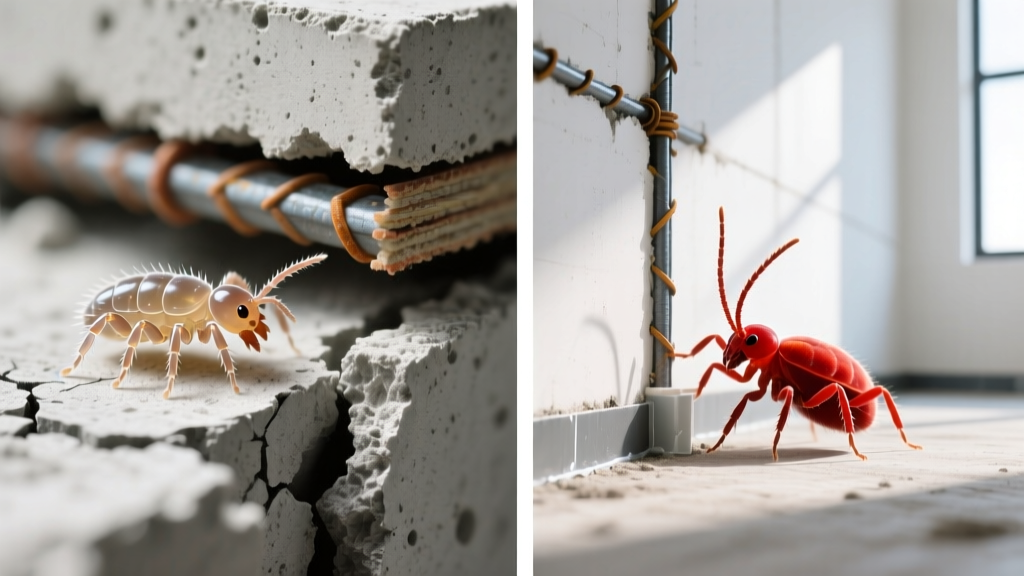
The 'Concrete Mite' Misnomer: Biological Reality vs. Colloquial Myth
In the structural pest management and concrete maintenance industries, the term 'concrete mite' is a pervasive colloquial misnomer. There is no scientifically recognized arachnid species classified as a concrete mite. When facility managers, homeowners, or contractors observe swarms of tiny, reddish-brown arthropods congregating on cementitious substrates, foundation walls, or broom-finished flatwork, they are almost exclusively observing the clover mite (Bryobia praetiosa).
Understanding the distinction in the concrete mites vs clover mites debate is critical for specifying the correct remediation and concrete sealing protocols. Clover mites do not consume concrete, nor do they bore into cementitious matrices like certain wood-boring insects. Instead, they utilize concrete surfaces for thermal regulation and overwintering. Concrete's high thermal mass absorbs solar radiation during the day and releases it slowly, creating a micro-climate that draws these cold-weather pests to south- and west-facing foundations and slabs.
Technical Comparison Matrix: Concrete-Dwelling Arthropods
While clover mites account for 95% of 'concrete mite' reports, other micro-arthropods may inhabit damp or poorly cured concrete environments. The table below differentiates the primary species encountered on or near cementitious surfaces.
| Trait | Clover Mite (Bryobia praetiosa) | Brown Wheat Mite (Petrobia latens) | Mold Mite (Tyrophagus putrescentiae) |
|---|---|---|---|
| Colloquial Name | Concrete Mite, Red Mite | Winter Grain Mite | Concrete Dust Mite |
| Coloration | Brick red to dark reddish-brown | Dark brown to black | Translucent white to pale brown |
| Size | ~0.75 mm (pinhead size) | ~0.6 mm | ~0.5 mm |
| Concrete Interaction | Overwinters in control joints and micro-fissures; stains unsealed surfaces. | Transient; crosses slabs to reach vegetation; no structural interaction. | Feeds on organic mold growing in persistently damp, unsealed concrete dust. |
| Crushing Residue | Bright red hemolymph (severe staining risk) | Clear/brown fluid (low staining risk) | Clear fluid (no staining risk) |
Why Mites Congregate on Cementitious Substrates
To engineer an effective exclusion strategy, one must understand the physical properties of concrete that attract Bryobia praetiosa. According to entomological research from the University of Minnesota Extension, clover mites seek out narrow, dark crevices to molt and overwinter.
The Micro-Fissure Harborage Effect
Standard broom-finished concrete and exposed aggregate surfaces possess a network of capillary pores and micro-cracks ranging from 0.05 mm to 1.0 mm in width. These dimensions perfectly match the harborage requirements of clover mites. Furthermore, standard saw-cut control joints (typically 1/4-inch to 1/2-inch wide) provide deep, protected channels that shield the mites from UV radiation and desiccation, making unsealed joints the primary ingress points into building envelopes.
Concrete Sealing Specifications for Mite Exclusion
Physical exclusion via chemical concrete sealers is the most durable method for mitigating mite harborage. The goal is to alter the surface tension of the concrete pores and fill macroscopic joints, eliminating the micro-climates mites require. When specifying sealers, adhere to the following technical parameters:
1. Penetrating Silane/Siloxane Sealers
For horizontal flatwork and vertical foundation walls, a penetrating siloxane emulsion is the industry standard. Unlike film-forming acrylics that can trap moisture vapor and cause spalling, siloxanes react with the free alkali (calcium hydroxide) in the concrete to form a hydrophobic resin within the pore structure.
- Specification: Use a 40% active solids siloxane emulsion (water-based to comply with 2026 SCAQMD Rule 1113 VOC limits of <100 g/L).
- Application Rate: 150 to 200 square feet per gallon, applied in a single flood coat using a low-pressure HVLP sprayer.
- Penetration Depth: 1.5 mm to 4.0 mm, depending on concrete porosity and compressive strength (PSI).
- Mite Exclusion Mechanism: While it does not physically plug the surface micro-fissures, it drastically reduces the moisture retention within those fissures, making the environment inhospitable for mite survival and mold growth.
2. Polyurea Joint Fillers for Control Joints
Penetrating sealers cannot bridge saw-cut control joints. To eliminate the primary overwintering harborage, joints must be filled with a flexible, high-durometer elastomer.
- Specification: 100% solids, rapid-cure polyurea joint filler (e.g., Metzger McGuire Spall Guard or Euclid Chem EucoJoint).
- Preparation: Joints must be routed and blown out with oil-free compressed air (minimum 90 CFM) to remove existing debris and mite casings prior to filling.
- Shore A Hardness: Specify a Shore A 45 to 55 hardness to withstand forklift traffic while maintaining enough elasticity to accommodate thermal expansion of the concrete slab.
Avoid using film-forming acrylic or urethane coatings on exterior, below-grade foundation walls for mite control. These coatings create a continuous vapor barrier. If hydrostatic pressure is present, the coating will blister and delaminate, creating larger, moisture-filled voids behind the coating that actually exacerbate pest and mold issues.
The Chemistry of Hemolymph Staining on Concrete
A critical aspect of the concrete mites vs clover mites discussion is the aesthetic damage caused by improper remediation. When clover mites are crushed, they exude hemolymph (arthropod 'blood') containing red pigments. On unsealed concrete, this organic pigment penetrates the capillary pores and reacts with the highly alkaline environment (pH 12.0 - 13.5).
Standard alkaline concrete cleaners and degreasers will not remove these stains; in fact, high-pH cleaners can permanently set the organic pigment into the calcium silicate hydrate (C-S-H) matrix. According to guidelines supported by Ohio State University Extension, mechanical crushing of mites on concrete must be strictly avoided.
Stain Remediation Protocol
- Vacuuming: Use a HEPA-filtered wet/dry vacuum to remove live mites from the concrete surface without crushing them.
- Acidic Neutralization: Apply a mildly acidic concrete cleaner (e.g., a 5% to 10% phosphoric acid solution or a specialized commercial organic stain remover formulated for masonry).
- Dwell Time: Allow the acid to dwell for 5 to 10 minutes to neutralize the surface alkalinity and break the chemical bond between the hemolymph pigment and the concrete pores.
- Extraction: Agitate with a medium-stiff nylon brush (avoid wire brushes, which leave iron particles that cause secondary rust stains) and extract with a high-pressure surface cleaner (minimum 2500 PSI).
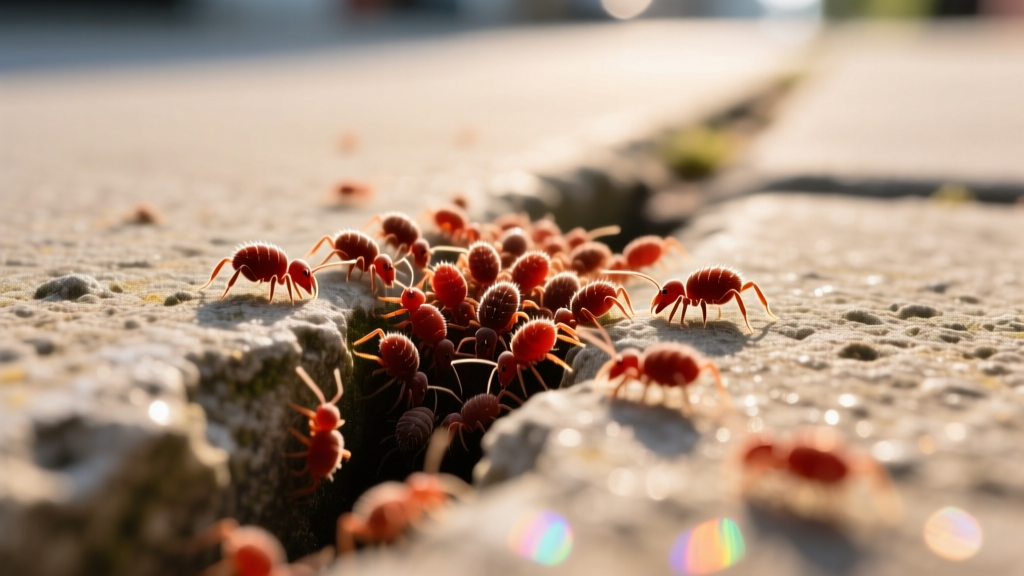
Chemical Perimeter Treatments for Concrete Slabs
When physical sealing is insufficient or during peak migration seasons (early spring and late autumn), chemical barrier treatments applied directly to the concrete perimeter are necessary. The Penn State Extension recommends establishing a continuous chemical barrier at the slab-to-grade intersection.
- Active Ingredients: Bifenthrin (0.06% - 0.1% suspension concentrate) or Cyfluthrin. These pyrethroids exhibit high efficacy against mites and possess strong residual activity on alkaline concrete surfaces.
- Application Zone: Apply a coarse, low-pressure spray to create a 2-foot wide band on the soil adjacent to the foundation, and a 2-foot high band on the vertical concrete foundation wall itself.
- Concrete Compatibility: Ensure the formulated product does not contain xylene or other harsh solvents that could degrade existing acrylic joint sealants or strip penetrating siloxane treatments from the concrete surface. Water-based microencapsulated formulations are preferred for application over sealed concrete.
Frequently Asked Questions (FAQ)
Do concrete mites cause structural spalling or rebar corrosion?
No. Clover mites are strictly nuisance pests. They do not possess the mandibles required to bore into concrete, nor do their biological processes alter the pH of the concrete matrix or accelerate the carbonation front. Any spalling or rebar corrosion observed in areas with high mite traffic is coincidental and caused by standard freeze-thaw cycles or chloride ingress.
Will sealing my concrete completely eliminate clover mites from my property?
Sealing concrete eliminates the harborage on the concrete itself, preventing them from overwintering in your slab joints and migrating indoors. However, clover mites breed in turfgrass and clover patches. To achieve total site control, concrete sealing must be paired with a 12-to-18-inch vegetation-free zone (mulch or gravel) immediately adjacent to the concrete perimeter.
How often must siloxane sealers be reapplied to maintain mite exclusion?
On horizontal, high-traffic broom-finished flatwork, a 40% solids siloxane sealer typically requires reapplication every 3 to 5 years as UV exposure and mechanical abrasion degrade the hydrophobic resin in the top 2 mm of the pore structure. On vertical foundation walls, the same sealer can last 7 to 10 years before re-treatment is necessary.
Written by
Priya KapoorPriya Kapoor is a real estate market analyst and construction economics researcher with expertise in housing affordability, development feasibility, and infrastructure investment. She holds a Master of Regional Planning from Cornell University and previously worked as a senior analyst at CBRE's Investment Properties group, where she modeled returns for $4B in mixed-use development pipelines. Priya now runs an independent research practice advising developers, municipalities, and REITs on construction cost forecasting and market timing. She publishes the quarterly "BuildMat Market Pulse" report tracking material price indices across 12 commodity categories. Based in Austin, TX, Priya serves on the board of Habitat for Humanity Austin and is a marathon runner.
More from Priya Kapoor
View all
Construction Cost
Cost to Build a 1600 Sq Ft Home in 2026: Full Breakdown
Accurate 2026 cost to build a 1600 sq ft home—material, labor, and regional pricing breakdowns included. Plan your budget with real-time estimates.
Aug 11, 2026

Wood & Lumber
Name the Types of Wood for Pressure Treatment and Preservation
Learn how to name the types of wood best suited for pressure treatment. Compare species treatability, chemical retention levels, and 2026 preservation costs.
Aug 4, 2026

Stone & Masonry
Stone Veneer Suppliers Lindenhurst: 2026 Cost Analysis
Analyze 2026 stone veneer costs in Lindenhurst, NY. Compare local supplier pricing, delivery fees, and Suffolk County installation labor rates.
Aug 4, 2026