2026 Concrete Parking Blocks Cost & Quantity Estimation Guide
Calculate exact 2026 costs and quantities for concrete parking blocks. Includes anchoring matrices, freight estimates, and lifecycle cost comparisons.
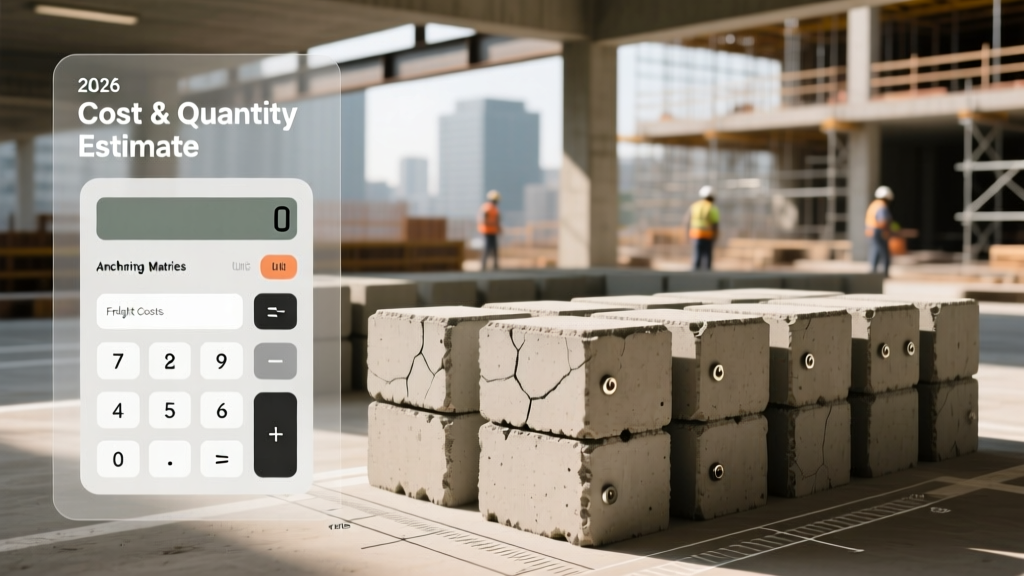
The True Cost of Concrete Parking Blocks in 2026
Estimating the budget for precast concrete parking blocks (wheel stops) requires looking far beyond the per-unit material price. In 2026, supply chain stabilization has normalized base concrete pricing, but freight logistics and specialized anchoring systems now account for up to 60% of the total installed cost. Procurement managers and site contractors must calculate the total landed cost to avoid severe budget overruns on commercial paving projects.
Quick Pricing Snapshot (2026 Averages)
- Standard 6-Foot Block (72" x 12" x 4.5"): $38.00 – $52.00 per unit (approx. 115–130 lbs)
- Standard 4-Foot Block (48" x 12" x 4.5"): $26.00 – $38.00 per unit (approx. 80–90 lbs)
- Heavy-Duty Airport/Industrial Profile (72" x 18" x 6"): $85.00 – $110.00 per unit
- LTL Freight (Less-Than-Truckload): $1.80 – $2.50 per mile/pallet (holds 12-16 units)
Freight and Logistics: The Hidden Budget Killer
Because a standard 6-foot concrete wheel stop weighs roughly 120 pounds, a single pallet of 12 units weighs nearly 1,500 pounds. Most regional precast yards require a minimum order of 2 to 4 pallets for delivery. If your project site is outside a 50-mile radius of the casting bed, LTL freight surcharges and liftgate fees for the delivery truck will add $3.50 to $6.00 per block to your final cost. Always request a 'delivered-to-site' quote rather than an FOB plant price when running your initial estimates.
Quantity Calculator: How Many Wheel Stops Do You Need?
Calculating the exact quantity of concrete parking blocks requires a site-specific approach based on municipal parking codes and the Americans with Disabilities Act (ADA). The general rule of thumb is one block per standard parking stall, but edge cases frequently alter this baseline.
The Baseline Calculation Formula
Use this framework to determine your base material order:
- Total Standard Stalls: Count all standard 8.5-foot to 9-foot wide parking spaces. (1 block per stall).
- End-of-Aisle Bumpers: Add 2 blocks for every aisle termination point where vehicles might overshoot into pedestrian walkways.
- Breakage and Waste Factor: Add 4% to your total for transit damage, corner spalling, and installation breakage.
Setback Distance Variables
The placement of the block dictates the length of the anchor bolts required. The industry standard setback is 2.5 to 3.0 feet from the face of the curb to the front edge of the block. This ensures the vehicle's front overhang does not extend past the block and strike a pedestrian or landscaping feature. If your site plan requires a 4-foot setback due to deep landscaping beds, you will need longer anchor sleeves, increasing hardware costs by roughly $2.00 per block.
Anchoring Systems: Cost vs. Longevity Matrix
The method used to secure concrete parking blocks to the asphalt or concrete substrate is the single largest variable in long-term maintenance costs. Unanchored blocks will migrate within 12 months due to tire friction and snowplow impact.
| Anchoring Method | Hardware Cost / Block | Install Time | Expected Lifespan | Best Application |
|---|---|---|---|---|
| Gravity (Unanchored) | $0.00 | 2 mins | < 2 Years | Temporary lots, private dirt lots |
| Rebar Pin (J-Pin) | $2.50 – $4.00 | 8 mins | 3 – 5 Years | Low-budget lots, non-salt regions |
| Epoxied Threaded Rod | $16.00 – $24.00 | 15 mins | 10 – 15+ Years | Commercial lots, freeze-thaw zones |
| Cast-in-Place (Wet Set) | $5.00 – $8.00 (Labor) | N/A (Poured) | 20+ Years | New concrete pours (not asphalt) |
For asphalt installations in 2026, the Epoxied Threaded Rod method is the industry standard for commercial properties. This involves drilling a 5/8-inch hole through the precast block and into the asphalt, injecting a two-part structural epoxy, and driving a galvanized threaded rod. This creates a chemical bond with the asphalt aggregate that resists the upward shear forces of snowplow blades.
Hidden Cost Traps & Failure Modes
When estimating replacement cycles and maintenance budgets, facility managers must account for specific mechanical and chemical failure modes inherent to precast concrete.
1. Rust Jacking (Rebar Oxidation)
Many budget-tier concrete parking blocks are cast with internal carbon steel rebar for structural integrity during transit. When installed in northern climates where magnesium chloride or sodium chloride de-icing salts are used, moisture penetrates the concrete pores. The internal rebar oxidizes and expands up to seven times its original volume. This creates internal tensile stress exceeding the concrete's 400 PSI tensile strength, causing the block to split longitudinally down the center. To prevent this, specify blocks cast with fiber-reinforced concrete (FRC) or galvanized internal mesh, which eliminates the rust-jacking failure mode entirely.
2. Snowplow Shear and Profile Geometry
The geometry of the block's front face dictates its survivability in snow-plowed lots. A standard wheel stop features a 30-degree to 45-degree sloped front face, allowing a snowplow blade to ride up and over the unit. If your procurement team accidentally orders 'landscape curbing' or vertical-face blocks to save money, the plow blade will catch the vertical edge. The kinetic energy transfer will instantly snap standard rebar pins and rip epoxy anchors out of the asphalt, resulting in a 100% replacement rate after the first winter storm.
3. Freeze-Thaw Spalling
According to guidelines published by the American Concrete Institute (ACI), exterior concrete exposed to moisture and freezing temperatures must be air-entrained. If your supplier ships standard interior-grade concrete blocks to a site in a freeze-thaw zone, trapped water will expand upon freezing, causing the surface to flake and spall within two seasons. Always verify that your purchase order specifies a minimum 4,000 PSI compressive strength mix with 5% to 7% air entrainment.
Concrete vs. Recycled Polymer: A Lifecycle Cost Analysis
While concrete remains the default choice for municipal and commercial lots due to its high mass and low base material cost, recycled HDPE (High-Density Polyethylene) and rubber composite blocks are capturing market share. Below is a 10-year Total Cost of Ownership (TCO) comparison for a 100-stall commercial lot.
10-Year TCO: Precast Concrete
- Material (100 blocks): $4,500
- Freight & Delivery: $850
- Epoxy Anchoring Install: $2,200
- Year 5 Replacement (15% failure): $1,100
- Total 10-Year Cost: $8,650
10-Year TCO: Recycled HDPE
- Material (100 blocks): $6,800
- Freight & Delivery: $300 (Lightweight)
- Spike Anchoring Install: $900
- Year 5 Replacement (2% failure): $150
- Total 10-Year Cost: $8,150
As demonstrated by the data, the higher upfront material cost of polymer blocks is entirely offset by drastically reduced freight weights (a 6-foot HDPE block weighs roughly 18 lbs compared to 120 lbs for concrete) and faster, cheaper installation using driven steel spikes rather than chemical epoxy. However, concrete remains superior in high-wind zones, on steep gradients, or where extreme vehicle impact resistance (such as fire lane barriers) is required due to its sheer mass.
Specification Checklist for Procurement
When drafting the procurement documents or submitting RFQs to precast yards, include these exact specifications to ensure you receive commercial-grade materials that will pass municipal inspections:
- Compressive Strength: Minimum 4,000 PSI at 28 days (verified by NRMCA certified batch tickets).
- Air Entrainment: 5.0% to 7.0% for freeze-thaw durability.
- Internal Reinforcement: Macro-synthetic fibers or hot-dipped galvanized wire mesh (strictly prohibit black carbon steel rebar).
- Profile Geometry: 30-degree maximum front slope for snowplow deflection.
- Anchor Holes: Pre-cast with two 1-inch diameter vertical voids, located 12 inches from each end, to prevent on-site drilling delays and corner blowouts.
- Curing Method: Steam-cured or wet-cured for a minimum of 48 hours prior to palletizing to prevent micro-fractures during transit.
By utilizing this estimation framework and enforcing strict material specifications, project managers can accurately forecast budgets, eliminate hidden freight surcharges, and deploy concrete parking blocks that survive the mechanical and environmental stresses of modern commercial infrastructure.