Concrete Parking Bumpers: Material Taxonomy & Selection Guide
Compare precast, polymer-modified, and reinforced concrete parking bumpers. Learn exact dimensions, load ratings, and selection criteria for any lot.
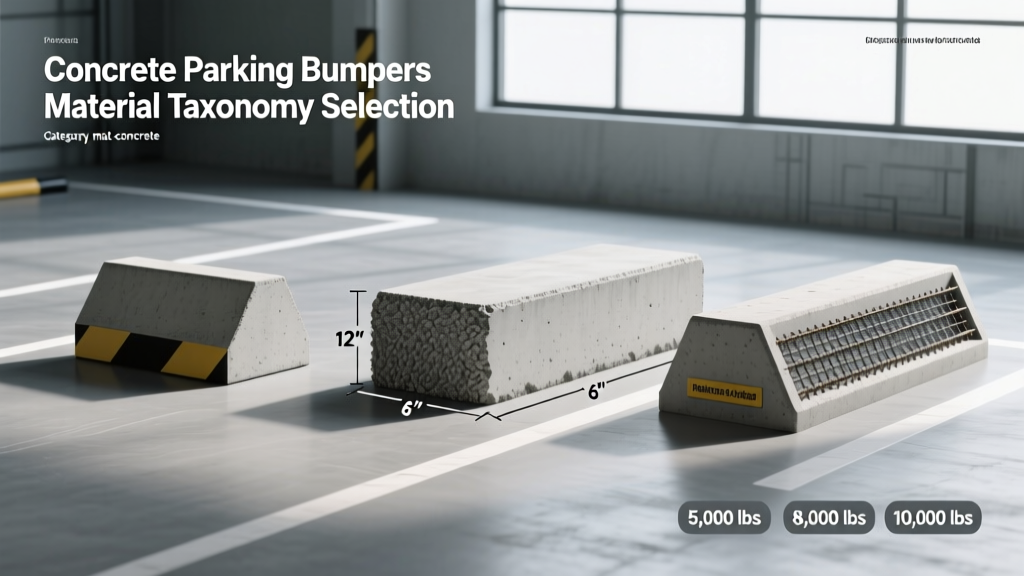
Concrete parking bumpers, technically classified as precast wheel stops, serve as the primary physical boundary for vehicular spatial management in paved lots. While they appear to be simple geometric blocks, their material composition, structural reinforcement, and dimensional tolerances dictate their lifespan and failure rate under repetitive kinetic impact. Selecting the incorrect bumper taxonomy for a specific subgrade or traffic class leads to rapid spalling, mid-span fracturing, and costly lot maintenance. This guide dissects the material taxonomy of concrete parking bumpers and provides a precise selection framework for commercial, industrial, and residential applications.
The Taxonomy of Concrete Parking Bumpers
Not all precast concrete blocks are poured from the same mix design. Manufacturers categorize parking bumpers into three primary material tiers based on compressive strength, tensile reinforcement, and aggregate composition.
1. Standard Precast Concrete (Type I)
Type I bumpers are cast from a standard 3,000 to 4,000 PSI concrete mix utilizing 3/8-inch coarse aggregate and Type I/II Portland cement. They are unreinforced, relying entirely on the compressive mass of the concrete to absorb impact. Because they lack tensile reinforcement, they are highly susceptible to mid-span snapping if struck off-center by heavy vehicles or dragged across uneven subgrades during snow removal operations.
2. Steel-Reinforced Precast (Type II)
Type II bumpers integrate a continuous internal steel armature, typically a #3 (3/8-inch) or #4 (1/2-inch) Grade 60 rebar running the longitudinal axis of the block. The concrete matrix is usually bumped to 5,000 PSI. The steel core bridges micro-fractures upon impact, preventing catastrophic failure and allowing the bumper to remain intact even if the outer concrete shell chips or spalls. This is the industry standard for high-traffic commercial lots.
3. Polymer-Modified & Fiber-Reinforced (Type III)
Type III bumpers incorporate macro-synthetic fibers or latex polymer admixtures into a high-early-strength mix (often exceeding 6,000 PSI). The polymer matrix drastically reduces the water-to-cement ratio, yielding a denser surface that resists deicing chemical penetration and freeze-thaw scaling (per National Precast Concrete Association durability guidelines). These are specified in harsh northern climates where traditional concrete spalls within two winters.
| Material Tier | Compressive Strength | Tensile Reinforcement | Avg. Weight (6-ft) | Primary Failure Mode | Relative Cost |
|---|---|---|---|---|---|
| Type I (Standard) | 3,000 - 4,000 PSI | None | 55 - 65 lbs | Mid-span snapping | $ |
| Type II (Reinforced) | 5,000 PSI | #3 or #4 Rebar Core | 75 - 85 lbs | End-cap spalling | $$ |
| Type III (Polymer) | 6,000+ PSI | Synthetic Fibers | 60 - 70 lbs | Surface abrasion | $$$ |
Dimensional Standards and Impact Physics
The physical geometry of a concrete parking bumper is strictly dictated by vehicular bumper overhang and tire scrub radius. Deviating from standard dimensions results in vehicle damage or inefficient spatial utilization.
- Height (4.0 to 4.5 inches): This specific height intercepts the forward tire tread before the vehicle's front fascia or bumper cover makes contact with the block. If a bumper exceeds 5 inches, it risks crushing the plastic bumper covers of modern low-profile sedans.
- Width/Base (5.5 to 6.0 inches): A 6-inch base provides a 45-degree sloped face, optimizing the kinetic transfer of a rolling 4,000-lb vehicle into downward friction against the asphalt, rather than allowing the block to slide.
- Lengths (48, 72, and 96 inches): The 72-inch (6-foot) block is the universal standard for perpendicular parking spaces, which typically measure 9 feet (108 inches) wide. This leaves 18 inches of clearance on each side for door swings and pedestrian egress.
According to the U.S. Access Board ADA Standards, parking bumpers must never encroach into the required 60-inch minimum width of an accessible pedestrian aisle, nor can they create a tripping hazard in designated walkways. Placement must be measured from the rear curb, not the painted stall line.
Selection Framework: Matching Bumper to Application
Use the following decision matrix to specify the correct concrete parking bumper for your project scope.
Light-Duty / Residential & Overflow Lots
Specification: Type I (Standard Precast), 48-inch or 72-inch lengths.
Rationale: Traffic volume is low, vehicle weights are restricted to passenger cars (under 5,000 lbs GVWR), and snowplow interaction is minimal. The lower cost of unreinforced units offsets the occasional replacement cycle.
Commercial / High-Traffic Retail & Office
Specification: Type II (Steel-Reinforced), 72-inch lengths, painted with high-visibility traffic enamel.
Rationale: High turnover rates increase the frequency of low-speed impacts. Delivery trucks and heavier SUVs generate higher kinetic energy upon contact. The internal rebar prevents the blocks from fracturing into trip hazards when struck by heavier axles.
Heavy-Duty / Industrial & Loading Docks
Specification: Type III (Polymer-Modified) or specialized high-mass reinforced blocks, 96-inch lengths.
Rationale: Industrial lots host box trucks and fleet vehicles weighing over 10,000 lbs. Standard blocks will shatter or slide under the momentum of a rolling commercial truck. Polymer-modified blocks resist the chemical degradation from diesel drips and heavy commercial deicers.
Installation & Anchoring Taxonomy
The most common cause of concrete parking bumper failure is not the concrete itself, but improper anchoring to the subgrade. An unanchored bumper will slide, chip the asphalt, and eventually crack under torsional stress. Anchoring methods must be strictly matched to the subgrade material.
Subgrade A: Asphalt (Flexible Pavement)
- Hardware: 1/2-inch or 5/8-inch diameter x 12-inch long ribbed rebar stakes (nails).
- Procedure: Position the bumper. Drive the rebar stake through the pre-cast mounting holes using a 3-lb sledgehammer until the head is flush with or slightly below the concrete surface.
- Friction Lock: The 12-inch depth penetrates through the typical 2-to-3-inch asphalt wear course and bites into the compacted aggregate base course, providing immense lateral shear resistance.
Subgrade B: Concrete (Rigid Pavement)
- Hardware: 3/8-inch or 1/2-inch zinc-plated wedge anchors or sleeve anchors (typically 3 to 4 inches in length).
- Procedure: Mark the hole locations through the bumper. Remove the bumper and hammer-drill holes into the concrete slab using a carbide masonry bit matching the anchor diameter. Clean out concrete dust with compressed air. Reposition the bumper, insert the wedge anchors, and torque to 30-40 ft-lbs.
- Alternative: For temporary layouts or indoor garages where slab penetration is prohibited, use heavy-duty polyurethane construction adhesive combined with surface-mounted galvanized masonry straps.
Cost Breakdown & Procurement (2026 Pricing)
Procurement costs fluctuate based on regional aggregate availability and freight weights. Concrete is exceptionally heavy; a single pallet of 72-inch bumpers weighs over 2,500 lbs, making local sourcing critical to avoid prohibitive LTL (Less-Than-Truckload) freight surcharges.
| Item Description | Material Tier | Avg. Unit Cost | Hardware / Anchor Cost |
|---|---|---|---|
| 48-inch Standard Bumper | Type I | $28.00 - $35.00 | $4.00 (2x Rebar Stakes) |
| 72-inch Standard Bumper | Type I | $42.00 - $55.00 | $6.00 (3x Rebar Stakes) |
| 72-inch Reinforced Bumper | Type II | $65.00 - $85.00 | $9.00 (3x Wedge Anchors) |
| 96-inch Polymer Bumper | Type III | $110.00 - $145.00 | $12.00 (4x Wedge Anchors) |
| High-Vis Traffic Paint (Quart) | N/A | $18.00 - $25.00 | N/A |
For large-scale commercial deployments exceeding 500 linear feet of bumpers, contact regional precast yards directly for volume-tier pricing, which typically yields a 15% to 20% discount off retail distributor rates. Always verify that the manufacturer adheres to the structural guidelines outlined by the Institute of Transportation Engineers (ITE) regarding parking facility design and traffic containment standards.