How Much Is Concrete Per Yard? 2026 PSI & Spec Costs
Discover how much is concrete per yard in 2026. Break down ready-mix costs by PSI ratings, slump, admixtures, and structural performance specifications.
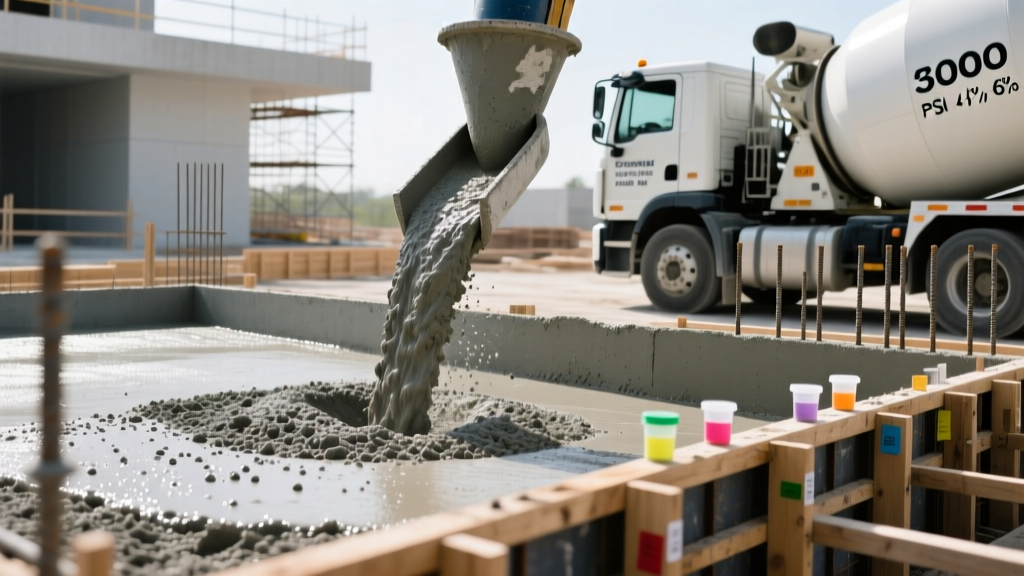
The True Cost of Ready-Mix: Beyond the Base Price
When contractors and homeowners ask, 'how much is concrete per yard,' the standard industry answer in 2026 is between $135 and $145 for a basic 3,000 PSI mix. However, treating concrete as a generic commodity is a critical estimating error. Concrete is a highly engineered composite material, and its final per-yard cost is dictated by strict performance ratings, structural specifications, and chemical admixtures required by local building codes.
According to the National Ready Mixed Concrete Association (NRMCA), over 70% of commercial and high-performance residential pours require customized mix designs. This guide breaks down the exact cost multipliers associated with compressive strength (PSI), slump tolerances, exposure classes, and reinforcement specifications, giving you the precise data needed to estimate structural concrete budgets accurately.
Baseline Pricing Matrix: Compressive Strength (PSI)
Compressive strength, measured in pounds per square inch (PSI) at 28 days of curing, is the primary driver of base material costs. Higher PSI requires a higher cement content, a lower water-to-cement (w/c) ratio, and often supplementary cementitious materials (SCMs) like fly ash or slag. Below is the 2026 baseline pricing matrix for standard ready-mix concrete before delivery fees and admixtures.
| PSI Rating | Typical Application | Base Cost Per Yard (2026) | Cement Content (Approx.) |
|---|---|---|---|
| 2,500 PSI | Light-duty walkways, non-structural fill | $125 - $135 | 400 - 425 lbs |
| 3,000 PSI | Residential driveways, sidewalks, patios | $135 - $145 | 450 - 475 lbs |
| 4,000 PSI | Garage floors, structural slabs, foundations | $150 - $165 | 500 - 550 lbs |
| 5,000+ PSI | Commercial columns, suspended decks, heavy industrial | $175 - $210 | 600+ lbs |
Under American Concrete Institute (ACI) 318 building codes, minimum PSI requirements are strictly tied to environmental exposure. For example, exterior flatwork in regions with severe freeze-thaw cycles legally mandates a minimum of 3,500 to 4,000 PSI, automatically elevating your baseline cost.
Decoding Exposure Classes and Air-Entrainment
If your project is in a climate that experiences freezing temperatures, you must specify air-entrained concrete. Air-entraining admixtures (ASTM C260) create microscopic, disconnected air bubbles that give expanding water room to freeze without cracking the matrix.
Specification Alert: Freeze-Thaw Exposure
For Exposure Class F2 or F3 (severe freeze-thaw with deicing chemicals), ACI mandates a minimum air content of 5% to 8%. Expect to pay an additional $6 to $10 per yard for air-entraining agents. Skipping this spec to save money will result in surface spalling and catastrophic slab failure within two to three winters.
The Hidden Cost Multipliers: Chemical Admixtures
Modern concrete relies heavily on chemical admixtures to manipulate set times, workability, and durability. These are dosed at the batch plant or added via the truck's automated dispensing system on-site. The Portland Cement Association (PCA) notes that precise mixture proportioning using these chemicals is essential for high-performance structural elements.
Common Admixture Cost Adders (Per Cubic Yard)
- Calcium Chloride Accelerators (ASTM C494 Type C): $8 - $12/yd. Used in cold weather to speed up set time. Warning: Never use calcium chloride in steel-reinforced concrete, as it promotes rapid rebar corrosion.
- Non-Chloride Accelerators (NCA): $15 - $22/yd. The mandatory alternative for reinforced structural foundations and bridge decks.
- Retarders (ASTM C494 Type B): $7 - $11/yd. Essential for hot-weather pours or long transit times to prevent cold joints and plastic shrinkage cracking.
- High-Range Water Redducers / Superplasticizers (ASTM C494 Type F): $18 - $28/yd. Drastically increases flowability without adding water, maintaining a low w/c ratio for high-early-strength (5,000+ PSI) mixes.
Slump Tolerances and Workability Specs
Slump measures the consistency and workability of fresh concrete. A standard residential mix is ordered at a 4-inch slump. If your formwork is heavily congested with rebar, or you are pumping concrete vertically, you may need a 6-inch to 8-inch slump.
The Water Trap: Adding water on-site to increase slump destroys the w/c ratio, dropping the PSI by up to 10% for every extra inch of slump. Instead, you must order a high-slump mix designed with superplasticizers. Upgrading from a standard 4-inch slump to a highly workable 8-inch pump mix typically adds $12 to $18 per yard.
Self-Consolidating Concrete (SCC)
For densely reinforced architectural walls or complex formwork where vibration is impossible, Self-Consolidating Concrete (SCC) flows under its own weight. SCC requires advanced viscosity-modifying admixtures (VMAs) and precise aggregate grading. Expect a premium of $35 to $60 per yard over standard mixes for SCC.
Fiber Reinforcement vs. Traditional Rebar
Many specifications now call for fiber reinforcement to control plastic shrinkage cracking and improve impact resistance. The cost impact depends heavily on the fiber type specified in your engineering documents:
| Fiber Type | ASTM Standard | Primary Function | Cost Adder Per Yard |
|---|---|---|---|
| Synthetic Microfibers | ASTM C1116 Type III | Secondary reinforcement, plastic shrinkage crack control | $8 - $14 |
| Synthetic Macrofibers | ASTM C1116 Type III | Post-crack ductility, can sometimes replace light wire mesh | $18 - $25 |
| Steel Fibers | ASTM A820 | Primary/Secondary structural reinforcement, heavy industrial floors | $35 - $65 |
Pro-Tip: When ordering steel fibers, specify the exact dosage rate (e.g., 40 lbs per cubic yard). Batch plants charge strictly by the pound of steel added, and under-dosing will fail structural pull-out tests.
Aggregate Sizing and Specialty Mixes
The maximum size of the coarse aggregate (usually 3/4-inch or 3/8-inch gravel) affects both the pumpability and the cost. A 3/4-inch aggregate is standard and most cost-effective. If you are pumping concrete through small lines or pouring thin overlays, you must specify 3/8-inch aggregate (pea gravel mix), which can add $5 to $10 per yard due to specialized stockpiling and handling at the batch plant.
Additionally, architectural mixes requiring specific colored aggregates, white cement, or exposed aggregate finishes operate on entirely different pricing tiers, often exceeding $220 per yard due to the premium raw materials and strict batching isolation required to prevent cross-contamination.
Logistics: Short-Load Fees and Surcharges
The per-yard price is only half the equation; delivery logistics dictate the final invoice. A standard ready-mix truck holds 10 cubic yards. If your project requires only 6 yards, you will be hit with a 'short-load fee.' In 2026, short-load fees typically range from $40 to $75 per missing yard, meaning a 6-yard load could incur up to $240 in penalty fees.
Ordering Framework: Avoiding Logistics Penalties
- Calculate Exact Volume: Use (Length x Width x Depth in feet) / 27. Always add a 5% to 10% overage factor for subgrade unevenness and formwork blowouts.
- Consolidate Pours: If you need 4 yards for a patio and 5 yards for a driveway, pour them on the same day to avoid two separate short-load fees and dual environmental/fuel surcharges.
- Verify Access: If the truck cannot reach the pour site and requires a concrete pump boom, factor in $800 to $1,200 for the pump truck minimum call-out fee, which is entirely separate from the ready-mix material cost.
Reading the Batch Ticket: Verification on Site
When the truck arrives, the driver will hand you a batch ticket. Do not just sign it. Verify the following performance specs match your order: the design number, the maximum w/c ratio, the slump target, the air content percentage, and the presence of specific admixtures (like non-chloride accelerators). If the ticket shows a higher w/c ratio or missing air-entrainment in a freeze-thaw zone, you have the right to reject the load before it begins pouring. Understanding exactly how much is concrete per yard requires mastering these specifications, ensuring you pay for the exact structural performance your project demands.