Match the Right Concrete Saw to Your Specific Cutting Scenario
Discover how to match the right concrete saw to your specific cutting scenario. Compare walk-behind, handheld, and early-entry saws for optimal results.
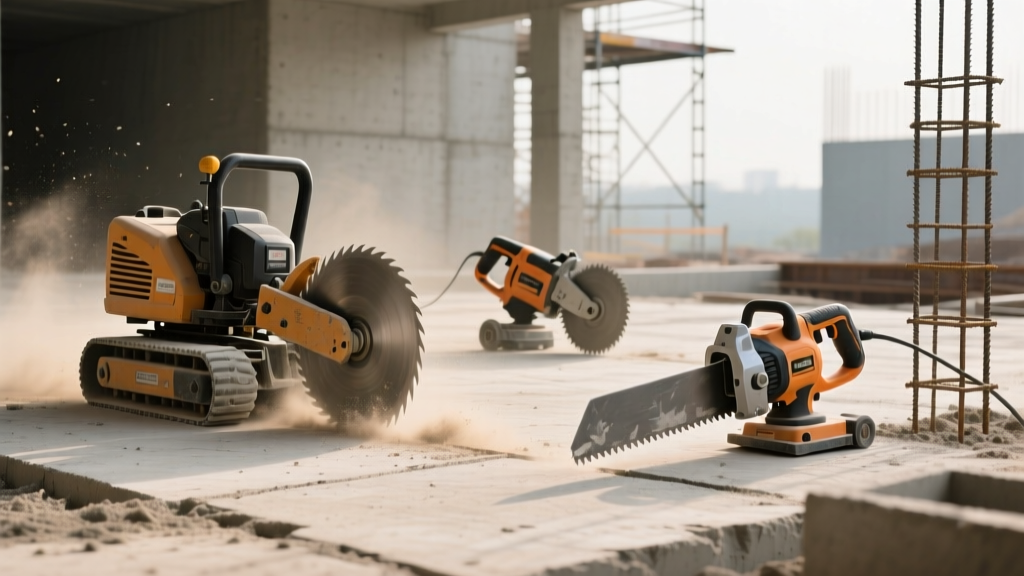
The Scenario-Matching Framework for Concrete Saws
Selecting a concrete saw is not a one-size-fits-all decision. The physical properties of the cured or green concrete, the required cut depth, and the environmental constraints of the job site dictate the exact machinery and diamond blade matrix required. Using an undersized walk-behind saw on a 12-inch thick reinforced slab will result in blade warping and severe undercutting, while deploying a heavy flat saw for shallow control joints will cause edge spalling. This guide maps specific cutting scenarios to the precise equipment, blade specifications, and operational parameters required for optimal execution in 2026.
Scenario 1: Deep Cuts on Thick Slabs (Flat Sawing)
Flat sawing is the standard for cutting expansion joints, removing damaged sections of thick pavement, or creating openings for stairwells in slabs exceeding 6 inches in thickness.
Rule of Thumb: For structural slab removal, the cut depth must penetrate 100% of the slab. For control joints, the cut depth should be exactly 25% to 33% of the total slab thickness to effectively relieve tensile stress without compromising structural interlock.
Equipment & Parameter Matching
- Slab Thickness 6" to 8": Requires a 20-inch to 24-inch diamond blade mounted on a mid-size walk-behind saw (13 HP to 25 HP gas/diesel). Maximum cut depth is typically 6 to 8 inches.
- Slab Thickness 10" to 14": Demands a heavy-duty diesel walk-behind saw (35 HP to 60 HP) equipped with a 36-inch to 42-inch blade. These units require a minimum water flow of 15 to 25 gallons per minute (GPM) for adequate blade cooling.
- Blade Matrix: Use a laser-welded diamond blade with a soft-to-medium metal bond if cutting heavily reinforced concrete (rebar #4 or larger). The soft bond ensures the metal matrix wears away fast enough to expose fresh, sharp diamonds as they encounter the steel reinforcement.
Scenario 2: Precision Control Joints (Early-Entry / Soff-Cut)
Waiting 12 to 24 hours for concrete to fully cure before sawing control joints often results in random, unsightly shrinkage cracking. Early-entry sawing (often referred to by the proprietary term Soff-Cut) allows contractors to cut joints within 1 to 4 hours of finishing the slab, while the concrete is still in its "green" state.
The Mechanics of Early-Entry Sawing
Early-entry saws utilize a unique skid plate mechanism that rides directly on the concrete surface, applying downward pressure adjacent to the cut. This prevents the aggregate from raveling or spalling at the joint edges, a common failure mode when using standard dry-cut saws on green concrete.
- Timing Window: The optimal window begins when the concrete has hardened enough that the aggregate does not dislodge (ravel) during cutting, but before internal tensile stresses exceed the concrete's tensile strength. In 70°F weather, this is typically 1.5 to 3 hours post-pour.
- Blade Specs: Early-entry blades are small (typically 3.5 to 6 inches in diameter) and feature a specialized narrow kerf. They are strictly dry-cut blades; introducing water at this stage will damage the green concrete surface.
- Depth Limitation: Early-entry saws are restricted to shallow cuts, generally 1 to 1.5 inches deep. They are designed to create a plane of weakness to induce controlled cracking below the surface, not to create a physical gap.
Scenario 3: Vertical Walls, Openings, and Tight Spaces
When the cutting plane is vertical, or when spatial constraints prevent the use of a walk-behind chassis, the scenario shifts to wall saws, ring saws, or heavy-duty handheld cut-off saws.
Matching the Tool to the Obstacle
- Wall Saws (Track-Mounted): Ideal for creating precise door, window, or HVAC openings in poured concrete walls or block masonry. The track is anchor-bolted to the wall, and a hydraulic or high-frequency electric carriage moves the blade. Best for cuts exceeding 12 inches in depth on vertical planes.
- Ring Saws: Utilizing an eccentric gear drive rather than a central arbor, ring saws can cut circular openings (like core holes for plumbing) or deep rectangular openings in confined spaces where a traditional wall saw track cannot be mounted. They offer a cutting depth up to 2.5 times greater than standard handheld saws of the same blade diameter.
- Handheld Cut-Off Saws (14-inch): Best for quick, shallow cuts (up to 5 inches deep) in curbs, parapets, or for trimming edges where a walk-behind cannot reach.
Concrete Saw Application Matrix & 2026 Cost Guide
The following matrix provides a quick-reference decision framework for equipment selection, including current average daily rental rates for the 2026 construction season.
| Saw Type | Optimal Scenario | Max Cut Depth | Power Source | Avg. Daily Rental (2026) |
|---|---|---|---|---|
| Early-Entry (Soff-Cut) | Green concrete control joints | 1.5 inches | Gas / Electric | $180 - $240 |
| Handheld Cut-Off (14") | Curbs, tight spaces, shallow trimming | 5 inches | Gas / Pneumatic | $75 - $120 |
| Mid-Size Walk-Behind | Standard slab joints, 6"-8" removal | 8 inches | Gas / Diesel | $150 - $220 |
| Heavy Walk-Behind (35HP+) | Deep structural removal, thick pavement | 14+ inches | Diesel | $300 - $450 |
| Track-Mounted Wall Saw | Vertical openings, thick retaining walls | 24+ inches | Hydraulic / HF Electric | $250 - $350 (Carriage only) |
Blade Selection: Matching the Aggregate to the Matrix
The most frequent cause of concrete saw failure is pairing the wrong diamond blade bond with the local aggregate. The metal matrix (bond) that holds the synthetic diamonds must wear away at a rate that matches the abrasiveness of the concrete being cut.
Critical Mismatch: If you use a hard-bond blade on hard aggregate (like quartz or basalt), the matrix will not wear away. The exposed diamonds will dull, resulting in "blade glazing," excessive heat, and eventual warping. Conversely, using a soft-bond blade on soft aggregate (like limestone) will cause the matrix to wear too fast, shedding expensive diamonds before they are fully utilized and resulting in rapid blade consumption.
Aggregate Matching Guide
- Hard Aggregates (Quartz, Basalt, River Rock): Require a Soft Bond. The soft metal matrix wears quickly, constantly exposing fresh, sharp diamonds to fracture the hard stone.
- Medium Aggregates (Granite, Trap Rock): Require a Medium Bond. This is the standard "general purpose" blade for most commercial flatwork.
- Soft Aggregates (Limestone, Sandstone, Fly Ash mixes): Require a Hard Bond. The highly abrasive sand and soft stone wear down the metal matrix rapidly; a hard bond resists this abrasion to extend blade life.
- Green / Uncured Concrete: Requires a Very Hard Bond. The uncured cement paste is immensely abrasive and will destroy a standard blade in a matter of feet if the bond is not specifically formulated for green concrete.
Wet vs. Dry Cutting: Environmental and Health Constraints
The decision between wet and dry cutting is rarely about preference; it is dictated by indoor/outdoor environments, silica dust regulations, and slab integrity.
Silica Dust and Regulatory Compliance
Dry cutting concrete generates massive amounts of respirable crystalline silica (RCS). Under current OSHA standards, the Permissible Exposure Limit (PEL) for RCS is strictly capped at 50 micrograms per cubic meter of air (µg/m³) as an 8-hour time-weighted average. Dry cutting indoors without engineering controls will exceed this limit within minutes.
- Wet Cutting: Mandatory for indoor environments and heavy-duty deep cutting. Water suppresses 95% of silica dust and cools the diamond segments. The trade-off is the generation of slurry, which requires containment and vacuum extraction to prevent environmental runoff violations.
- Dry Cutting with HEPA Vacuum: If water cannot be used (e.g., early-entry sawing, electrical hazard zones), the saw must be shrouded and connected to a HEPA-filtered dust extractor. According to NIOSH guidelines, the vacuum must provide a minimum of 25 cubic feet per minute (CFM) of airflow per inch of blade diameter to maintain compliance.
Common Failure Modes and Troubleshooting Decision Tree
When a concrete saw underperforms, operators often blame the machinery. In reality, 90% of failures stem from improper application-fit or operational errors. Use this decision tree to diagnose and correct issues on the fly.
Symptom: Blade Glazing (Spinning without cutting)
- Cause: The bond is too hard for the aggregate, or the operator is not applying enough downward pressure to fracture the diamonds.
- Fix: Make several shallow passes in a highly abrasive material (like an old concrete block or asphalt) to mechanically dress the blade and expose new diamonds. If the issue persists, switch to a softer bond segment.
Symptom: Undercutting (Cutting into the subbase)
- Cause: The saw blade diameter is too large for the required depth, causing the blade to cut past the slab thickness and bite into the gravel or soil subbase. This destroys the blade segments and destabilizes the slab edge.
- Fix: Never set the blade depth more than 1/2 inch below the slab thickness. If cutting a 6-inch slab, set the depth stop to exactly 6.25 inches. Verify subbase depth using ground-penetrating radar or test cores before making long production runs.
Symptom: Edge Spalling and Chipping
- Cause: The blade is wobbling due to a worn arbor flange, the saw is being forced laterally (turning while cutting), or the concrete was cut too late (tensile stress already caused micro-fractures at the edge).
- Fix: Inspect the arbor flanges for flatness; replace if warped. Ensure the operator pushes the saw in a perfectly straight line. For control joints, refer to the American Concrete Institute guidelines on cracking control to ensure sawing occurs before internal stresses exceed the concrete's tensile strength.
Final Application Verification
Before mobilizing equipment to the site, verify the concrete compressive strength (psi), the aggregate type, the presence and depth of steel reinforcement, and the local environmental regulations regarding slurry and silica dust. Matching the concrete saw chassis, power source, and diamond blade matrix to these specific variables is the only way to ensure linear cutting speeds, acceptable blade life, and regulatory compliance.