Guide to Concrete Supply in Denver, NC: Mix Types & Selection
Expert guide to navigating concrete supply in Denver, NC. Compare ready-mix types, local red clay subgrade requirements, and 2026 Lake Norman pricing.
The Denver, NC Concrete Supply Ecosystem
Building in Denver, North Carolina—situated in Lincoln County along the rapidly developing Lake Norman corridor—presents unique structural and logistical challenges. The transition from the coastal plains to the Piedmont region means dealing with expansive Cecil-Pacolet red clay soils, steep topographical drops near the lake, and distinct seasonal temperature swings. Selecting the right concrete supply and mix design is not a one-size-fits-all endeavor; it requires a precise understanding of local material taxonomy and batch plant logistics.
Most ready-mix concrete supplied to Denver, NC (Zip Code 28037) originates from batch plants situated along the NC-16 and Highway 73 corridors, or is dispatched from the northern fringes of the Charlotte metro area. Because concrete begins its hydration process the moment water meets cement in the drum, transit times of 45 to 60 minutes from larger metro plants necessitate specific chemical admixtures to maintain workability, especially during the humid Carolina summers.
Material Taxonomy: Matching Mix Designs to Application
Ordering concrete requires specifying a mix design tailored to the structural load, environmental exposure, and finishing requirements of your project. The National Ready Mixed Concrete Association (NRMCA) categorizes mixes primarily by compressive strength (PSI), aggregate size, and slump (workability).
Standard Flatwork: 3,000 to 4,000 PSI
For residential driveways, patios, and sidewalks in the Denver area, a 3,000 to 4,000 PSI mix is the industry standard. These mixes typically utilize a 3/4-inch crushed stone aggregate, which provides an optimal balance of strength and finishability. A standard 4-inch to 5-inch slump is requested to allow finishers to work the surface without adding excess water on-site, which severely compromises surface durability and invites scaling.
Structural Foundations: 4,000 to 5,000 PSI
Footings, basement walls, and suspended slabs require higher compressive strength and lower water-cement ratios. A 4,000 to 5,000 PSI mix is mandated for structural elements supporting multi-story residential builds or heavy commercial loads. These mixes often incorporate fly ash or slag cement to reduce the heat of hydration, preventing thermal cracking in thick foundation pours.
Specialty Mixes: Flowable Fill and Fiber-Reinforced
For trench backfilling around utilities on steep Lake Norman lots, Controlled Low-Strength Material (CLSM), or flowable fill, is heavily utilized. It eliminates the need for mechanical compaction in tight trenches. Additionally, synthetic macro-fibers are increasingly specified in place of welded wire mesh for driveway slabs to provide secondary reinforcement and control plastic shrinkage cracking.
Piedmont Climate Admixtures
Summer (June - September): When ambient temperatures exceed 85°F, request a hydration stabilizer (retarder). This delays the initial set by 1 to 2 hours, preventing cold joints and plastic shrinkage cracks caused by rapid moisture evaporation.
Winter (December - February): While Denver, NC does not experience extreme northern freezes, the Piedmont region still sees hard freeze-thaw cycles. Any exterior concrete exposed to moisture and deicing salts must include air-entrainment (4% to 6%). This creates microscopic air bubbles that give freezing water room to expand, preventing surface spalling.
Overcoming Lincoln County’s Expansive Red Clay
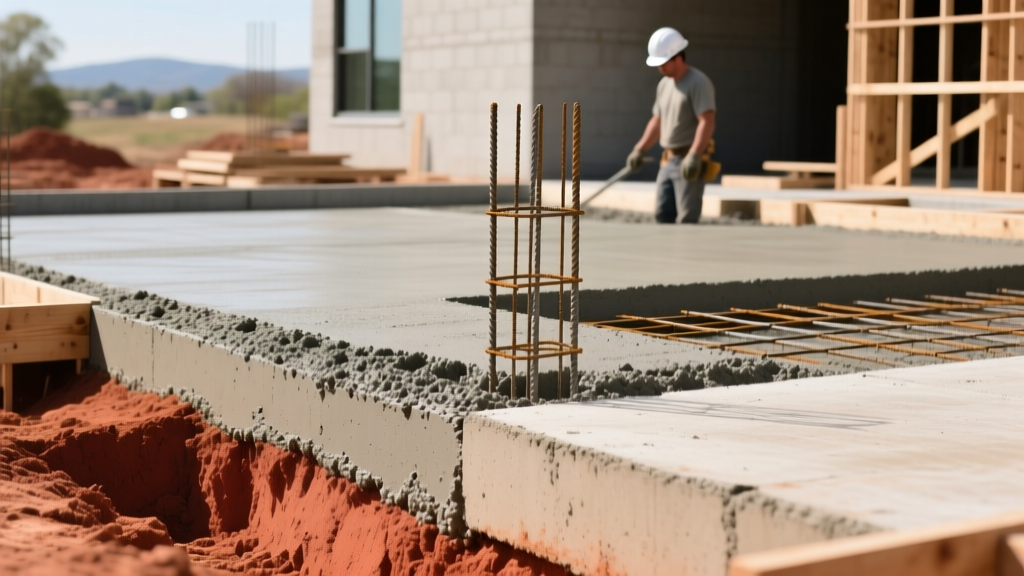
The most common cause of concrete failure in the Denver, NC area is not the mix design itself, but inadequate subgrade preparation. The native Cecil-Pacolet soil is highly expansive; it swells significantly when wet and shrinks during droughts. Pouring a slab directly on uncompacted red clay guarantees differential settlement and catastrophic cracking.
According to guidelines referenced by the Portland Cement Association (PCA), a proper subgrade requires the removal of topsoil and the installation of a 4-inch to 6-inch layer of Aggregate Base Course (ABC) or washed crushed stone. This layer must be mechanically compacted to 95% Proctor density. Furthermore, a minimum 10-mil polyethylene vapor barrier must be laid over the aggregate before placing the concrete to prevent moisture migration from the clay subgrade into the slab, which can ruin interior floor coverings and cause efflorescence.
2026 Concrete Mix & Cost Matrix for Denver, NC
Pricing in the Lake Norman and Lincoln County market reflects current fuel surcharges, aggregate availability, and labor costs. The table below outlines standard specifications and estimated costs for local ready-mix supply.
| Application | Target PSI | Slump / Air % | Est. Cost per Cubic Yard (2026) |
|---|---|---|---|
| Sidewalks & Patios | 3,000 PSI | 4" Slump / 0% Air | $135 - $145 |
| Driveways & Garage Slabs | 4,000 PSI | 4.5" Slump / 5% Air | $145 - $155 |
| Footings & Foundation Walls | 4,000 - 5,000 PSI | 5" Slump / 0% Air | $150 - $165 |
| Flowable Fill (CLSM) | 50 - 100 PSI | Self-Leveling | $110 - $125 |
Navigating Delivery Logistics and Hidden Fees
When coordinating concrete supply in Denver, NC, understanding batch plant logistics is just as critical as the mix design. Local suppliers enforce strict parameters to maintain profitability and fleet efficiency.
- Short-Load Fees: A standard ready-mix truck carries 8 to 10 cubic yards. If your project requires less than 8 yards (e.g., a small patio or hot tub pad), expect a short-load fee ranging from $50 to $85 per missing yard. For very small pours, consider mobile volumetric mixers or high-strength bagged concrete to avoid these penalties.
- Pump Truck Requirements: Many residential lots near Lake Norman feature steep slopes or limited access that prevent a standard 30-ton mixer truck from reaching the pour site. In these cases, a concrete pump truck is required. Budget an additional $900 to $1,200 flat fee, plus $50 to $70 per yard pumped.
- Washout and Environmental Compliance: Lincoln County enforces strict stormwater runoff regulations. Drivers must wash their chutes in designated washout pits or containers on-site. Never allow a driver to wash out into a storm drain or directly onto the red clay subgrade, as the high alkalinity of concrete washwater can result in severe EPA fines.
The Contractor’s Pre-Pour Specification Checklist
To ensure the material delivered matches your structural requirements, verify the following details on the batch ticket before the truck begins discharging:
- Verify the Mix ID: Cross-reference the ticket's mix design number with your approved structural engineering plans.
- Check the Water-Cement Ratio: Ensure the maximum w/c ratio does not exceed 0.45 for exterior flatwork or 0.40 for structural foundations. If the slump is too low, request the driver to add a superplasticizer (water reducer) rather than raw water.
- Confirm Air-Entrainment: If pouring exterior concrete between November and March, verify the air content is listed between 4% and 6% on the ticket.
- Monitor Transit Time: Check the batch time printed on the ticket. In hot weather, concrete should be discharged within 90 minutes of batching. If the truck was delayed in Highway 73 traffic, the load may need to be rejected or treated with a secondary retarder at the site.
By treating concrete not as a generic commodity, but as a highly engineered material tailored to the specific soil and climate conditions of the Denver, NC region, builders can eliminate costly callbacks, prevent structural cracking, and ensure the longevity of their foundations and flatwork.