Fiber Glass vs Concrete Pool: Mix Design and Material Durability
Compare fiber glass vs concrete pool materials. Explore shotcrete mix designs, compressive strength, and structural durability for backyard builds.
The Core Material Divide: Molded Polymer vs. Cementitious Matrix
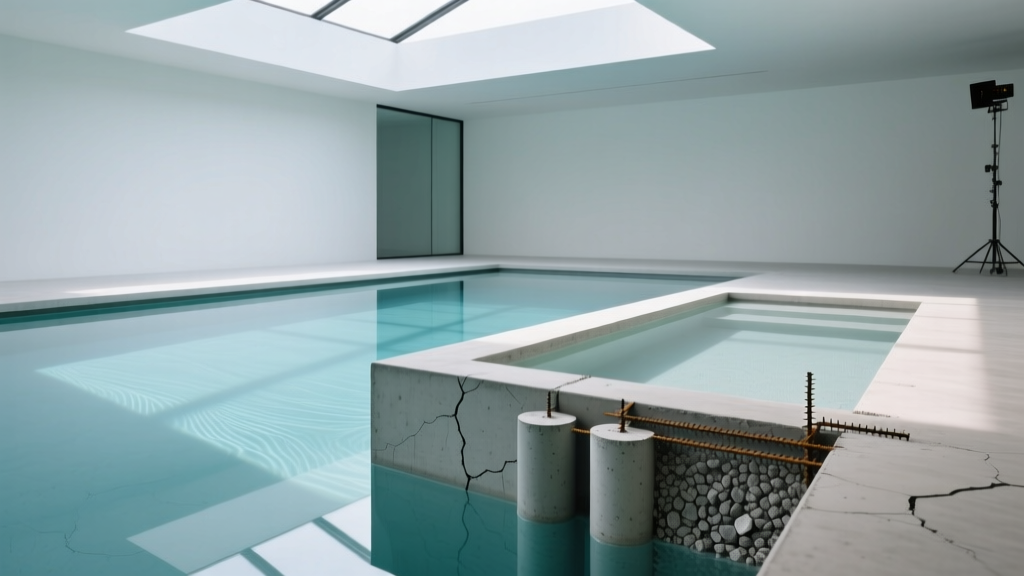
When evaluating a fiber glass vs concrete pool project, the decision ultimately hinges on the fundamental differences between a factory-cured polymer matrix and a site-applied cementitious composite. Fiberglass pools are manufactured using a layered composite of vinyl ester or isophthalic polyester resins reinforced with woven roving and chopped fiberglass strands. The structural integrity relies on the tensile strength of the glass fibers and the chemical resistance of the gelcoat, which typically measures 15 to 20 mils thick.
Conversely, a concrete pool shell is a rigid, compressive structure built on-site using pneumatically applied mortar or concrete (shotcrete or gunite). From a mix design perspective, the concrete pool is a highly engineered composite that requires precise proportioning of cement, aggregates, water, and chemical admixtures to achieve the necessary 4,000 to 5,000 psi compressive strength while minimizing permeability. Understanding the material science behind these two distinct building methods is critical for structural engineers, contractors, and homeowners planning a long-term aquatic investment in 2026.
Concrete Pool Mix Designs: Gunite vs. Shotcrete Specifications
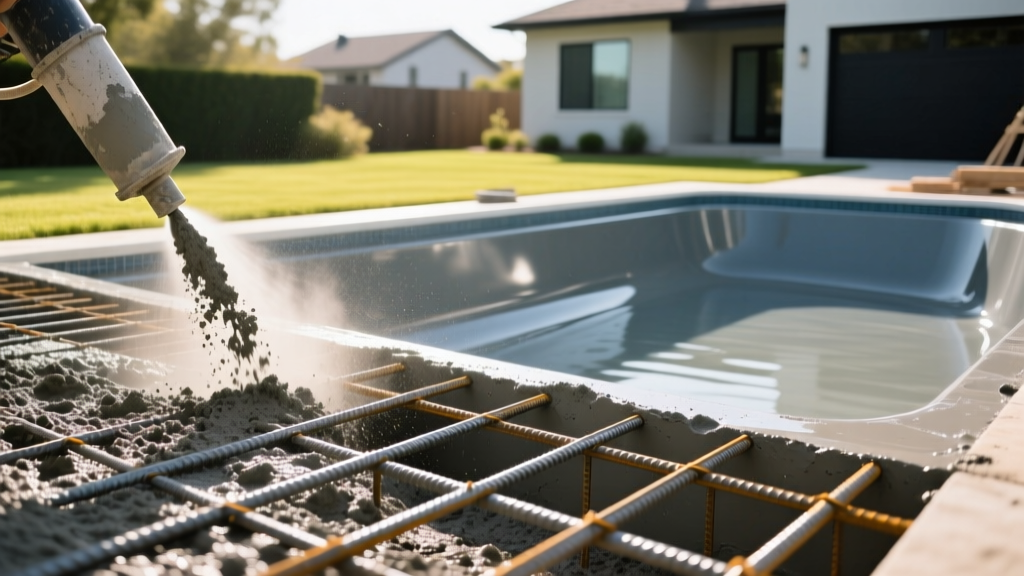
The terminology surrounding concrete pool construction often confuses buyers. 'Gunite' refers specifically to the dry-mix process, while 'shotcrete' generally refers to the wet-mix process, though both fall under the broader umbrella of pneumatically applied concrete. The mix designs for these two methods differ significantly in their water-cement (w/c) ratios, aggregate sizing, and rebound characteristics.
Dry-Mix (Gunite) Proportioning
In the dry-mix process, the cement and damp sand are pre-mixed and blown through a hose to the nozzle, where water is added. The nozzleman controls the w/c ratio in real-time. For pool shells, the target w/c ratio is strictly maintained between 0.40 and 0.45. A lower w/c ratio yields higher compressive strength (often exceeding 5,000 psi at 28 days) but increases rebound—the phenomenon where aggregate particles bounce off the rebar and form weak, porous pockets in the shell. Maximum aggregate size is typically limited to 3/8 inch to ensure smooth pneumatic flow.
Wet-Mix (Shotcrete) Proportioning
Wet-mix shotcrete involves batching all ingredients, including water and admixtures, at the plant or in a mobile volumetric mixer. The w/c ratio is locked in before pumping, typically targeting 0.42 to 0.45. Wet-mix designs allow for the inclusion of larger aggregates (up to 1/2 inch) and liquid admixtures that are difficult to introduce in dry-mix applications. According to guidelines maintained by the American Shotcrete Association, wet-mix shotcrete generally produces a more uniform compressive strength and significantly lower rebound rates (under 5%) compared to dry-mix gunite (which can see 10% to 15% rebound if poorly executed).
| Parameter | Dry-Mix (Gunite) | Wet-Mix (Shotcrete) | Fiberglass Composite |
|---|---|---|---|
| Cement Content | 700 - 800 lbs/yd³ | 650 - 750 lbs/yd³ | N/A (Resin Matrix) |
| Water-Cement Ratio | 0.40 - 0.45 (Nozzle controlled) | 0.42 - 0.45 (Batch controlled) | N/A |
| Max Aggregate Size | 3/8 inch | 1/2 inch | N/A |
| 28-Day Compressive Strength | 4,500 - 6,000 psi | 4,000 - 5,500 psi | N/A (Measured in Tensile/Flexural) |
| Typical Rebound Rate | 10% - 15% | 3% - 5% | 0% (Factory Molded) |
Structural Reinforcement: Steel Rebar vs. Fiberglass Strands
A concrete pool shell is essentially unreinforced masonry without its steel skeleton. Standard pool engineering requires a continuous grid of #3 or #4 (3/8" to 1/2") Grade 60 steel rebar, spaced 8 to 12 inches on center. The concrete provides the compressive strength, while the steel absorbs the tensile and shear forces exerted by hydrostatic pressure and soil expansion.
Pool water chemistry is inherently aggressive to embedded metals. If the concrete cover over the rebar is less than 2 inches, or if the mix design is too porous, chlorides from saltwater sanitization systems will penetrate the matrix. As detailed by the Portland Cement Association, once chlorides reach the steel, they break down the passive oxide layer, leading to expansive rust that spalls the concrete. Fiberglass pools, being entirely non-metallic in their structural shell, are completely immune to this specific failure mode.
To mitigate corrosion in concrete pools without switching to fiberglass, modern mix designs increasingly incorporate epoxy-coated rebar or synthetic macro-fibers. Adding polypropylene or macro-synthetic fibers at a dosage of 3 to 5 lbs per cubic yard does not replace structural rebar, but it significantly reduces plastic shrinkage cracking, thereby limiting the pathways for chloride ingress.
Permeability, Admixtures, and Long-Term Degradation
The primary vulnerability of a concrete pool is its permeability. Unlike a fiberglass shell, which is a monolithic, non-porous barrier, concrete is a capillary network. To transform a standard concrete mix into a watertight pool shell, specific supplementary cementitious materials (SCMs) and chemical admixtures are mandatory in 2026 mix designs.
- Silica Fume (Microsilica): Replacing 5% to 8% of the Portland cement by weight with silica fume is standard practice for wet-mix pool shotcrete. The ultra-fine particles fill the microscopic voids between cement grains, dramatically reducing permeability and increasing the bond strength to the steel rebar. It also acts as a rheological modifier, reducing rebound during pneumatic application.
- Hydrophobic Pore-Blocking Admixtures: These integral waterproofing agents react with the calcium hydroxide in the cement paste to form insoluble crystalline structures, effectively blocking capillary tracts.
- Superplasticizers (HRWR): High-range water reducers allow the batch plant to achieve high workability and pumpability in wet-mix shotcrete without increasing the water content, preserving the critical low w/c ratio required for high compressive strength.
Despite these admixtures, concrete pools require an interior finish—typically white marcite (plaster), quartz aggregate, or pebbleTec. The National Plasterers Council emphasizes that the interaction between the alkaline concrete shell (pH 12-13) and the interior plaster requires a strict 28-day curing and chemical startup protocol to prevent delamination and mottling. Fiberglass pools, by contrast, require no interior finish; the gelcoat is the finish, eliminating plaster dust, acid washes, and the need for resurfacing every 10 to 15 years.
Installation Timelines and Material Curing Windows
The curing kinetics of cementitious materials dictate the construction timeline of a concrete pool. After the shotcrete shell is applied, it must be kept continuously moist for a minimum of 7 days to ensure proper hydration and prevent plastic shrinkage cracking. The entire excavation, steel tying, plumbing, shotcrete application, and curing process typically spans 4 to 8 weeks before the interior plaster can even be applied.
Fiberglass pools bypass the curing window entirely. Because the structural polymer matrix is fully cured in a climate-controlled factory using catalysts and exothermic chemical reactions, the shell arrives on-site as a finished product. A fiberglass pool can be set into an excavated and gravel-prepared hole, backfilled, and filled with water in a matter of days. However, this speed comes at the cost of design flexibility; you are limited to the manufacturer's existing mold catalog, whereas a shotcrete mix can be sprayed into any custom geometric form.
Cost and Lifecycle Matrix
When analyzing the fiber glass vs concrete pool debate from a material and lifecycle cost perspective, the initial capital expenditure and long-term maintenance diverge sharply.
| Metric | Engineered Concrete (Shotcrete/Gunite) | Fiberglass Composite |
|---|---|---|
| Average Shell Material & Labor Cost | $75,000 - $110,000 | $45,000 - $75,000 |
| Total Project Cost (with decking/copings) | $120,000 - $200,000+ | $80,000 - $130,000 |
| Interior Resurfacing Interval | 10 - 20 years (Plaster/Pebble) | Never (Gelcoat lasts 25+ years) |
| Chemical Consumption | High (Alkaline shell buffers pH) | Low (Inert shell requires minimal balancing) |
| Susceptibility to Ground Movement | High (Rigid shell may crack) | Low (Flexible shell absorbs minor shifts) |
Expert Verdict: When to Specify Concrete Mixes Over Fiberglass
The choice between a fiber glass vs concrete pool is not merely aesthetic; it is a structural engineering decision. If the project demands a highly customized geometric footprint, an infinity edge, or integration with complex architectural hardscaping, a custom-proportioned wet-mix shotcrete shell is the only viable option. The ability to engineer the mix design with silica fume and synthetic fibers ensures the shell can handle the immense hydrostatic loads of deep-end profiles and complex cantilevered edges.
However, if the priority is rapid installation, minimal long-term chemical maintenance, and immunity to rebar corrosion in high-salinity environments, the factory-cured fiberglass composite offers superior lifecycle value. For contractors and engineers, specifying the correct concrete mix design—strictly controlling the w/c ratio, mandating low rebound, and ensuring adequate rebar cover—is the only way to ensure a concrete pool achieves the multi-decade durability that fiberglass provides by default.
Written by
Marcus ChenMarcus Chen is a licensed structural engineer (PE) and building materials analyst with over 12 years of experience across residential, commercial, and industrial construction. He holds a Master of Science in Civil Engineering from UC Berkeley and spent six years at Thornton Tomasetti before transitioning to independent consulting and technical writing. Marcus specializes in material selection for seismic-prone regions, concrete reinforcement strategies, and lifecycle cost analysis. His work has been cited by the American Concrete Institute (ACI) and the Structural Engineers Association of California (SEAOC). When he is not on a job site or at his desk, you will find him hiking the Sierra Nevada or restoring a 1920s craftsman bungalow in Oakland, CA.
More from Marcus Chen
View all
Construction Cost
How Much Did the Eiffel Tower Cost to Build?
How much did the Eiffel Tower cost to build in 1889? We adjust for inflation and compare its budget to modern skyscraper construction.
Aug 4, 2026

Fire Resistance
What Is a Fire Resistant Material? Testing & Certification Guide
Discover what is a fire resistant material through ASTM and UL testing. Learn how fire ratings, certifications, and assemblies work in construction.
Aug 4, 2026

Construction Cost
How Much Did the Burj Khalifa Cost to Build?
How much did the Burj Khalifa cost to build? We break down the $1.5B project and extract 5 money-saving strategies for your next build.
Jul 30, 2026