Stamped Concrete Patio Selection: Mixes and Patterns
Compare stamped concrete patio mixes, stamp patterns, and sealers. Expert guide on material taxonomy, psi ratings, and costs for durable outdoor slabs.
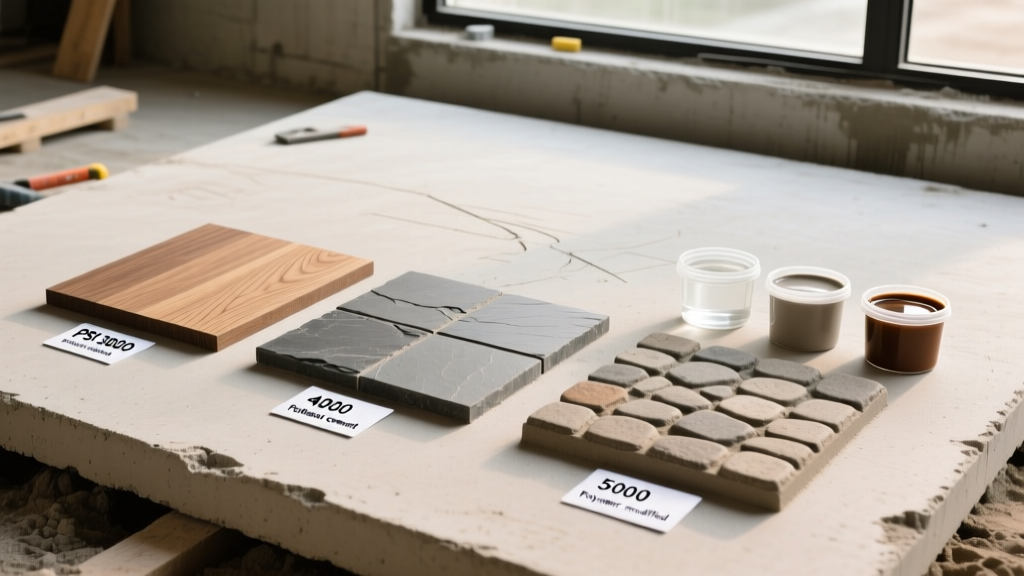
Selecting materials for a stamped concrete patio requires navigating a complex taxonomy of mix designs, coloration systems, and protective chemistries. Unlike standard flatwork, stamped slabs demand precise control over slump, air entrainment, and surface curing to accept deep-texture stamping mats without delamination or edge slumping. This guide breaks down the exact material specifications required for a durable, high-fidelity stamped concrete installation.
Base Concrete Mix Specifications for Stamped Slabs
The foundation of any stamped patio is the ready-mix concrete itself. Standard 3000 PSI driveway mixes are inadequate for deep-texture stamping because they lack the surface paste required to hold sharp grout lines. For stamped applications, specify a 4000 PSI air-entrained mix with strict water-cement (w/c) ratio controls.
| Parameter | Specification for Stamped Patios | Rationale |
|---|---|---|
| Compressive Strength | 4,000 PSI (28-day) | Provides sufficient early strength to resist surface scaling during stamping and sealing. |
| Water-Cement Ratio | 0.45 to 0.50 maximum | Prevents excessive bleed water, which dilutes surface color hardeners and causes mottling. |
| Slump | 4.0 inches (± 0.5 inch) | Higher slumps cause aggregate settlement and stamp mat sinking; lower slumps prevent mat impression. |
| Air Entrainment | 4% to 6% (Freeze-Thaw zones) | Creates microscopic voids to accommodate water expansion, preventing surface spalling in winter. |
| Aggregate Size | 3/4 inch maximum | Larger aggregates interfere with stamp mat edges, tearing the surface paste and ruining grout lines. |
According to the National Ready Mixed Concrete Association (NRMCA), requesting a mid-range water-reducing admixture (such as Euclid Chemical EUCON 37) at the batch plant allows the producer to achieve the necessary 4-inch slump without adding excess water, preserving the structural integrity of the surface paste.
Coloration & Release Agent Material Taxonomy
Color in stamped concrete is achieved through a two-part system: the base color and the contrasting antiquing release. Selecting the wrong combination leads to UV fading or poor stamp release.
Integral Color vs. Dry-Shake Color Hardener
Integral Color: Liquid or powder iron-oxide pigments added directly to the ready-mix truck. While it colors the slab all the way through (useful if the surface chips), it produces a flat, monochromatic look and does not increase surface abrasion resistance.
Dry-Shake Color Hardener: A broadcast-applied blend of cement, silica sand, and iron oxides troweled into the wet surface. This is the industry standard for high-end patios. It densifies the top 1/8 inch of the slab, increasing surface compressive strength to over 8,000 PSI while providing vibrant, UV-stable color.
Antiquing Release Agents
Release agents prevent the polyurethane stamp mats from bonding to the wet concrete. Powder releases (hydrophobic powders tinted with contrasting colors) are the most common, lodging in the grout lines to create an aged, variegated stone appearance. Liquid releases are used when a uniform, non-antiqued color is desired, though they require more aggressive washing post-cure.
Stamp Tooling: Mat Rigidity and Texture Depth
Stamping tools are categorized by their polyurethane durometer (hardness) and physical dimensions. A complete patio stamping set requires a mix of three tool types to navigate edges and obstacles.
- Rigid Mats (70-80 Durometer): Typically 3x3 feet. Used for the main field of the patio. Their stiffness allows workers to stand on them and stomp the texture deeply into the slab without bending.
- Floppy Mats (60 Durometer): Thinner, more flexible versions of the rigid mats. Essential for stamping within 12 inches of house foundations, retaining walls, or steps where a rigid mat cannot physically fit.
- Texture Skins (50 Durometer): Large, seamless sheets (often 4x6 feet) that impart only the surface texture (e.g., slate fissures) without deep grout lines. Used to blend seams between rigid mats and create a continuous, natural stone look.
Protective Sealer Chemistry and Selection Matrix
The sealer locks in the antiquing release and protects the color hardener from UV degradation and moisture intrusion. The Brickform technical library categorizes sealers by their resin chemistry, which dictates gloss level, breathability, and lifespan.
| Sealer Type | Resin Base | Gloss Level | Breathability | Best Use Case |
|---|---|---|---|---|
| Solvent-Based Acrylic | Styrene Acrylic | High Gloss (Wet Look) | Low | Maximum color enhancement; ideal for dark slate/cobblestone patterns in dry climates. |
| Water-Based Acrylic | Acrylic Polymer | Satin / Matte | High | Eco-friendly, low VOC; allows moisture vapor transmission, preventing white blush in humid zones. |
| Aliphatic Polyurethane | Polyurethane | Semi-Gloss | Medium | High abrasion resistance; required for patios with heavy outdoor dining furniture or high foot traffic. |
Critical Warning: Never apply a non-breathable solvent-based sealer over a slab that has not fully cured (minimum 28 days) or over a slab with a high moisture vapor emission rate (MVER). Trapped moisture will cause the sealer to turn opaque white (blushing) and delaminate.
Subgrade Preparation and Reinforcement Protocols
Stamped concrete is highly susceptible to differential settlement, which causes unsightly cracking that disrupts the stamped pattern. The subgrade must be excavated to a depth of 8 to 10 inches and backfilled with 4 to 6 inches of 3/4-inch minus crushed aggregate.
Compaction must reach 95% Standard Proctor density using a vibratory plate compactor. For reinforcement, macro-synthetic fibers (dosed at 3 to 5 lbs per cubic yard) are increasingly preferred over welded wire mesh (WWM). Fibers provide three-dimensional micro-crack control throughout the entire slab depth, whereas WWM only functions after a crack has already initiated. If using rebar, specify #4 (1/2-inch) epoxy-coated bars placed at 18 inches on center, elevated on 2-inch dobies to sit in the upper third of the 4-inch slab.
2026 Cost Estimates and Material Yields
Material and labor costs for stamped concrete patios vary by region, pattern complexity, and site accessibility. Below is a baseline cost matrix for a standard 400-square-foot patio installation.
| Material / Phase | Estimated Unit Cost (2026) | Total for 400 Sq Ft |
|---|---|---|
| Ready-Mix Concrete (4000 PSI) | $175 - $210 per cubic yard | $850 - $1,050 (approx. 5 yards) |
| Dry-Shake Color Hardener | $0.85 - $1.20 per sq ft | $340 - $480 |
| Antiquing Release & Sealer | $0.60 - $0.90 per sq ft | $240 - $360 |
| Labor (Prep, Pour, Stamp, Seal) | $10.00 - $16.00 per sq ft | $4,000 - $6,400 |
| Total Project Estimate | $13.60 - $20.75 per sq ft | $5,430 - $8,290 |
Troubleshooting Common Material Failures
Even with premium materials, improper execution leads to specific failure modes. Understanding the chemistry behind these failures is critical for material selection and site supervision.
Surface Delamination and Scaling
Cause: Finishing the surface while bleed water is still present, or over-troweling, which traps a thin layer of high w/c ratio paste at the surface. When the stamping mats are pressed in, this weak layer separates from the structural concrete below.
Prevention: Use a bull float immediately after screeding. Wait for the bleed water to completely evaporate before broadcasting the color hardener. Never add water to the surface during the troweling phase.
Efflorescence (White Powdery Residue)
Cause: Water-soluble calcium hydroxide migrates to the surface and reacts with atmospheric carbon dioxide. This is exacerbated by using calcium chloride accelerators in the mix design during cold weather pours.
Prevention: Explicitly ban calcium chloride accelerators in your ready-mix ticket. Specify non-chloride accelerators (like Master Builders POZZOLITH) if early strength is needed. Apply a penetrating silane/siloxane water repellent before the final acrylic sealer to block moisture migration.
Sealer Yellowing and UV Degradation
Cause: Using aromatic polyurethanes or low-grade acrylics that lack UV stabilizers. Aromatic resins break down under direct sunlight, turning the patio a sickly yellow-brown.
Prevention: Always specify aliphatic acrylics or aliphatic polyurethanes for exterior stamped concrete. Aliphatic resins are chemically engineered to resist UV bond cleavage, maintaining optical clarity for 2 to 3 years before a recoat is necessary.