Top Stamped Concrete Patterns & Mat Brands for 2026
Compare top stamped concrete patterns from Butterfield and Proline. Explore mat hardness, pricing, and structural installation tips for 2026.
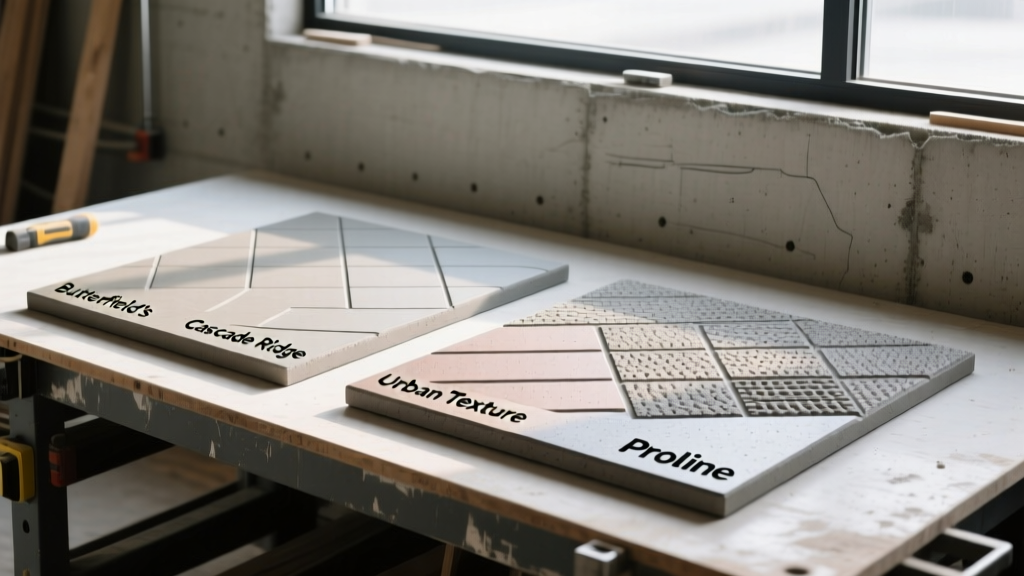
The Anatomy of a Premium Stamping Mat
The quality of stamped concrete patterns relies entirely on the elastomeric properties of the polyurethane mats used to transfer the texture. In 2026, professional-grade stamping tools are categorized by their Shore A hardness scale, which dictates how the mat behaves under the weight of the crew and the hydrostatic pressure of the plastic concrete.
- Rigid Mats (70-75 Shore A): These form the core of the stamping field. They are stiff enough to be tamped with a heavy hand or a tamp pole, transferring deep grout lines and sharp stone edges without distorting.
- Floppy Mats (60-65 Shore A): Used against vertical barriers, curbs, and walls where a rigid mat cannot bend. They transfer the pattern but require careful hand-tooling to define the joints.
- Texture Skins (50-55 Shore A): Thin, flexible sheets that impart surface texture (like slate or stone grain) without deep grout lines. Often used for seamless applications or to blend seams between rigid mats.
Cheap, imported mats often use lower-grade elastomers that lack UV stabilizers. When exposed to the highly alkaline environment of curing concrete and the abrasive nature of release agents, these inferior mats degrade, leading to torn edges and loss of micro-texture detail within a single season.
Brand Deep-Dive: Butterfield Color Perma-Texture Line
Butterfield Color remains a dominant force in the decorative concrete industry, and their Perma-Texture stamping mats are engineered for high-volume commercial and residential applications. Their molds are cast from actual natural stone and historical brick, ensuring organic randomization.
Key Patterns and Specifications
Two of their most specified patterns for 2026 are the Mayan and European Fan Cobblestone. The Mayan pattern features heavily fractured, irregular stone shapes that excel at hiding surface undulations in poorly graded substrates. The mats feature interlocking alignment pins that prevent "slippage" during the tamping phase.
Brand Deep-Dive: Proline’s Ashlar and Slate Series
Proline Concrete Products approaches stamped concrete patterns with a focus on modularity and seam-hiding. Their Ashlar Slate line is arguably the most replicated pattern in the industry, but Proline's original tooling features randomized grout line widths (varying from 1/4" to 5/8") that break up the visual grid, a common failure point in cheaper knock-off patterns.
According to industry data compiled by the Concrete Network, Ashlar and random stone patterns account for over 60% of residential stamped concrete installations due to their versatility in matching various architectural facades. Proline's Ashlar stamping mats utilize a proprietary polyurethane blend that offers a slightly softer "bite" on the concrete surface, allowing for excellent detail transfer even when the concrete slump is on the lower end (4 to 4.5 inches).
Pattern Selection Matrix: Matching Aesthetic to Structural Reality
Choosing a stamped concrete pattern is not purely an aesthetic decision; it dictates jointing strategies, slip resistance, and substrate preparation. The matrix below outlines critical performance metrics for top-tier patterns.
| Pattern Name / Brand | Nominal Grout Depth | Dynamic Coefficient of Friction (DCOF) | Control Joint Integration | Best Application Scenario |
|---|---|---|---|---|
| Ashlar Slate (Proline) | 3/8" - 1/2" | 0.52 (Wet) | Camouflaged in deep grout lines | Pool decks, high-traffic patios |
| Mayan Stone (Butterfield) | 1/2" - 3/4" | 0.58 (Wet) | Requires strategic saw-cutting | Driveways, heavy vehicular loads |
| Seamless Texture (Various) | 0" (Surface only) | 0.45 (Wet) | Saw-cut joints highly visible | Large commercial plazas, interiors |
| Running Bond Brick (Various) | 1/4" - 3/8" | 0.48 (Wet) | Grid-aligned, easy to hide | Walkways, traditional facades |
Note: A DCOF of 0.42 or higher is generally required for ADA compliance in commercial wet environments. Deeper patterns naturally yield higher slip resistance but require more aggressive cleaning maintenance to prevent debris accumulation in the grout lines.
Avoiding Critical Failure Modes in Pattern Stamping
Even with premium polyurethane mats, improper execution will ruin the visual continuity of the slab. Understanding the mechanical causes of common failures is essential for quality control.
The "Zipper" Effect and Misaligned Interlocks
The zipper effect occurs when the interlocking edges of the stamping mats fail to seat perfectly, creating a jagged, continuous line across the slab. This is rarely a mat defect; it is a timing and slump issue. If the concrete surface has crusted over due to wind or low humidity, the mat cannot penetrate deeply enough to engage the alignment pins. The Fix: Use a retarder spray on the surface to keep the top 1/4" of the concrete plastic, or adjust the batch design to include a mid-range water reducer to maintain workability without increasing the water-cement ratio.
Applying too much antiquing release powder creates a thick, impermeable barrier between the concrete and the eventual acrylic sealer. When the slab cures and undergoes thermal expansion, the sealer will delaminate and peel off in large sheets, taking the release color with it. Always sweep and blow off excess release agent thoroughly before sealing, and consider a light power-wash 24 hours post-stamping to remove surface dust.
Double-Stamping and Ghosting
Ghosting happens when a mat is lifted and inadvertently placed slightly offset from its original impression, creating a blurred, double-image effect. This occurs when the stamping crew works too far ahead of the finishing crew, and the concrete begins its initial set while the mat is still being tamped. Maintain a strict 10-foot maximum buffer between the bull-floating crew and the stamping crew.
2026 Pricing & Procurement Breakdown
Investing in a professional stamping mat set is a significant capital expenditure. Below is the current market pricing for a standard commercial-grade tooling set and the associated consumable chemicals required for a 1,000 square foot project.
| Item Category | Specification / Quantity | Estimated 2026 Cost |
|---|---|---|
| Rigid Stamping Mats | Set of 8 (3'x3' or 2'x3') | $2,800 - $3,400 |
| Floppy / Flex Mats | Set of 2 | $650 - $800 |
| Texture Skin | 1 Large (4'x4') | $350 - $450 |
| Antiquing Release Agent | Two 30lb pails (Covers 1,000 sq ft) | $130 - $160 |
| Solvent-Based Acrylic Sealer | 5 Gallons (2 coats, 1,000 sq ft) | $225 - $275 |
Sourcing and Long-Term Mat Maintenance
To maximize the lifespan of your polyurethane tools, never store them in direct sunlight or in the bed of a truck where they can be crushed by heavy equipment. After every use, clean the mats with a mild detergent and a soft-bristle brush—never use wire brushes or high-pressure washers, which will erode the microscopic stone grain texture. Lightly coat the mats with a silicone-based release spray before storing them in a flat, climate-controlled environment to prevent the polyurethane from drying out and cracking over the winter months.