Thinset Tile Mortar Calculator: Coverage & 2026 Costs
Calculate exact thinset tile mortar coverage and costs. Learn how trowel notch size, tile format, and mortar type impact your 2026 tiling budget.
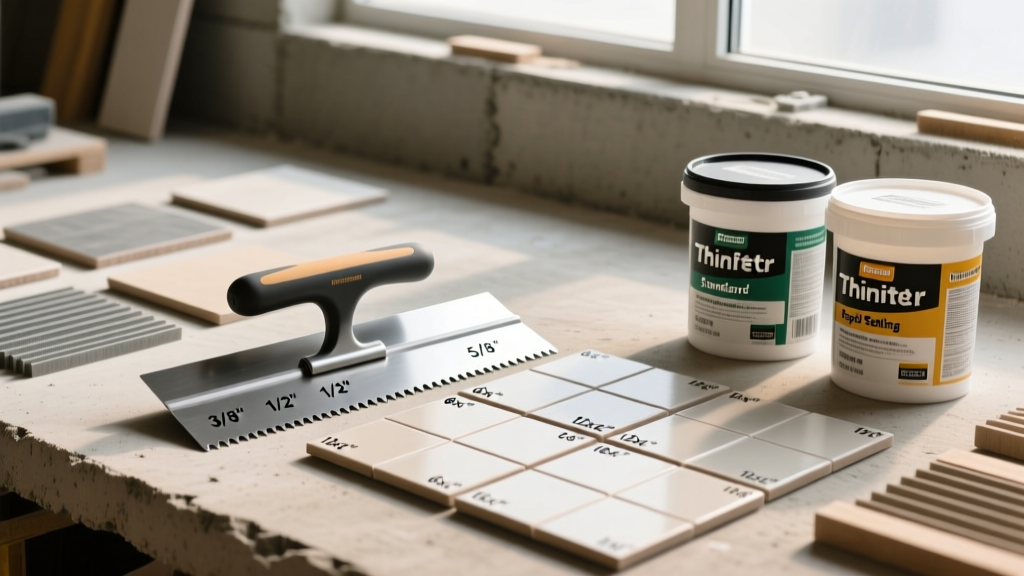
The Mathematics of Thinset Coverage
Accurately estimating thinset tile mortar is one of the most frequently miscalculated variables in residential and commercial tiling projects. Buying too little halts production and risks batch-to-batch color or chemical inconsistencies, while buying too much results in wasted capital and expired materials. Unlike dimensional lumber or drywall, thinset coverage is not a fixed constant; it is a dynamic variable dictated by substrate flatness, tile format, and the specific geometry of your trowel notch.
The Tile Council of North America (TCNA) mandates a minimum 80% mortar contact area for dry interior spaces, and 95% for wet areas or exterior installations. Achieving this contact ratio requires selecting the correct trowel notch to accommodate the natural warpage of modern porcelain and ceramic tiles. When you press a tile into the mortar, the ridges created by the notched trowel must collapse fully to eliminate air voids. If the notch is too small, you starve the bond; if it is too large, the excess mortar squeezes into the grout joints, creating a massive cleanup burden and wasting material.
Step 1: Match Tile Size to Trowel Notch and Coverage
The following table maps standard tile dimensions to the required trowel notch profile and the resulting estimated coverage per standard 50-pound bag of thinset tile mortar. These figures assume a perfectly flat substrate (within 1/8-inch over 10 feet). If your substrate requires spot-patching or leveling, increase your material estimate by 15% to 25%.
| Tile Format | Trowel Notch Profile | Est. Coverage (per 50lb Bag) | Application Notes |
|---|---|---|---|
| Mosaic to 4x4 inches | 1/4" x 1/4" x 1/4" Square | 70 - 85 sq. ft. | Standard wall applications, backsplashes. |
| 4x4 to 8x8 inches | 1/4" x 3/8" x 1/4" Square | 50 - 65 sq. ft. | Standard residential floors and shower walls. |
| 12x12 to 12x24 inches | 1/2" x 1/2" x 1/2" Square | 35 - 45 sq. ft. | Requires back-buttering for 95% contact in wet areas. |
| Large Format (15"+ on any side) | 3/4" U-Notch or 1/2" x 3/4" x 1/2" Square | 25 - 35 sq. ft. | Must use Large and Heavy Tile (LHT) mortar to prevent sag. |
Step 2: Calculate Base Area and Waste Factor
To calculate your baseline requirement, multiply the length by the width of your installation area. Once you have the gross square footage, you must apply a waste factor. For standard straight-set patterns on flat walls, add 10%. For diagonal patterns, herringbone, or complex cuts around plumbing fixtures, increase the waste factor to 15%. When installing large-format tile (LFT) that requires back-buttering (applying a flat layer of mortar to the back of the tile with the flat side of the trowel), you must add an additional 20% to 25% to your total thinset estimate, as back-buttering effectively doubles the mortar thickness.
2026 Thinset Mortar Cost Breakdown by Type
The cost of thinset tile mortar varies wildly based on its chemical composition. In 2026, supply chain stabilizations have normalized cement costs, but polymer additives used in modified mortars continue to command a premium. Choosing the wrong type of mortar is not just a financial mistake; it is a structural liability. For instance, using an unmodified mortar over a waterproofing membrane like Schluter-Kerdi voids the manufacturer's warranty and risks delamination.
| Mortar Classification | ANSI Standard | 2026 Avg. Cost (50lb Bag) | Primary Use Case |
|---|---|---|---|
| Unmodified (Dry-Set) | ANSI A118.1 | $16.00 - $22.00 | Installing impervious tiles over uncoupling membranes or fresh concrete slabs. |
| Modified (Polymer) | ANSI A118.4 / A118.11 | $28.00 - $42.00 | Standard porcelain, ceramic, and stone over cement backer board or drywall. |
| Large & Heavy Tile (LHT) | ANSI A118.15 (Improved) | $38.00 - $58.00 | Tiles with any side 15 inches or longer; prevents lippage and sag on vertical surfaces. |
| Rapid-Setting Modified | ANSI A118.4F | $45.00 - $65.00 | Commercial turnarounds or exterior work where freezing temperatures are imminent within 24 hours. |
Real-World Calculation Scenario: 200 sq. ft. Bathroom Floor
Let us apply these metrics to a practical scenario. You are tiling a 200-square-foot master bathroom floor using 12x24-inch porcelain tiles in a standard brick-joint (staggered) pattern. The substrate is a flat cement backer board.
- Identify Coverage Rate: A 12x24 tile requires a 1/2" x 1/2" x 1/2" square notch trowel. According to our matrix, coverage is approximately 40 sq. ft. per 50lb bag.
- Calculate Base Bags: 200 sq. ft. / 40 sq. ft. per bag = 5.0 bags.
- Apply Waste Factor: Because 12x24 tiles are prone to warpage and require back-buttering to achieve the TCNA-mandated 95% contact in a wet area, we apply a 25% waste and back-buttering multiplier. 5.0 bags x 1.25 = 6.25 bags.
- Determine Purchasing Volume: You must purchase 7 bags of mortar. (Never round down on thinset; running out mid-floor forces you to mix a new batch while the previous batch begins to skin over, creating cold joints and height discrepancies).
- Calculate Material Cost: Selecting a high-quality ANSI A118.15 LHT modified mortar (e.g., LATICRETE 4-XLT or Custom Building Products ProLite) at an average 2026 price of $48.00 per bag. 7 bags x $48.00 = $336.00 total thinset budget.
Hidden Costs and Failure Modes to Avoid
When building your estimation spreadsheet, thinset is rarely the only cementitious product required. Failing to account for substrate preparation is the number one reason tiling budgets overrun.
- Self-Leveling Underlayment (SLU): Modern large-format tiles require a substrate flatness of 1/8-inch over 10 feet. If your concrete slab or wood subfloor deviates beyond this, you must budget for SLU. A standard 50lb bag of SLU covers roughly 40-50 sq. ft. at a 1/8-inch depth and costs between $35 and $45, plus the cost of a mandatory primer ($40-$60 per gallon).
- Mortar Expiration and Storage: Thinset tile mortar contains water-soluble polymers that degrade when exposed to ambient humidity. A bag of modified thinset has a shelf life of exactly one year from the date of manufacture (printed on the bag). Never purchase discounted, expired mortar from big-box clearance bins; the polymers will have coagulated, resulting in a powdery, friable bond that will fail under foot traffic.
- The Slaking Period: Modified mortars require a 10-minute "slake" (rest) period after initial mixing, followed by a secondary remix without adding water. This allows the polymers to fully hydrate. Skipping this step to save time reduces the mortar's shear bond strength by up to 30%, leading to hollow-sounding tiles and eventual delamination.
- Pot Life Limitations: Standard modified thinsets have a pot life of 2 to 3 hours at 70°F (21°C). If you are working in high heat or low humidity, the pot life shrinks drastically. Estimate your mixing batches so that you only mix what you can trowel and embed within 45 minutes. Mortar that has begun to skin over in the bucket cannot be re-tempered with water; it must be discarded.
Industry Standards and Sourcing
Accurate estimation and proper material selection must always be anchored in current industry standards. The Tile Council of North America (TCNA) Handbook remains the definitive guide for substrate requirements, mortar selection based on environmental exposure, and deflection limits (L/360 for floors). Additionally, the National Tile Contractors Association (NTCA) Reference Manual provides exhaustive troubleshooting matrices for mortar failure modes, including efflorescence, plasticizer migration, and improper hydration.
When procuring materials for 2026 projects, prioritize manufacturers that publish transparent Technical Data Sheets (TDS) detailing exact ANSI compliance. Brands like MAPEI, LATICRETE, and Custom Building Products offer proprietary lightweight thinset formulations that reduce installer fatigue and increase coverage rates by up to 20% compared to traditional sand-heavy mortars, ultimately lowering the total cost of ownership despite a higher upfront per-bag price.