West Branch Concrete: Performance Ratings & Mix Specifications
Analyze West Branch concrete mix specifications, compressive strength ratings, air-entrainment, and freeze-thaw performance for regional construction.
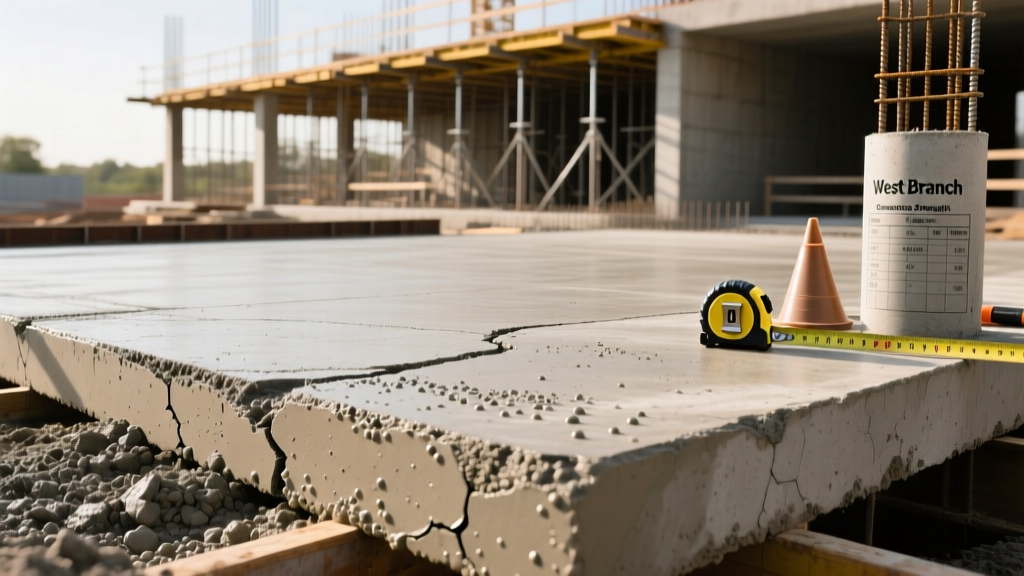
Decoding West Branch Concrete Performance Standards
When specifying ready-mix for projects in regions with severe seasonal temperature fluctuations, standard baseline mixes are insufficient. West Branch concrete performance ratings are engineered specifically to withstand the aggressive freeze-thaw cycles, de-icing salt exposure, and heavy load demands typical of Midwestern and Northern US climates. Understanding the exact mix designs, water-cementitious (w/cm) ratios, and air-void systems is critical for structural longevity.
Unlike generic commodity concrete, regional West Branch concrete formulations prioritize durability over sheer workability. The primary failure mode for flatwork and structural elements in these zones is surface scaling and internal micro-cracking caused by the expansion of freezing pore water. To combat this, local batch plants adhere to strict ACI Committee 201 durability guidelines, mandating precise air-entrainment and low permeability matrices.
Core Mix Specifications and ASTM Compliance
Performance is dictated by the batch plant's adherence to American Society for Testing and Materials (ASTM) standards. A high-performing West Branch concrete mix relies on ASTM C150 Type I/II Portland cement, ASTM C33 graded aggregates, and specialized chemical admixtures. Below is the standard specification matrix for regional ready-mix deliveries.
| Mix Designation | Target 28-Day Strength | Max w/cm Ratio | Slump Tolerance | Air Content | Primary Application |
|---|---|---|---|---|---|
| WB-3000 | 3,000 psi | 0.50 | 4.0 in. ± 1.0 | 5.0% ± 1.5% | Interior non-structural, footings |
| WB-4000 | 4,000 psi | 0.45 | 4.0 in. ± 1.0 | 6.0% ± 1.5% | Exterior flatwork, driveways, sidewalks |
| WB-5000 | 5,000 psi | 0.40 | 5.0 in. ± 1.0 | 6.5% ± 1.5% | Structural beams, heavy-duty industrial |
| WB-6000-HPC | 6,000 psi | 0.35 | 6.0 in. ± 1.5 | 7.0% ± 1.5% | Bridge decks, high-performance infrastructure |
Air-Entrainment and Freeze-Thaw Durability
The most vital performance rating for West Branch concrete is its freeze-thaw resistance, tested under ASTM C666. According to the Portland Cement Association, air-entraining admixtures (ASTM C260) create microscopic, disconnected air bubbles that act as expansion chambers for freezing water.
However, total air volume is only half the equation. The spacing factor—the maximum distance any point in the cement paste is from an air void—must be strictly controlled. For severe exposure conditions, the spacing factor must be less than 0.008 inches, and the specific surface area of the voids must exceed 24 square millimeters per cubic millimeter. If the batch plant's microscopic air-void analysis (ASTM C457) fails these parameters, the concrete will spall within three winters, regardless of its compressive strength.
Evaluating Compressive Strength vs. Workability
Contractors often face a trade-off between the structural engineer's demand for high compressive strength (low w/cm) and the finisher's demand for high workability (high slump). West Branch concrete suppliers utilize advanced polycarboxylate-based high-range water reducers (HRWR) to bridge this gap.
| Slump Rating | Workability Profile | Finisher Impact | Best Use Case |
|---|---|---|---|
| 3.0 Inches | Stiff / Low | Difficult to hand-finish; requires heavy vibration. Excellent for slip-form paving. | Curbs, gutters, steep slopes |
| 4.0 Inches | Moderate / Standard | Ideal for screeding and troweling. Holds edge well without bleeding. | Standard driveways, patios, flatwork |
| 6.0+ Inches | Fluid / High | Highly fluid; prone to segregation and excessive bleed water if not properly designed. | Heavily reinforced columns, deep walls |
Field Testing and Quality Control Protocols
Performance ratings are only theoretical until verified in the field. When a West Branch concrete truck arrives on-site, the QA/QC technician must execute three mandatory tests before the truck is cleared to pour.
- Slump Test (ASTM C143): Measures consistency. If the ticket calls for 4.0 inches and the test yields 6.5 inches, the load must be rejected or heavily discounted, as the w/cm ratio has likely been compromised.
- Air Content Test (ASTM C231): Uses a pressure meter to determine the total volume of entrained air. A reading below 4.5% on a WB-4000 exterior mix is grounds for immediate rejection in winter conditions.
- Cylinder Casting (ASTM C31): Technicians cast 4x8 inch or 6x12 inch cylinders for 7-day and 28-day break tests (ASTM C39). These cylinders must be cured in a temperature-controlled environment (60-80°F) to accurately reflect the mix's design strength, not the ambient weather conditions on the day of the pour.
2026 Pricing, Logistics, and Ordering Best Practices
As of 2026, the regional pricing for ready-mix concrete reflects both raw material volatility and stringent environmental compliance costs. Standard WB-4000 air-entrained mix typically ranges from $145 to $165 per cubic yard. However, logistical variables heavily influence the final ticket price.
- Short-Load Fees: Trucks carrying less than 8 cubic yards will incur a short-load surcharge, usually calculated at $40 to $60 per missing yard.
- Winter Heating Surcharges: From November through March, batch plants heat the mixing water and sometimes the aggregates to ensure the concrete arrives at a minimum placement temperature of 50°F. Expect a winter surcharge of $15 to $25 per cubic yard.
- Fiber Reinforcement: Adding macro-synthetic fibers (e.g., 1.5 lbs per cubic yard) for secondary shrinkage reinforcement will add approximately $12 to $18 per cubic yard to the base price.
The Perfect Batch Plant Order Ticket
To ensure you receive exactly what your structural drawings require, provide the batch plant dispatcher with this exact phrasing:
'I need 45 yards of WB-4000 exterior flatwork mix. Specify a maximum 0.45 w/cm ratio, 6.0% air-entrainment per ASTM C260, and a 4-inch slump. Please include 1.5 lbs of macro-synthetic fibers per yard, and do not use calcium chloride accelerators. Ensure the truck arrives with a minimum concrete temperature of 55°F.'
Long-Term Curing and Performance Realization
The highest-performing West Branch concrete mix will fail if curing protocols are ignored. The hydration process requires continuous moisture to develop the specified 28-day compressive strength and low-permeability surface. For exterior flatwork, apply a ASTM C309 compliant curing compound immediately after final finishing, or use wet burlap and polyethylene sheeting for a minimum of 7 days. In temperatures below 40°F, insulated curing blankets are mandatory to prevent the surface from freezing before it reaches 500 psi, the critical threshold required to resist internal frost damage.