How Much Does It Cost to Build an Aircraft Carrier? (2026 Guide)
Discover how much it costs to build an aircraft carrier, breaking down the $13B+ price tag, material costs, and the complex federal financing strategies used.
The Ultimate Mega-Project: Estimating Naval Supremacy
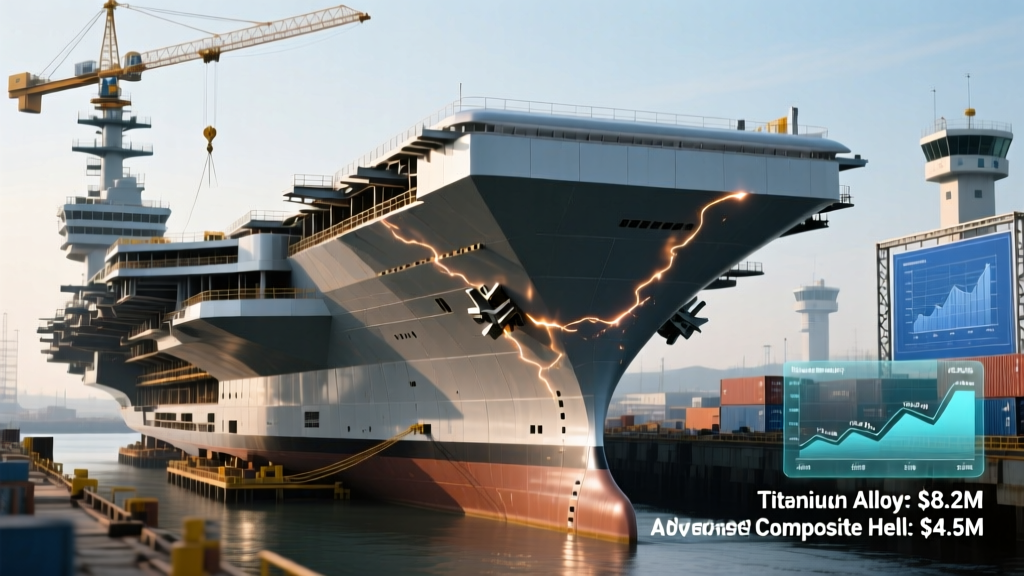
For construction cost estimators, quantity surveyors, and project finance professionals, the Gerald R. Ford-class aircraft carrier represents the absolute apex of the estimating discipline. When asking how much does it cost to build an aircraft carrier, you are not just looking at a building; you are analyzing a floating, nuclear-powered city that requires the coordination of over 5,000 subcontractors and the procurement of highly specialized, defense-grade materials. As of 2026, the procurement cost for a single Ford-class carrier (such as the CVN-81 Doris Miller) hovers between $12.4 billion and $13.3 billion. However, the raw construction estimate is only half the equation. Understanding the financing mechanisms, long-lead material sourcing, and lifecycle cost structures is critical for anyone studying mega-project economics.
2026 Baseline Cost Snapshot
Procurement Cost: $12.4B - $13.3B per hull
Research & Development (Amortized): ~$4.5B (spread across early class vessels)
Mid-Life Overhaul (RCOH): ~$5.5B
Total Estimated Lifecycle Cost: $32B+ over 50 years
Breaking Down the $13 Billion Construction Estimate
Unlike commercial skyscrapers where structural steel and concrete dominate the bill of quantities, an aircraft carrier's cost profile is heavily skewed toward advanced propulsion, electromagnetic systems, and combat integration. According to data tracked by the Congressional Research Service (CRS), the cost breakdown for a modern supercarrier reveals a heavy reliance on specialized technology rather than raw bulk materials.
| Cost Category | Estimated Allocation | Key Components & Materials |
|---|---|---|
| Hull & Structural | $3.2 Billion | 100,000+ tons of HSLA-80/100 steel, welding, dry dock fees |
| Nuclear Propulsion | $2.9 Billion | Two A1B nuclear reactors, steam turbines, shielding |
| Combat & Radar Systems | $2.4 Billion | DBR/AMDR radar arrays, CIWS, ESSM launchers, C4ISR |
| Launch & Recovery | $1.8 Billion | EMALS (Electromagnetic Launch), AAG (Advanced Arresting Gear) |
| Integration & Testing | $2.5 Billion | Systems engineering, sea trials, shock testing, crew training |
Material Realities: Beyond Standard Structural Steel
A standard commercial high-rise might use ASTM A992 steel. An aircraft carrier requires High-Strength Low-Alloy (HSLA) steel, specifically HSLA-80 and HSLA-100 grades, which offer superior yield strength and fracture toughness at low temperatures. The flight deck alone requires specialized steel alloys capable of withstanding the extreme thermal shock of jet exhaust and the kinetic impact of 60,000-pound aircraft landing at 150 mph. Sourcing this material is a bottleneck; only a handful of foundries globally possess the capacity to roll these specific naval-grade plates.
Financing a Megaproject: The Federal Appropriation Strategy
How does a client finance a $13 billion asset without bankrupting their annual operating budget? In the commercial sector, this would require a massive syndicated loan or sovereign wealth fund. For the U.S. Navy, the financing relies on a complex legislative mechanism known as Incremental Funding.
Under standard Department of Defense policy, a procurement must be 'fully funded' in a single fiscal year. However, because a single carrier would consume the entirety of the Navy's Shipbuilding and Conversion (SCN) account, Congress grants a special exception. The Congressional Budget Office (CBO) frequently analyzes this approach, noting that incremental funding allows the Navy to spread the procurement cost of a single hull over 6 to 8 fiscal years. This ensures that other vital shipbuilding programs, like the Virginia-class submarine or the Constellation-class frigate, are not entirely defunded.
Cost estimators working on defense mega-projects must account for the Nunn-McCurdy Act. If a major defense acquisition program's unit cost grows by more than 15% over the baseline estimate, it triggers a mandatory congressional review. If it breaches 25%, the program is automatically canceled unless the Secretary of Defense certifies that the project is essential to national security and new management structures are in place. Accurate initial estimating is not just about budget; it is about program survival.
Multi-Year Procurement (MYP) and Block Buys
To combat inflation and supply chain volatility, the Navy utilizes Multi-Year Procurement (MYP) contracts. By authorizing a 'Block Buy' of two carriers simultaneously (e.g., CVN-80 Enterprise and CVN-81 Doris Miller), the prime contractor, HII Newport News Shipbuilding, can leverage Economic Order Quantity (EOQ) pricing. Purchasing nuclear-grade forgings, massive turbine shafts, and specialized cabling in bulk for two ships rather than one yields savings of approximately $2.5 billion. For a cost estimator, this highlights the immense value of schedule-driven procurement strategies in mitigating long-lead material inflation.
The Hidden Back-End: Lifecycle and RCOH Costs
Novice estimators often stop at the delivery date. Expert estimators know that the handover is merely the end of the first financial phase. An aircraft carrier is designed for a 50-year service life. At the 25-year mark, the vessel must undergo a Refueling and Complex Overhaul (RCOH).
- Defueling & Refueling: Stripping out the spent nuclear cores and installing new ones (Cost: ~$1.5B)
- Systems Modernization: Upgrading legacy copper wiring to fiber optics, replacing legacy radar with modern AESA arrays, and updating HVAC systems. (Cost: ~$2.5B)
- Hull & Propulsion Maintenance: Replacing thousands of valves, pumps, and shaft bearings, and repainting the massive hull with advanced anti-fouling coatings. (Cost: ~$1.5B)
The RCOH takes approximately four years and costs roughly $5.5 billion in 2026 dollars. Furthermore, the eventual decommissioning and nuclear disposal of the vessel at the end of its 50-year lifecycle adds another $1.5 billion to the total cost of ownership, a figure that must be recognized in comprehensive lifecycle cost analyses.
Supply Chain Bottlenecks and Labor Constraints
The primary risk factor in carrier construction is not design, but the fragility of the tier-2 and tier-3 supplier base. According to the U.S. Navy Fact File, a carrier relies on a vast network of specialized vendors. If a single foundry that produces the main propulsion shaft forgings experiences a labor strike or a furnace failure, the critical path of the entire $13 billion project is delayed.
Labor is equally constrained. Building a carrier requires roughly 40,000 workers at peak construction, including nuclear-certified welders, specialized electricians, and marine architects. The geographic monopoly of Newport News Shipbuilding in Virginia as the sole shipyard capable of building and refueling supercarriers means there is no alternative commercial market to absorb these specialized workers during downtime, forcing the government to subsidize the labor base to maintain readiness.
Frequently Asked Questions (FAQ)
How does the cost of a U.S. carrier compare to international equivalents?
The U.S. Ford-class is uniquely expensive due to its nuclear propulsion and electromagnetic launch systems. By comparison, the UK's Queen Elizabeth-class carriers (conventional propulsion, ski-jump ramp) cost approximately $4 billion per hull. China's Fujian (conventional propulsion, EMALS) is estimated at $6 to $8 billion, though direct cost comparisons are difficult due to differing state-subsidized labor and material pricing models.
What is the most expensive single component on the ship?
While the hull requires the most raw material, the A1B nuclear propulsion plant and its associated shielding and steam generation systems represent the highest cost-per-pound ratio on the vessel, requiring exotic alloys and extreme precision manufacturing.
Can commercial shipyards build aircraft carriers to save money?
No. The security classifications, nuclear handling certifications, and specialized dry-dock infrastructure required to build a supercarrier are restricted. Furthermore, the shock-testing requirements (where the ship is subjected to underwater explosives to test system resilience) are unique to naval military standards and incompatible with commercial shipbuilding practices.
Written by
Sarah WhitfieldSarah Whitfield is a chartered quantity surveyor (MRICS) and construction cost analyst with 15 years of experience in material pricing, procurement strategy, and project budgeting. She earned her degree in Construction Management from the University of Reading (UK) and has worked on projects ranging from $2M custom homes to $180M mixed-use developments across North America and Europe. Sarah currently leads cost estimating for BuildMat Insight, maintaining a proprietary database of 4,000+ material price points updated quarterly. She is a frequent contributor to RSMeans cost data panels and has presented at the International Cost Engineering Council (ICEC) congress. Based in Denver, CO, Sarah is an avid trail runner and volunteer mentor for Women in Construction.
More from Sarah Whitfield
View all
Wood & Lumber
What Are the Different Types of Wood? A Builder's Guide
Compare structural softwoods, finish hardwoods, and engineered lumber. Analyze Janka ratings, MOE values, and 2026 pricing for construction.
Aug 4, 2026

Walls & Panels
Steel Framing vs Wood Framing: Corrosion and Moisture Defense
Compare steel framing vs wood framing for moisture resistance. Learn about galvanized coatings, condensation risks, and corrosion protection strategies.
Jul 21, 2026

Stone & Masonry
How to Cut Stone Veneer: Wet Saw vs Grinder Comparison
Compare the best tools for cutting stone veneer. We review wet saws, angle grinders, and chop saws to help you achieve clean, chip-free cuts.
Jul 21, 2026