AT&T Stadium Cost to Build: Money-Saving Lessons for Mega-Projects
Discover how the $1.3B AT&T Stadium cost to build was managed. Learn money-saving strategies like design-build, prefab steel, and PTFE roofing.
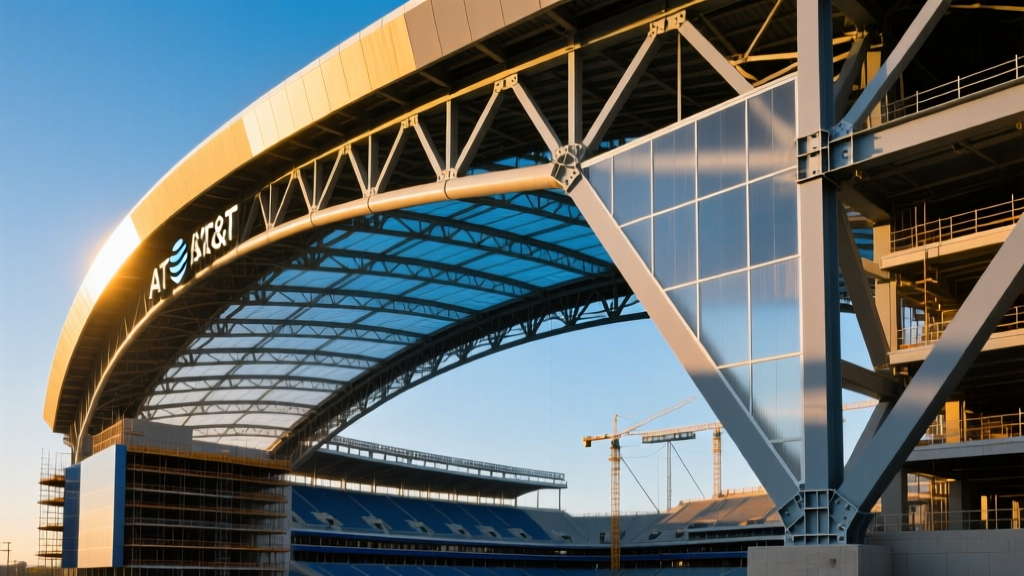
The True AT&T Stadium Cost to Build: Breaking Down the $1.3 Billion Mega-Project
When analyzing the economics of modern sports infrastructure, the AT&T Stadium cost to build remains a masterclass in large-scale capital management. Completed in 2009 in Arlington, Texas, the home of the Dallas Cowboys carried a base construction contract of $1.15 billion, with total project costs ultimately reaching $1.3 billion. Adjusted for modern material inflation, replicating this 3-million-square-foot behemoth today would easily exceed $2.2 billion.
However, the true value for construction estimators and commercial developers lies not in the sheer volume of capital deployed, but in the aggressive value engineering and money-saving strategies utilized to keep the project from ballooning out of control. By deconstructing the historical construction data of AT&T Stadium, mid-scale and mega-project estimators can extract actionable frameworks for material optimization, delivery methods, and structural load reduction.
Project Financial Snapshot
- Base Construction Contract: $1.15 Billion
- Total Project Cost (with site/financing): $1.3 Billion
- Total Enclosed Area: 3.0 Million Square Feet
- Structural Steel Tonnage: 30,000+ Tons
- Primary Delivery Method: Design-Build
4 Money-Saving Strategies Extracted from the Cowboys' Playbook
Mega-projects are notorious for cost overruns, frequently exceeding initial estimates by 20% to 40%. The AT&T Stadium build mitigated these risks through four specific construction management strategies.
1. Design-Build Delivery to Eliminate Change Orders
Traditional Design-Bid-Build (DBB) delivery methods on projects exceeding $100M routinely generate change orders accounting for 8% to 12% of the total contract value. These arise from discrepancies between the architect's drawings and the general contractor's field execution. To control the AT&T Stadium cost to build, the ownership group utilized a Design-Build (DB) delivery method, pairing HKS Inc. (architect) and Manhattan Construction Co. (general contractor) under a single unified contract.
This unified approach allowed for concurrent engineering. While the foundation piles were being driven, the superstructure steel was still being finalized. This overlap, known as fast-tracking, shaved an estimated 14 months off the critical path. In commercial construction, time is capital; reducing the financing carry costs by over a year saved tens of millions in interest payments alone.
2. Off-Site Prefabrication of the 30,000-Ton Steel Skeleton
The stadium's most iconic features are its twin 1,290-foot-long steel arches, which support the massive roof structure. Fabricating 1,225-ton arch segments in the air, hundreds of feet above the stadium floor, would have required exorbitant crane rental fees, extensive scaffolding, and high-risk labor premiums.
Instead, the construction team utilized extreme off-site prefabrication. The steel arches were assembled horizontally at ground level in massive sections. Once welded and bolted, they were hoisted into place using a synchronized strand-jack lifting system. This strategy reduced high-altitude steel erection labor by roughly 40% and minimized weather-related delays, a critical money-saving tactic for any project relying on heavy structural steel.
3. Material Value Engineering: The PTFE Fiberglass Roof
The original conceptual designs for the stadium's retractable roof considered heavy polycarbonate or glass panels. The engineering team pivoted to PTFE (polytetrafluoroethylene) coated fiberglass. According to official stadium architectural specifications, this membrane allows natural light to penetrate while blocking UV rays and heat.
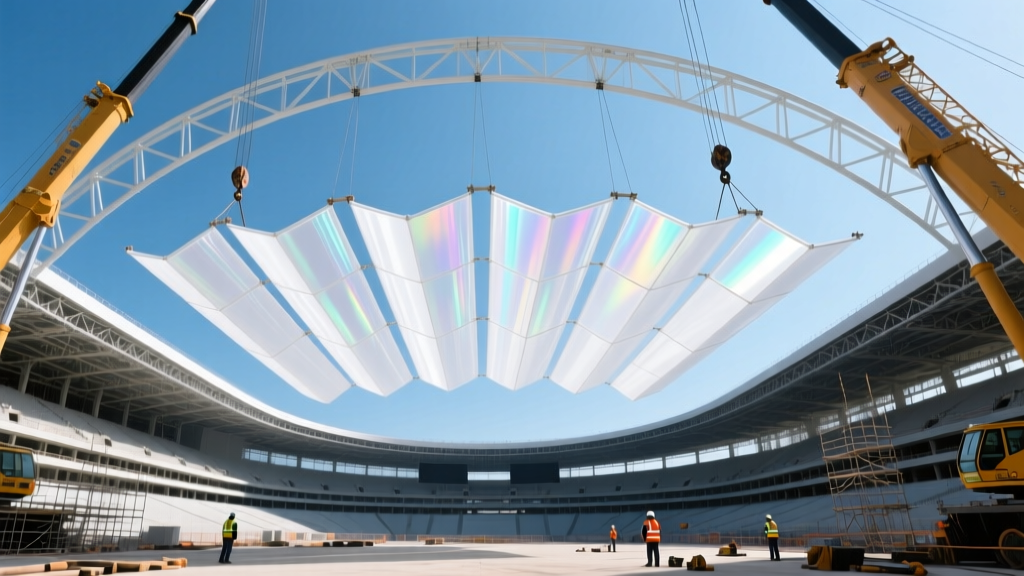
From a cost-estimating perspective, the financial genius of PTFE lies in its dead-load reduction. PTFE membrane weighs approximately 1/30th of traditional architectural glass. By drastically reducing the roof's dead load, the structural engineers were able to downsize the supporting steel trusses and reduce the footprint of the concrete foundation piers required to anchor the arches. This single material substitution saved an estimated $45 million in secondary structural steel and deep-foundation concrete costs.
4. Phased Site Logistics and Just-In-Time Delivery
The 140-acre site in Arlington presented severe logistical bottlenecks. Staging 30,000 tons of steel and 150,000 cubic yards of concrete simultaneously would have required leasing adjacent off-site staging yards, adding millions in double-handling and transport fees. The project management team implemented a Just-In-Time (JIT) delivery protocol, treating the site like a manufacturing assembly line. Materials arrived on flatbeds precisely as the tower cranes were ready to lift them, eliminating double-handling and reducing site security and inventory shrinkage costs.
Public-Private Financing: Shifting the Capital Burden
A critical, often overlooked aspect of the AT&T Stadium cost to build is the financial engineering that preceded the physical construction. The $1.3 billion price tag was not borne entirely by the private ownership. A robust Public-Private Partnership (P3) shifted a significant portion of the capital expenditure to the municipality, subsidized by end-users rather than local property taxpayers.
| Capital Source | Amount | Funding Mechanism |
|---|---|---|
| City of Arlington (Public) | $325 Million | 2% Hotel/Motel Tax, 10% Rental Car Tax, Sales Tax Rebate |
| Dallas Cowboys (Private) | $875 Million+ | Owner Equity, NFL G-3 Stadium Loan, Private Debt |
| Total Project Capitalization | $1.2+ Billion | Blended Public-Private Debt & Equity |
For commercial developers, the lesson is clear: before breaking ground, exhaust municipal tax increment financing (TIF), opportunity zone grants, and infrastructure rebates. Shifting 20% of your site-work and utility costs to local economic development grants directly protects your private equity margins.
Applying Mega-Project Savings to Mid-Scale Commercial Builds
You do not need a $1.3 billion budget to apply the value engineering principles that controlled the AT&T Stadium cost to build. Mid-scale commercial developers (projects in the $10M to $50M range) can adapt these frameworks immediately:
- Adopt Design-Build for Fast-Track Schedules: If you are building a 100,000 sq. ft. distribution center, utilize a design-build contract. Overlapping the site-grading phase with the finalization of the structural steel shop drawings can reduce your construction loan interest carry by 3 to 5 months.
- Specify Tensile Membranes for Atriums and Skylights: Instead of heavy structural glass for commercial atriums or canopy walkways, specify PTFE or ETFE (ethylene tetrafluoroethylene) foil cushions. You will drastically reduce the required steel tonnage for the supporting glulam or steel trusses.
- Mandate Ground-Level Assembly: When estimating roofing or HVAC equipment installation, price out the cost of renting a heavy-duty mobile crane for two days to lift fully assembled rooftop units (RTUs) or pre-fabricated duct runs, versus the labor cost of piecing them together at elevation over three weeks.
- Implement JIT Staging on Tight Urban Lots: If building on an infill urban site where laydown space is zero, negotiate JIT delivery windows with your concrete batch plant and steel fabricator. Factor the premium for coordinated logistics into your estimate, as it will be offset by the elimination of off-site staging yard leases and double-handling labor.
Estimator's Insight: The greatest cost overruns on complex structures do not come from material price spikes; they come from spatial conflicts during assembly. Investing 1.5% of your total budget in advanced 3D BIM (Building Information Modeling) clash detection prior to procurement will yield a 5% to 8% savings in field rework and steel modification change orders.
Frequently Asked Questions
How much would it cost to build AT&T Stadium today?
Factoring in the 2026 construction cost index, inflation in structural steel, concrete, and specialized labor, replicating the exact 3-million-square-foot AT&T Stadium today would cost an estimated $2.2 billion to $2.5 billion. Recent NFL stadiums, such as SoFi Stadium in Los Angeles, have pushed the ceiling for luxury sports venues past the $5 billion mark.
What was the most expensive single component of the stadium?
The structural steel superstructure, specifically the twin 1,290-foot arches and the complex node connections required to support the retractable roof mechanism, represented the largest single material and labor expenditure, consuming over 30,000 tons of steel.
Did the retractable roof add significantly to the AT&T Stadium cost to build?
Yes. A fixed roof would have been substantially cheaper. The mechanized track systems, heavy-duty motorized bogies, and the reinforced steel required to handle the dynamic moving loads of the 34,000-square-foot retractable panels added an estimated $50 million to $75 million to the overall structural budget.
Written by
Marcus ChenMarcus Chen is a licensed structural engineer (PE) and building materials analyst with over 12 years of experience across residential, commercial, and industrial construction. He holds a Master of Science in Civil Engineering from UC Berkeley and spent six years at Thornton Tomasetti before transitioning to independent consulting and technical writing. Marcus specializes in material selection for seismic-prone regions, concrete reinforcement strategies, and lifecycle cost analysis. His work has been cited by the American Concrete Institute (ACI) and the Structural Engineers Association of California (SEAOC). When he is not on a job site or at his desk, you will find him hiking the Sierra Nevada or restoring a 1920s craftsman bungalow in Oakland, CA.
More from Marcus Chen
View all
Construction Cost
How Much Did the Eiffel Tower Cost to Build?
How much did the Eiffel Tower cost to build in 1889? We adjust for inflation and compare its budget to modern skyscraper construction.
Aug 4, 2026

Fire Resistance
What Is a Fire Resistant Material? Testing & Certification Guide
Discover what is a fire resistant material through ASTM and UL testing. Learn how fire ratings, certifications, and assemblies work in construction.
Aug 4, 2026

Construction Cost
How Much Did the Burj Khalifa Cost to Build?
How much did the Burj Khalifa cost to build? We break down the $1.5B project and extract 5 money-saving strategies for your next build.
Jul 30, 2026