Average Cost for Materials to Build a House: 2026 Breakdown
Discover the 2026 average cost for materials to build a house. Get a detailed breakdown of framing, roofing, MEP, and interior finish pricing.
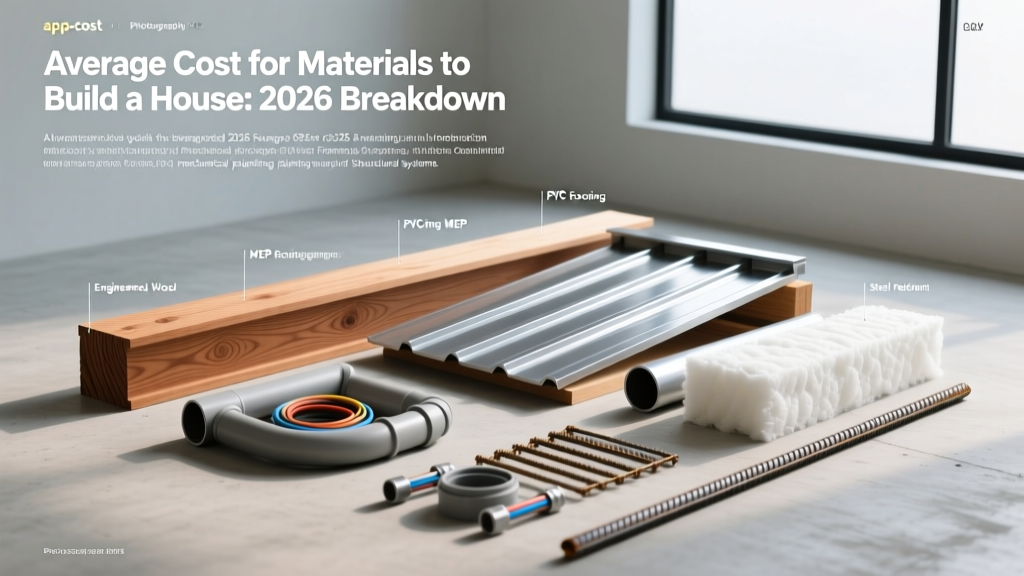
The 2026 Material Cost Baseline for Residential Construction
Calculating the average cost for materials to build a house requires moving beyond outdated per-square-foot rules of thumb. In 2026, material expenses represent approximately 45% to 50% of total hard construction costs, with labor and overhead absorbing the remainder. According to the National Association of Home Builders (NAHB), the national baseline for material costs on a standard 2,000-square-foot, single-family home currently ranges from $110,000 to $160,000. This translates to $55 to $80 per square foot for materials alone, excluding land, permits, and labor.
However, this average masks extreme variances between structural shells and interior finishes. To build an accurate budget, general contractors and owner-builders must deconstruct the bill of materials by trade phase, accounting for 2026 supply chain realities and updated building code requirements.
- Foundation & Flatwork: $14,000 – $22,000
- Framing Lumber & Sheathing: $28,000 – $42,000
- Exterior Envelope & Roofing: $22,000 – $38,000
- MEP (Mechanical, Electrical, Plumbing) Rough-In: $18,000 – $26,000
- Interior Finishes & Trim: $28,000 – $65,000+
Foundation and Framing: Where the Budget Anchors
Concrete and Slab Specifications
Ready-mix concrete prices have stabilized compared to the peaks of the early 2020s, but regional aggregate shortages still cause localized spikes. For a standard monolithic slab or stem-wall foundation, expect to pay $145 to $165 per cubic yard for a 3,000 PSI mix delivered to the site. Upgrading to a 4,000 PSI mix with synthetic fiber mesh reinforcement—highly recommended for driveway aprons and garage slabs to prevent micro-cracking—adds approximately $12 to $18 per cubic yard. Rebar (#4 or #5 grade 60) currently averages $0.85 to $1.10 per linear foot.
Structural Framing Matrix: Wood vs. Cold-Formed Steel
While dimensional lumber remains the dominant framing material, the Bureau of Labor Statistics Producer Price Index continues to show volatility in softwood lumber markets. Many builders in high-wind or termite-prone regions are pivoting to cold-formed steel (CFS). Below is a comparative breakdown of material costs for a 2,000-square-foot exterior and interior framing package:
| Material Category | Wood Framing (#2 SPF / Douglas Fir) | Cold-Formed Steel (16-Gauge) |
|---|---|---|
| Exterior Walls (2x6 vs 6" Stud) | $8,500 – $11,000 | $10,500 – $13,500 |
| Floor Joists (I-Joists vs C-Joists) | $6,200 – $8,000 | $7,800 – $9,500 |
| Roof Trusses | $9,000 – $14,000 | $12,500 – $17,000 |
| Sheathing (OSB vs Steel Decking) | $4,500 – $6,000 | $5,500 – $7,500 |
| Total Framing Package | $28,200 – $39,000 | $36,300 – $47,500 |
Exterior Envelope and Roofing Material Breakdown
The exterior envelope dictates both the aesthetic curb appeal and the long-term thermal performance of the structure. The Department of Energy Building Technologies Office emphasizes that investing in higher-R-value sheathing and advanced weather barriers yields significant lifecycle energy savings.
| Envelope Component | Standard / Builder-Grade Material | Premium / High-Performance Material |
|---|---|---|
| Siding | Vinyl (Dutch Lap): $2.50 - $4.00 / sq ft | James Hardie Fiber Cement: $6.50 - $9.50 / sq ft |
| Roofing | 3-Tab Asphalt Shingles: $1.10 - $1.50 / sq ft | 24-Ga Standing Seam Metal: $10.00 - $15.00 / sq ft |
| House Wrap | Standard Tyvek: $0.60 - $0.85 / sq ft | Fluid-Applied Membrane: $1.25 - $1.80 / sq ft |
| Windows | Double-Pane Vinyl (Low-E): $280 - $450 each | Triple-Pane Fiberglass: $650 - $950 each |
Interior Finishes: The Highest Variance Category
Interior finishes represent the largest variable in the material budget. A builder-grade finish package can cost as little as $14 per square foot, while custom selections can easily exceed $45 per square foot.
Drywall and Insulation
Standard 1/2-inch gypsum board (e.g., USG Sheetrock UltraLight) costs roughly $0.45 to $0.60 per square foot for the material. Upgrading to sound-dampening board (e.g., QuietRock 510) for media rooms or shared bedroom walls increases material costs to $1.60 to $2.10 per square foot. For insulation, open-cell spray foam averages $0.55 to $0.75 per board foot, while closed-cell 2lb foam (R-7 per inch) ranges from $1.30 to $1.65 per board foot.
Flooring and Millwork
Luxury Vinyl Plank (LVP) with a 20-mil wear layer remains the dominant choice for mid-tier builds, with material costs holding steady between $2.80 and $4.50 per square foot. Engineered hardwood (3/4-inch, 4-inch plank) ranges from $7.50 to $12.00 per square foot. Baseboards and casing (MDF primed) cost $1.10 to $1.80 per linear foot, whereas solid poplar or oak millwork jumps to $3.50 to $6.00 per linear foot.
Supply Chain Warning: Custom cabinetry and specialized architectural windows currently carry 12- to 16-week lead times in 2026. Order these materials before the foundation is even poured to prevent dry-in delays.
MEP Rough-In Materials: PEX, Copper, and Load Centers
Mechanical, Electrical, and Plumbing (MEP) materials are highly regulated and subject to strict code compliance, leaving little room for cost-cutting without compromising safety.
- Plumbing: Type L Copper remains the premium standard but costs $4.50 to $7.00 per linear foot. The industry standard has largely shifted to PEX-A (e.g., Uponor AquaPEX), which costs $1.10 to $1.60 per linear foot and requires fewer fittings due to its expansion properties.
- Electrical: A 200-Amp main breaker panel (e.g., Square D Homeline or Siemens) costs $350 to $550. Romex SIMpull (12/2 AWG) averages $0.85 to $1.15 per linear foot. Smart home infrastructure, such as Cat6A ethernet and conduit runs for future EV chargers, adds $1,200 to $2,500 in raw materials.
- HVAC: A standard 16 SEER2, 3-ton central heat pump system (equipment only, excluding ductwork) ranges from $3,800 to $5,200. Upgrading to a multi-zone mini-split system (e.g., Mitsubishi Hyper-Heat) increases equipment costs to $7,500 – $11,000.
Strategic Sourcing Framework to Mitigate Volatility
To protect your budget against mid-build price fluctuations, apply this conditional sourcing framework:
- If framing lumber is spiking: Switch exterior wall assemblies to 2x4 studs with 2 inches of continuous exterior rigid foam insulation (XPS or Polyiso). This meets modern energy codes while reducing the volume of dimensional lumber required.
- If roofing lead times are delayed: Utilize synthetic roofing underlayment (e.g., GAF FeltBuster) which can be left exposed to UV for up to 6 months without degrading, allowing you to dry-in the house and proceed with interior work while waiting for the primary shingle delivery.
- If concrete prices surge locally: Evaluate post-tensioned slab designs. Post-tensioning requires specialized steel cables but reduces the total volume of concrete and rebar needed by up to 20%, often resulting in net savings despite the specialized engineering costs.
Written by
David NakamuraDavid Nakamura is a licensed architect (AIA) and construction technology writer focused on sustainable building methods, mass timber engineering, and high-performance building envelopes. He holds a Master of Architecture from the University of Washington and is a certified Passive House Consultant (CPHC). David spent eight years at the Seattle firm Mithun, where he led the design of three LEED Platinum projects, before founding his own practice specializing in net-zero residential design. He serves on the editorial advisory board of GreenBuilder Magazine and has authored peer-reviewed papers on cross-laminated timber (CLT) connections for the Journal of Structural Engineering. In his spare time, David teaches woodworking at Pratt Fine Arts Center and kayaks the Puget Sound.
More from David Nakamura
View all
Construction Cost
Labor Cost to Build a Deck Per Sq Ft: 2026 Installation Guide
Discover the exact labor cost to build a deck per sq ft in 2026. This installation guide breaks down contractor rates, complexity factors, and hidden fees.
Aug 4, 2026

Construction Cost
How Much Does It Cost to Build a 3 Bedroom House? Financing Guide
Learn exactly how much it costs to build a 3 bedroom house and explore 2026 financing options, construction loan types, and budget frameworks for your build.
Aug 4, 2026

Construction Cost
Cost to Build a Tennis Court: 2026 Guide
How much does it cost to build a tennis court in 2026? Breakdowns for asphalt, concrete, and synthetic surfaces plus fencing and lighting.
Jul 30, 2026