Avg Cost to Build a Home: 2026 Budget Planning Guide
Discover the avg cost to build a home in 2026. This budget planning guide breaks down hard costs, soft costs, and regional pricing to prevent overruns.
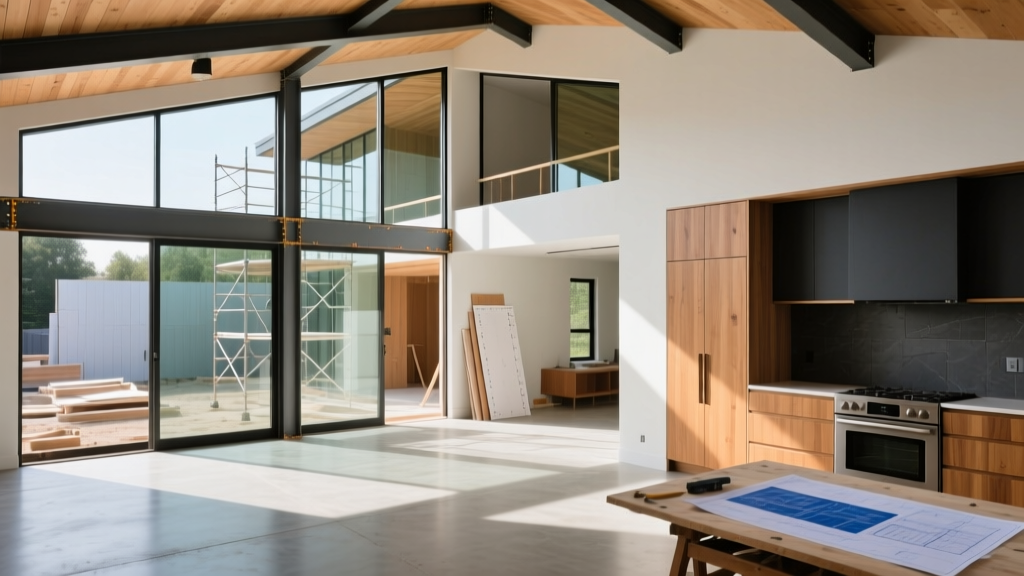
The Reality of the Avg Cost to Build a Home in 2026
Calculating the avg cost to build a home requires moving beyond national averages and dissecting the specific variables of your build site, design complexity, and local labor market. In 2026, the national baseline for a production-grade, single-family residence sits between $155 and $225 per square foot. For fully custom architectural homes, that figure scales to $300 to $550+ per square foot. For a standard 2,400-square-foot home, expect total hard construction costs to range from $372,000 to $540,000, strictly excluding land acquisition and site development.
- Median Lot Cost: $75,000 - $120,000
- Median Soft Costs: $45,000 - $65,000
- Median Hard Costs: $415,000 - $480,000
- Total Median Project Cost: $535,000 - $665,000
Hard Costs vs. Soft Costs: Where Your Money Actually Goes
Budget planning fails when owner-builders only account for lumber, concrete, and fixtures. Soft costs routinely consume 15% to 25% of the total project budget. Failing to line-item these expenses is the primary reason construction loans run dry before the drywall phase begins.
Material & Labor Breakdown (The Hard Costs)
Hard costs represent the physical structure. According to data tracked by the National Association of Home Builders (NAHB), the allocation of hard costs follows a predictable matrix, though material volatility can shift these percentages by 2-4% annually.
| Construction Phase | % of Hard Costs | Est. Cost (per sq. ft.) | Key 2026 Variables |
|---|---|---|---|
| Site Work & Foundation | 12% - 15% | $18 - $28 | Expansive clay soils requiring engineered piers |
| Framing & Exterior Shell | 18% - 22% | $30 - $45 | Engineered lumber (LVL/I-joist) supply constraints |
| Major Systems (MEP) | 14% - 18% | $22 - $35 | Heat pump mandates and electrical panel upgrades |
| Interior Finishes | 25% - 30% | $40 - $65 | Cabinet tier selection and flooring material |
| Roofing & Waterproofing | 6% - 8% | $10 - $16 | Synthetic underlayment and architectural shingles |
The Hidden Soft Costs That Derail Budgets
Soft costs are the administrative, legal, and engineering fees required to legally execute the build. These must be paid upfront or rolled into your construction loan draw schedule:
- Geotechnical Soil Borings ($1,800 - $3,200): Skipping this to save $2,000 routinely results in $40,000 foundation change orders when excavators hit undocumented bedrock or high water tables.
- Municipal Impact Fees ($2,000 - $15,000): Charged by local governments to offset the strain on public infrastructure (schools, roads, fire services). These vary wildly by ZIP code.
- Utility Tap Fees ($3,000 - $9,000): The cost to physically connect your site to municipal water and sewer lines. If well and septic are required, expect $15,000 - $25,000 for engineering, permitting, and drilling.
- Architectural & Engineering (5% - 10% of hard costs): Structural engineering stamps, energy compliance modeling, and custom blueprint drafting.
Regional Pricing Variations: Geography Dictates Price
The avg cost to build a home fluctuates aggressively based on your region. Local building codes dictate material requirements, and regional unionization levels dictate labor rates. Data from the U.S. Census Bureau New Residential Construction reports consistently highlight these geographic disparities.
2026 Regional Cost Multipliers
- Northeast (1.15x - 1.25x Multiplier): High union labor density, strict energy codes requiring triple-pane windows, and deep frost lines requiring 4-foot+ foundation footings.
- West Coast (1.20x - 1.40x Multiplier): Seismic strapping requirements, wildfire-resistant exterior materials (fiber cement, metal roofing), and severe labor shortages.
- Midwest (0.90x - 0.95x Multiplier): Favorable labor markets, flat topography reducing site-work costs, and readily available regional timber.
- South (0.85x - 1.05x Multiplier): Slab-on-grade foundations eliminate deep footing costs, though coastal zones require expensive hurricane tie-downs and impact-rated glass.
Financing and Carrying Costs: The Overlooked Budget Killers
When calculating the avg cost to build a home, most budgets omit the cost of money. Construction loans operate differently than traditional mortgages. You only pay interest on the money drawn to date, but those interest payments can accumulate rapidly during a 9-to-14-month build cycle.
If your total hard and soft costs equal $500,000, and your construction loan carries an 8.5% interest rate, you will pay approximately $21,250 in interest over a 12-month build. Furthermore, you must budget for loan extension fees ($500 - $1,500 per month) if weather delays or contractor scheduling pushes your build past the original 12-month maturity date. Always budget 100% of the estimated interest carry as a distinct line item in your initial pro forma.
Budget Planning Framework: The 20% Contingency Rule
Never finalize a construction loan without a dedicated contingency fund. The industry standard for tract builders is 5-10%, but for complex custom sites or first-time owner-builders, a 20% contingency is mandatory. This is not 'extra money' to spend on upgraded countertops; it is an insurance policy against site anomalies and material spikes.
Step-by-Step Contingency Deployment Strategy
- Phase 1: Earthwork (Months 1-2): Hold 40% of your contingency in reserve. Excavation is where the most expensive unknowns (bedrock, underground springs, buried debris) are discovered.
- Phase 2: Dry-In (Months 3-5): Hold 30% in reserve. Weather delays and lumber market fluctuations typically occur here.
- Phase 3: MEP & Finishes (Months 6-10): Hold 30% in reserve. Backordered appliances, custom cabinet measurement errors, and subcontractor rework happen in the final stretch.
Value Engineering: Cutting Costs Without Sacrificing Quality
Value engineering is the systematic method of improving the value of goods by analyzing function, not just cutting quality. When your bids come in 15% over budget, use these specific 2026 tactics to recover capital:
- Advanced Framing Techniques: Switch from traditional 2x4 studs at 16 inches on-center to 2x6 studs at 24 inches on-center. This uses up to 20% less lumber, allows for thicker cavity insulation (R-21 vs R-13), and reduces thermal bridging. Savings: $2,500 - $4,000 on a 2,500 sq. ft. footprint.
- Integrated Weather Barriers: Swap traditional housewrap (Tyvek) plus exterior rigid foam for Huber ZIP System® sheathing. The integrated water-resistive barrier and taped seams reduce labor hours and eliminate the need for separate housewrap installation. Savings: $1,800 - $3,000 in combined material and labor.
- Flooring Substitutions: Swap 3/4-inch solid oak hardwood ($9 - $14/sq. ft. installed) for 20-mil wear layer luxury vinyl plank (LVP) ($4.50 - $7.00/sq. ft. installed). Modern LVP offers identical visual depth with superior waterproofing and no seasonal expansion gaps. Savings: $8,000 - $12,000.
- Roof Pitch Reduction: Reduce the primary roof pitch from 8/12 to 5/12. Steeper pitches require specialized scaffolding, slower labor pacing, and significantly more roofing material. Savings: 15% - 20% on total roofing package.
Finalizing Your Build Budget
Understanding the avg cost to build a home is only the starting point. A resilient 2026 budget requires line-item granularity, a deep understanding of local soft costs, and a ruthless approach to value engineering. By securing a 20% contingency fund and locking in material pricing early with your general contractor, you insulate your project from the volatility that forces lesser-planned builds into financial distress.
Written by
Sarah WhitfieldSarah Whitfield is a chartered quantity surveyor (MRICS) and construction cost analyst with 15 years of experience in material pricing, procurement strategy, and project budgeting. She earned her degree in Construction Management from the University of Reading (UK) and has worked on projects ranging from $2M custom homes to $180M mixed-use developments across North America and Europe. Sarah currently leads cost estimating for BuildMat Insight, maintaining a proprietary database of 4,000+ material price points updated quarterly. She is a frequent contributor to RSMeans cost data panels and has presented at the International Cost Engineering Council (ICEC) congress. Based in Denver, CO, Sarah is an avid trail runner and volunteer mentor for Women in Construction.
More from Sarah Whitfield
View all
Wood & Lumber
What Are the Different Types of Wood? A Builder's Guide
Compare structural softwoods, finish hardwoods, and engineered lumber. Analyze Janka ratings, MOE values, and 2026 pricing for construction.
Aug 4, 2026

Walls & Panels
Steel Framing vs Wood Framing: Corrosion and Moisture Defense
Compare steel framing vs wood framing for moisture resistance. Learn about galvanized coatings, condensation risks, and corrosion protection strategies.
Jul 21, 2026

Stone & Masonry
How to Cut Stone Veneer: Wet Saw vs Grinder Comparison
Compare the best tools for cutting stone veneer. We review wet saws, angle grinders, and chop saws to help you achieve clean, chip-free cuts.
Jul 21, 2026