How Much Would It Cost to Build a Basketball Court? Size & Scope Guide
Calculate how much it would cost to build a basketball court. Breakdown of pricing by size, surface material, site prep, and hoop installation.
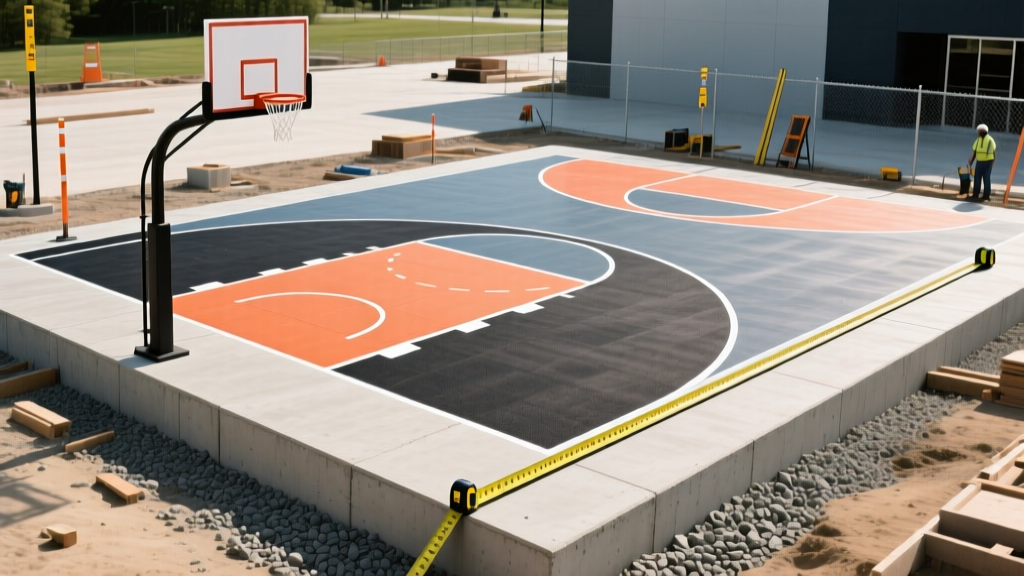
The True Cost to Build a Basketball Court by Footprint
When homeowners and facility managers ask how much would it cost to build a basketball court, the answer scales non-linearly with size. Fixed mobilization costs for heavy machinery, concrete trucks, and excavation crews mean that smaller courts carry a higher cost per square foot than regulation-sized facilities. On average, a standard backyard half-court (30x30 feet) costs between $10,500 and $16,500, while a full regulation court (94x50 feet) ranges from $23,500 to $42,000. According to construction cost aggregators like HomeGuide, site preparation and surface finishing account for over 60% of the total budget.
Base Footprint and Dimension Pricing
The first variable in your scope calculator is the physical footprint. You must account for a minimum 2-foot to 5-foot runoff perimeter around the actual playing lines to prevent players from stepping off the slab.
| Court Type | Playing Dimensions | Total Slab Size (with runoff) | Square Footage | Estimated Base Cost (Concrete) |
|---|---|---|---|---|
| Driveway / Junior | 18' x 18' | 20' x 20' | 400 sq ft | $4,000 - $6,500 |
| Backyard Half-Court | 30' x 30' | 34' x 34' | 1,156 sq ft | $10,500 - $16,500 |
| High School Half | 42' x 50' | 46' x 54' | 2,484 sq ft | $21,000 - $28,000 |
| NCAA / NBA Full | 94' x 50' | 100' x 56' | 5,600 sq ft | $42,000 - $58,000 |
Surface Material Matrix: Asphalt vs. Concrete vs. Modular
The sub-base and wearing surface dictate the longevity, playability, and maintenance cycle of the court. Do not pour a 4-inch residential driveway slab and expect it to hold up to the dynamic lateral loads of basketball. A proper court requires a minimum 5-inch to 6-inch reinforced concrete slab or a heavily compacted asphalt base.
| Surface Material | Cost per Sq Ft | Lifespan | Pros & Cons |
|---|---|---|---|
| Asphalt (Uncoated) | $4.00 - $6.00 | 10-15 Years | Pros: Lowest initial cost. Flexible in freeze-thaw cycles. Cons: Prone to cracking, requires acrylic resurfacing every 5 years, softer surface degrades under hoop poles. |
| Concrete (Broom Finish) | $7.00 - $9.00 | 25+ Years | Pros: Extremely durable, minimal maintenance, true ball bounce. Cons: Hard on joints, requires control joints that can trip players if poorly troweled. |
| Acrylic Coated Concrete | $9.00 - $13.00 | 20+ Years | Pros: Pro-level traction (using systems like DecoTurf or Plexipave), UV stable, customizable colors. Cons: Requires flawless concrete curing before application. |
| Modular Polypropylene | $3.50 - $6.00 (Plus base) | 15-20 Years | Pros: Superior shock absorption, excellent drainage, brands like Mateflex or SnapSports offer pro aesthetics. Cons: Requires a perfectly level concrete sub-base, can be slippery when wet. |
Site Preparation: Where the Scope Calculator Breaks
The most common reason basketball court projects exceed their budget is hidden site preparation costs. A flat, easily accessible backyard is rare. You must calculate the cut-and-fill requirements to achieve a perfectly level pad.
Excavation and Subgrade Engineering
For a 5,600 sq ft full court, excavating just 8 inches deep requires moving roughly 1,400 cubic yards of soil. At $2.50 to $4.00 per cubic yard for cut-and-fill operations, earthmoving alone can add $3,500 to $5,600 to the project. If your soil has high clay content, the National Asphalt Pavement Association (NAPA) and concrete engineering standards recommend installing a geogrid reinforcement layer and a 4-inch base of crushed aggregate (3/4-inch minus gravel) to prevent differential settling.
Accessories and Perimeter Scope
Once the slab is cured, the secondary scope items dictate the final functionality of the space.
- In-Ground Hoop Systems: Portable hoops with sand bases are unsuitable for serious play due to vibration and tipping risks. Invest in an in-ground system like the Goalrilla G54 or Pro Dunk Hercules. These require a 36-inch deep, 24-inch wide concrete collar poured independently of the main slab to isolate vibration. Expect to pay $1,800 to $3,500 for the unit and professional installation.
- LED Court Lighting: For evening play, a standard setup requires four 20-foot galvanized steel poles, each mounting two 300W LED fixtures (4000K color temperature). Including trenching for electrical conduit, materials, and an electrician, budget $5,500 to $8,500 for a fully illuminated half-court.
- Perimeter Fencing: To keep balls from rolling into streets or damaging landscaping, a 10-foot high chain-link fence with a top rail is standard. Pricing averages $28 to $38 per linear foot installed. A 34x34 half-court requires roughly 136 linear feet, adding $3,800 to $5,100 to the total scope.
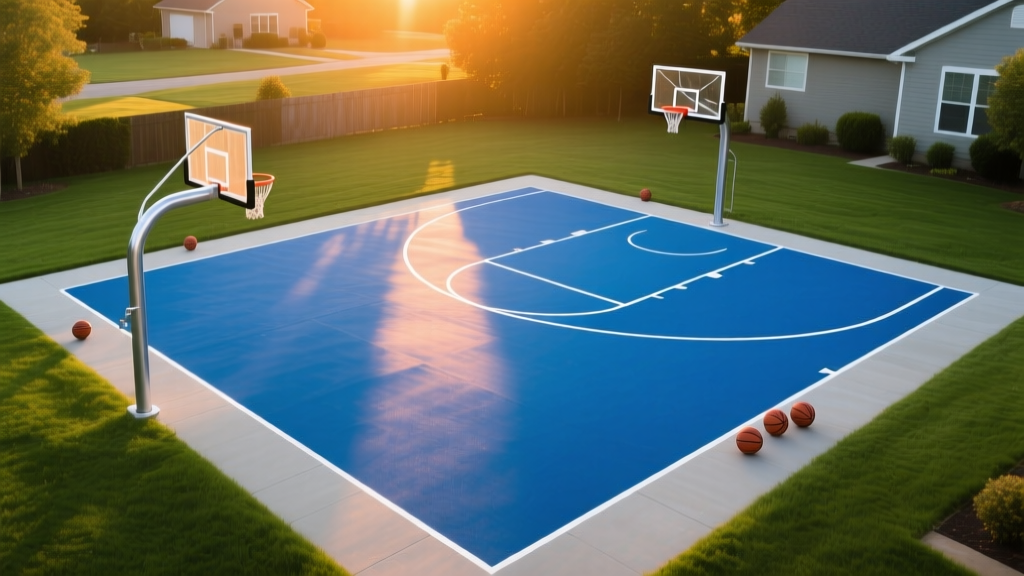
Common Failure Modes to Avoid
'The number one cause of premature concrete failure in recreational courts is root intrusion from nearby vegetation and improper control joint spacing.' — American Sports Builders Association (ASBA) Guidelines
When planning your scope, enforce a strict 10-foot clearance zone from any mature trees. Tree roots will easily heave a 6-inch concrete slab within five years. Additionally, ensure your contractor saw-cuts control joints every 10 to 12 feet. If they skip this step to save time, the concrete will crack randomly as it cures and shrinks, ruining the ball bounce and creating trip hazards.
Step-by-Step Scope Calculation Formula
To calculate your exact budget, use this sequential framework rather than relying on generic square-foot averages:
- Calculate Base Slab Volume: Multiply your total footprint (including runoff) by 0.5 (for a 6-inch slab) to get cubic feet. Divide by 27 to get cubic yards of concrete. Multiply by your local concrete delivery rate (typically $140-$160 per yard in 2026).
- Add Subgrade Costs: Multiply the total square footage by $1.50 to $2.50 for gravel base and compaction.
- Apply Surface Multiplier: Multiply the playing area square footage by your chosen surface coating cost (e.g., $3.50/sq ft for acrylic).
- Factor in Fixed Accessories: Add exact quotes for your chosen hoop model, linear footage of fencing, and lighting poles.
- Apply the Site Complexity Multiplier: If your lot is sloped, heavily wooded, or requires retaining walls, multiply your total earthwork estimate by 1.5 to account for engineering and retaining wall block costs ($25-$40 per sq ft of wall face).
By breaking down how much it would cost to build a basketball court into these distinct, measurable phases, you eliminate the guesswork and prevent contractor change-orders from derailing your project budget.
Written by
Elena RodriguezElena Rodriguez is a civil engineer and technical writer specializing in concrete technology, masonry systems, and ASTM/ACI compliance. She earned her B.S. in Civil Engineering from Texas A&M University and spent a decade at a materials testing laboratory, performing over 2,000 concrete compressive strength tests and masonry prism evaluations. Elena is an ACI-certified Field Testing Technician (Grade I) and a member of ASTM Committee C12 on Natural Building Stone. She currently consults on forensic engineering cases involving concrete failures and moisture intrusion. Based in San Antonio, TX, Elena is a proud member of the Society of Women Engineers (SWE) and coaches her daughter's FIRST Robotics team.
More from Elena Rodriguez
View all
Walls & Panels
Cost Analysis: Light Gauge Steel Framing Advantages and Disadvantages
Evaluate light gauge steel framing advantages and disadvantages through a strict cost analysis lens, comparing material, labor, and lifecycle expenses.
Aug 4, 2026

Walls & Panels
Gypsum Board Types: Exact Specifications, Thickness & Dimensions
Compare standard, Type X, and moisture-resistant gypsum board types. Get exact specifications, thicknesses, dimensions, and ASTM standards for your project.
Aug 4, 2026

Fire Resistance
Best Fire-Resistant Outdoor Decking Materials: 2026 Buyer Guide
Discover the best fire-resistant outdoor decking materials for 2026. Compare Class A PVC, aluminum, and hardwood options for WUI compliance and safety.
Aug 4, 2026