How Much Did It Cost to Build the Biltmore House? Modern Estimate
Discover how much it cost to build the Biltmore House historically and what a 178,000 sq ft French Renaissance chateau would cost in Asheville today.
The Historical Ledger: 1895 Construction Costs
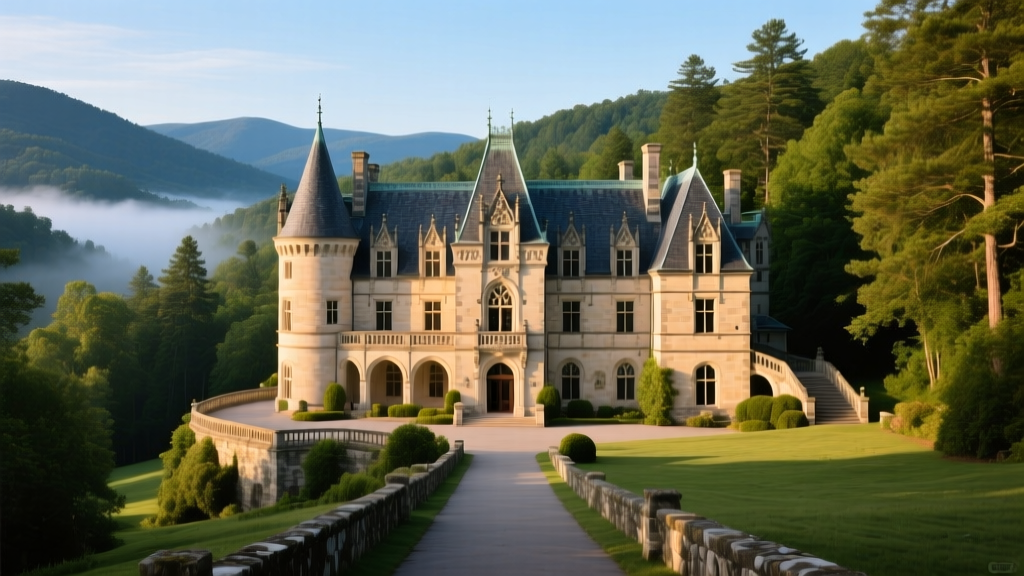
When George Vanderbilt commissioned architect Richard Morris Hunt to design a French Renaissance chateau in the Blue Ridge Mountains, the project defied the architectural and financial norms of the Gilded Age. Spanning 178,926 square feet with 250 rooms, 65 fireplaces, and a pioneering structural steel frame, the Biltmore House remains the largest privately owned home in the United States. But how much did it cost to build the biltmore house in its original era?
Historical ledgers and estate archives indicate that Vanderbilt spent between $4 million and $6 million from the start of construction in 1889 to its completion on Christmas Eve, 1895. According to Biltmore's official historical records, this figure covered not just the main house, but the initial landscaping by Frederick Law Olmsted, the Biltmore Village infrastructure, and the on-site brick and woodworking factories built specifically to supply the estate.
Historical Context: At $5 million in 1895, the Biltmore House cost roughly $28 per square foot. However, this metric is highly deceptive for modern estimators, as it excludes the value of Vanderbilt's captive labor force, on-site material manufacturing, and the absence of modern building codes.
Why Standard Inflation Fails Construction Estimating
A common mistake in historical cost analysis is applying the Consumer Price Index (CPI) to construction budgets. A standard CPI inflation calculator suggests that $5 million in 1895 is equivalent to roughly $185 million today. For a 178,000-square-foot mega-estate, $185 million yields just $1,033 per square foot—a figure that barely covers mid-tier custom residential construction in 2026, let alone a limestone chateau.
The PPI vs. CPI Discrepancy
Construction costs scale according to the Producer Price Index (PPI) for construction materials and specialized labor, not consumer goods. According to Bureau of Labor Statistics data on construction indices, the cost of skilled masonry labor, structural steel, and quarried stone has vastly outpaced general consumer inflation. Furthermore, the 'craftsmanship premium'—the cost of artisans capable of executing 19th-century plasterwork and stone carving—has skyrocketed due to extreme scarcity in the modern labor pool.
Regional Price Analysis: Asheville, NC Topography & Labor
To accurately estimate the modern cost of building the Biltmore House, we must apply a regional price analysis to Asheville, North Carolina. The Southeast US generally benefits from lower baseline labor rates compared to the Northeast or West Coast, but building a mega-estate in the Blue Ridge Mountains introduces severe regional multipliers.
Topographical and Site Prep Costs
The Biltmore Estate sits on undulating, mountainous terrain. Modern site preparation for a 178,000-square-foot footprint in this region requires extensive bedrock blasting, deep foundation piers, and complex retaining wall engineering to manage water runoff and soil stability. Excavating solid granite in Western North Carolina currently costs between $150 and $300 per cubic yard, pushing site-work costs for an estate of this magnitude past $12 million before a single foundation pour.
The Specialized Labor Deficit
Asheville possesses a robust general contracting workforce, but it lacks the concentrated guilds of master stone carvers, Guastavino-style vaulting masons, and ornamental plasterers required for a French Renaissance replica. A modern project manager would need to import specialized crews from the Northeast or Europe, adding 30% to 45% in per diem, travel, and housing logistics to the baseline labor rate.
Material Cost Matrix: Replicating the Chateau
The Biltmore House was constructed using over 5,000 tons of Indiana Limestone, a massive slate roof, and early structural steel. Below is a modern regional cost matrix for sourcing and installing these specific materials in Western North Carolina today.
| Material Component | Modern Specification | Est. Regional Cost (2026) | Total Estimate (Biltmore Scale) |
|---|---|---|---|
| Exterior Cladding | Select-grade Indiana Limestone (cut & carved) | $110 - $160 / sq ft | $65,000,000+ |
| Roofing System | Vermont structural slate with copper flashing | $45 - $75 / sq ft | $18,500,000 |
| Interior Millwork | Quarter-sawn white oak & mahogany (hand-carved) | $350 - $500 / linear ft | $42,000,000 |
| Structural Frame | Heavy structural steel with fireproofing | $85 - $120 / sq ft | $19,000,000 |
| Ornamental Plaster | Custom cast cornices and ceiling medallions | $150 - $250 / sq ft | $22,000,000 |
The 'Mega-Estate Multiplier' and Modern Code Compliance
When estimating historical replicas, modern construction cost estimators must apply a 'mega-estate multiplier.' This accounts for the diseconomies of scale that occur when integrating 21st-century life safety and mechanical systems into a 19th-century architectural envelope.
If the Biltmore House were built today, it would be subject to strict commercial-grade building codes, including the National Park Service guidelines for historic preservation (if designated as such) and modern International Building Code (IBC) requirements for fire suppression, ADA accessibility, and seismic/wind uplift resistance.
- HVAC & Climate Control: Heating and cooling 178,000 square feet of space with 35-foot ceilings requires a commercial-grade chilled water system and massive concealed ductwork. Concealing this infrastructure without altering the historical sightlines adds an estimated $35 million to the mechanical budget.
- Fire Suppression: A high-pressure wet-pipe sprinkler system, integrated with early-warning aspirating smoke detection (to protect ornamental plaster and woodwork from water damage), would cost upwards of $8 million.
- Logistics & Crane Time: Setting 5-ton limestone blocks and 60-foot steel trusses in a mountainous environment requires heavy-lift tower cranes. Crane rental, assembly, and operation in Western NC for a 4-year build cycle easily exceeds $6 million.
Final Modern Cost Synthesis
Combining hard construction costs, specialized regional labor premiums, site topography challenges, and modern mechanical integrations, the cost to build the Biltmore House today is estimated between $780 million and $920 million.
This breaks down to roughly $4,350 to $5,140 per square foot. While standard luxury custom homes in Asheville might build for $800 to $1,200 per square foot, the Biltmore's sheer volume, historical material requirements, and structural complexity push it into the realm of institutional and monumental construction pricing.
Understanding the true cost of the Biltmore House requires looking past simple inflation calculators. It demands a rigorous regional price analysis that respects the scarcity of artisanal labor, the logistical realities of mountain construction, and the uncompromising cost of monumental masonry. For modern estate developers, the Biltmore remains the ultimate benchmark in the economics of architectural ambition.
Written by
Priya KapoorPriya Kapoor is a real estate market analyst and construction economics researcher with expertise in housing affordability, development feasibility, and infrastructure investment. She holds a Master of Regional Planning from Cornell University and previously worked as a senior analyst at CBRE's Investment Properties group, where she modeled returns for $4B in mixed-use development pipelines. Priya now runs an independent research practice advising developers, municipalities, and REITs on construction cost forecasting and market timing. She publishes the quarterly "BuildMat Market Pulse" report tracking material price indices across 12 commodity categories. Based in Austin, TX, Priya serves on the board of Habitat for Humanity Austin and is a marathon runner.
More from Priya Kapoor
View all
Construction Cost
Cost to Build a 1600 Sq Ft Home in 2026: Full Breakdown
Accurate 2026 cost to build a 1600 sq ft home—material, labor, and regional pricing breakdowns included. Plan your budget with real-time estimates.
Aug 11, 2026

Wood & Lumber
Name the Types of Wood for Pressure Treatment and Preservation
Learn how to name the types of wood best suited for pressure treatment. Compare species treatability, chemical retention levels, and 2026 preservation costs.
Aug 4, 2026

Stone & Masonry
Stone Veneer Suppliers Lindenhurst: 2026 Cost Analysis
Analyze 2026 stone veneer costs in Lindenhurst, NY. Compare local supplier pricing, delivery fees, and Suffolk County installation labor rates.
Aug 4, 2026