How Much Does It Cost to Build a Bowling Alley? Home vs Commercial
Discover how much it costs to build a bowling alley. Compare residential string pinsetter setups to commercial free-fall lane construction budgets.
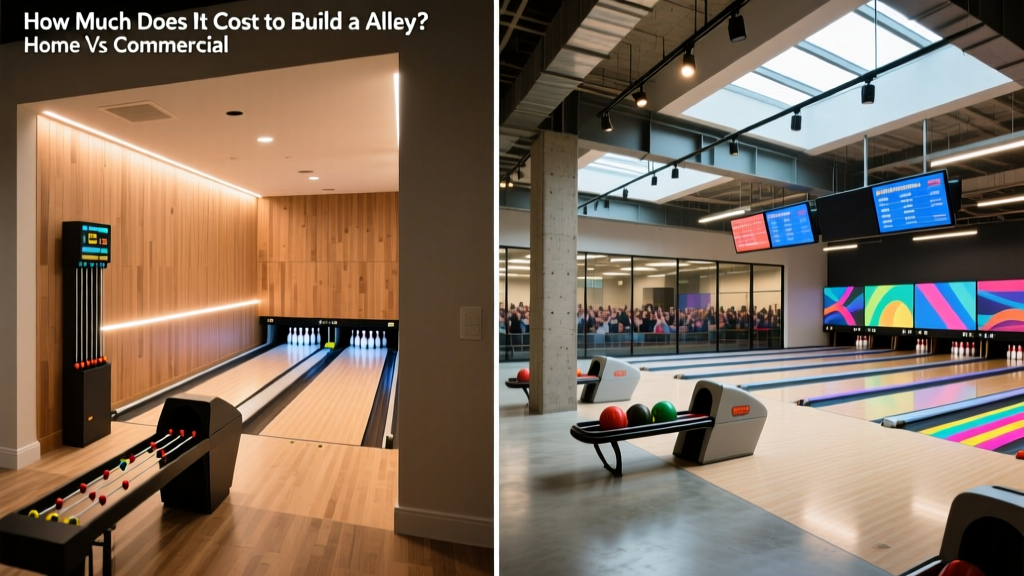
The Core Question: How Much Does It Cost to Build a Bowling Alley?
When investors, commercial developers, and luxury home builders ask how much does it cost to build a bowling alley, the answer hinges entirely on the chosen pinsetter technology, facility footprint, and infrastructure baseline. A single-lane residential setup utilizing modern string pinsetter technology typically ranges from $85,000 to $130,000. In contrast, a traditional 16-lane commercial center equipped with free-fall pinsetters, full HVAC climate control, and boutique scoring systems frequently exceeds $1.6 million. The divergence in cost is not merely about scale; it is driven by the mechanical complexity of the pin-setting equipment and the structural demands of the building envelope.
- Residential (1-2 Lanes): $85,000 – $220,000
- Boutique Commercial (4-8 Lanes): $450,000 – $950,000
- Traditional Commercial (12-24 Lanes): $1.2M – $3.5M+
Residential vs. Commercial: A Cost Comparison Matrix
To understand where capital is allocated, we must break down the cost per lane across three distinct project profiles. The following matrix isolates equipment, site preparation, and digital infrastructure costs.
| Cost Category | Residential (1-Lane String) | Boutique (6-Lane Hybrid) | Traditional (16-Lane Free-Fall) |
|---|---|---|---|
| Pinsetter & Lane Equipment | $45,000 - $60,000 | $75,000 - $90,000 / lane | $85,000 - $110,000 / lane |
| Synthetic Lane Surface | $12,000 - $18,000 | $15,000 - $22,000 / lane | $14,000 - $20,000 / lane |
| Scoring & POS Systems | $4,000 - $7,000 | $10,000 - $14,000 / lane | $9,000 - $13,000 / lane |
| Subfloor & Pit Construction | $5,000 - $12,000 | $18,000 - $25,000 / lane | $22,000 - $35,000 / lane |
| HVAC & Acoustic Treatment | Integrated into home HVAC | $120,000 - $180,000 (Total) | $250,000 - $400,000 (Total) |
| Estimated Total Per Lane | $85,000 - $130,000 | $110,000 - $145,000 | $125,000 - $175,000 |
Equipment Deep Dive: String Pinsetters vs. Free-Fall
The single largest variable in your budget is the pinsetter. According to equipment specifications from QubicaAMF and Brunswick Bowling, the industry has bifurcated into two distinct mechanical approaches, each with vastly different installation and maintenance cost profiles.
String Pinsetter Technology (The Home & Boutique Choice)
String pinsetters utilize high-tensile Kevlar cords attached to the neck of each pin, connected to a motorized spool system above the pit. When a pin is knocked down, the sensor detects the slack in the cord and the spool retracts it. Cost Impact: Because string pinsetters eliminate the complex sweep bars, elevators, and heavy steel distribution tables found in free-fall machines, they reduce moving parts by up to 70%. This translates to a lower initial equipment cost (roughly $45,000 to $65,000 per lane) and significantly cheaper subfloor requirements. String machines can often be installed on a flat floor with a slightly raised approach, eliminating the need for expensive concrete pit excavation.
Free-Fall Pinsetters (The Traditional Commercial Standard)
Free-fall machines (such as the Brunswick GSX or AMF 82-90XL) rely on gravity and complex mechanical sweeps to clear the deck and reset pins. Cost Impact: These machines weigh over 2,000 pounds and require a dedicated machine pit. Excavating a 34-inch deep pit across a 100-foot long building footprint adds tens of thousands of dollars in concrete and structural engineering costs. Furthermore, free-fall machines require heavy-duty 3-phase electrical drops and specialized maintenance technicians, pushing the per-lane equipment and installation cost to $85,000–$110,000.
Hidden Infrastructure Costs That Derail Budgets
Novice developers often budget strictly for the lane equipment, only to be blindsided by the architectural and environmental requirements necessary to protect the investment. Industry analysis featured in Bowlers Journal International frequently highlights infrastructure failures as the primary cause of budget overruns.
- Dimensional Clearances: A regulation bowling lane requires exactly 62 feet, 10 3/16 inches from the foul line to the head pin. Add a 15-foot approach, a 5-foot pinsetter footprint, and a 3-foot rear service aisle, and your absolute minimum interior room length is 86 feet. If your building shell is 84 feet, you cannot install regulation lanes without altering the exterior walls.
- Ceiling Height Restrictions: Traditional free-fall pinsetters require a minimum ceiling height of 10 feet to accommodate the ball return tracks and pin elevator. However, modern boutique alleys utilizing elaborate LED lighting rigs, acoustic baffling, and overhead masking units require 12 to 14 feet of clear height. Failing to verify truss heights before signing a lease can result in unbuildable spaces.
- Climate Control (HVAC): Synthetic lanes and lane conditioners (oils) are highly sensitive to temperature and humidity fluctuations. The environment must be strictly maintained between 68°F and 72°F, with relative humidity held between 40% and 50%. If the HVAC system fails to maintain this envelope, the synthetic panels can expand and contract, causing the lane oil to break down prematurely and altering the ball reaction. Retrofitting a commercial warehouse with precision climate control can add $150,000 to $300,000 to the project.
- Acoustic Isolation: A 16-pound urethane ball impacting a synthetic lane and the subsequent pin crash generates significant low-frequency decibel spikes. If the bowling alley is situated in a mixed-use development or below residential units, you must budget for floating subfloors and mass-loaded vinyl (MLV) acoustic decoupling, adding $8 to $14 per square foot to the flooring budget.
Scoring and POS Systems: The Digital Backbone
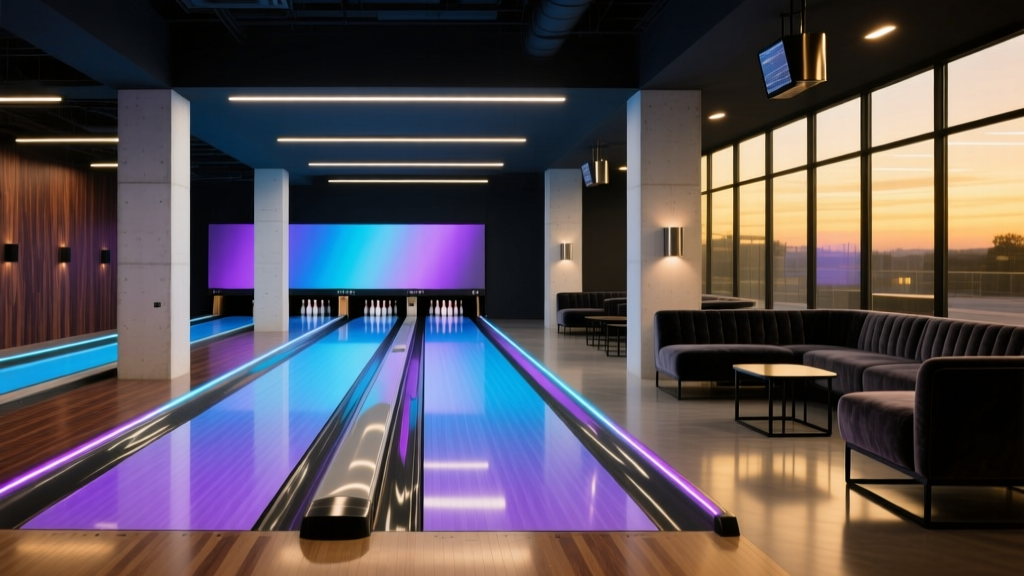
The scoring system is the primary user interface for your customers and the central nervous system for your point-of-sale (POS) operations. Modern systems like the Brunswick Sync or QubicaAMF BES X do far more than count pins; they manage lane lighting, integrate with F&B ordering, and run interactive digital games. Expect to allocate between $9,000 and $14,000 per lane for a fully integrated scoring and POS package. This includes the overhead pinsetter cameras, the bowler-facing touchscreens, the main server racks, and the POS terminals at the front desk. For boutique venues, add an additional $3,000 to $5,000 per lane for dynamic LED masking units and programmable RGB lane lighting that syncs with the scoring software for "cosmic" or VIP bowling modes.
Decision Framework: Which Setup Matches Your ROI Goals?
Choosing the right configuration requires aligning your capital expenditure with your target demographic and operational model.
The Luxury Home Setup
Best for: High-net-worth residential builds, basement entertainment wings.
Strategy: Utilize 1-2 string pinsetter lanes. Avoid the structural nightmare of excavating a 34-inch pit in an existing basement. Focus budget on premium synthetic lane graphics, custom wood approaches, and high-end lounge furniture.
The Boutique F&B Venue
Best for: Urban entertainment districts, corporate event spaces, craft breweries.
Strategy: Build 4-8 lanes. Prioritize high-margin food and beverage spaces over lane density. Use string or hybrid pinsetters to reduce back-of-house maintenance staff. Invest heavily in acoustic treatment and programmable lighting to transition the space from family-friendly by day to nightlife by evening.
The Traditional League Center
Best for: Suburban family entertainment centers, competitive league play.
Strategy: 12-24 lanes of free-fall equipment. League bowlers demand the exact pin carry and deck reaction of traditional free-fall machines. Budget heavily for a pro shop, locker rooms, and a robust HVAC system to ensure perfect lane conditions for sanctioned USBC tournaments.
"The most expensive mistake in bowling alley construction isn't overpaying for the pinsetters; it's underestimating the structural span and HVAC requirements needed to protect the lane surface. A $100,000 lane installation will warp and fail in months if the building envelope cannot hold a strict 50% humidity baseline."
— Commercial Entertainment Facility Architect
Ultimately, determining the exact cost of your project requires a site-specific structural analysis and a clear definition of your operational intent. By isolating the mechanical, structural, and digital variables, developers can accurately forecast capital requirements and avoid the hidden infrastructural traps that plague under-researched entertainment builds.
Written by
Marcus ChenMarcus Chen is a licensed structural engineer (PE) and building materials analyst with over 12 years of experience across residential, commercial, and industrial construction. He holds a Master of Science in Civil Engineering from UC Berkeley and spent six years at Thornton Tomasetti before transitioning to independent consulting and technical writing. Marcus specializes in material selection for seismic-prone regions, concrete reinforcement strategies, and lifecycle cost analysis. His work has been cited by the American Concrete Institute (ACI) and the Structural Engineers Association of California (SEAOC). When he is not on a job site or at his desk, you will find him hiking the Sierra Nevada or restoring a 1920s craftsman bungalow in Oakland, CA.
More from Marcus Chen
View all
Construction Cost
How Much Did the Eiffel Tower Cost to Build?
How much did the Eiffel Tower cost to build in 1889? We adjust for inflation and compare its budget to modern skyscraper construction.
Aug 4, 2026

Fire Resistance
What Is a Fire Resistant Material? Testing & Certification Guide
Discover what is a fire resistant material through ASTM and UL testing. Learn how fire ratings, certifications, and assemblies work in construction.
Aug 4, 2026

Construction Cost
How Much Did the Burj Khalifa Cost to Build?
How much did the Burj Khalifa cost to build? We break down the $1.5B project and extract 5 money-saving strategies for your next build.
Jul 30, 2026