How Much Does It Cost to Build a Carwash? Type Comparison
Discover how much it costs to build a carwash. Compare express tunnel, in-bay automatic, and self-serve CapEx, OpEx, and ROI timelines.
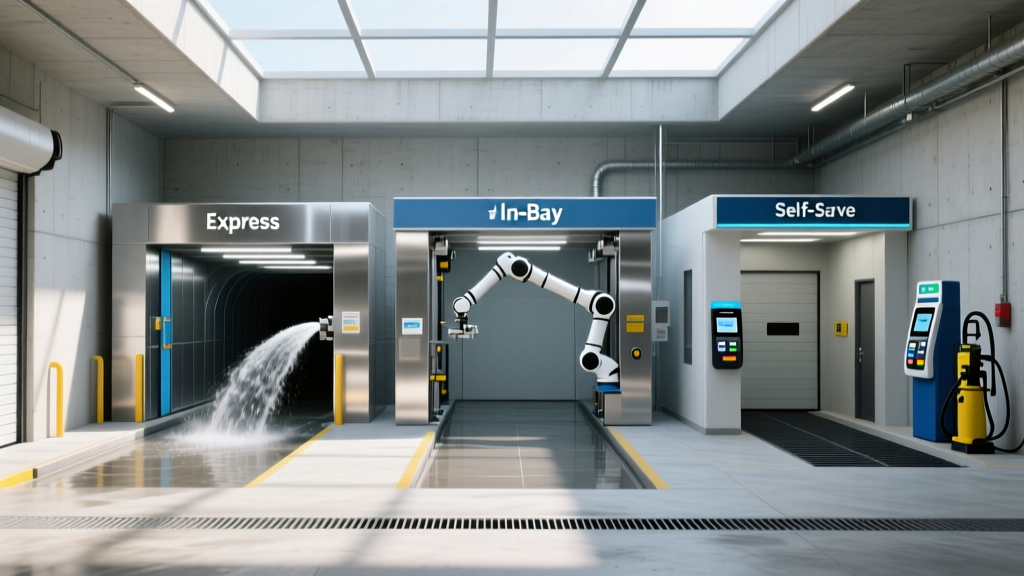
The True Cost Spectrum: Express vs. Full-Service vs. Self-Serve
Determining exactly how much it costs to build a carwash requires moving beyond generic industry averages. A self-serve wand bay and a 120-foot express tunnel operate on entirely different capital expenditure (CapEx) and operational expenditure (OpEx) models. According to the International Carwash Association, the express tunnel model has dominated new development over the last decade due to higher throughput and lower labor dependencies, but the barrier to entry is substantially higher.
2026 Baseline CapEx Comparison Matrix
- Express Tunnel (100-130 ft): $4,000,000 – $8,500,000 (Land + Build + Equipment)
- In-Bay Automatic (IBA) 2-Bay: $900,000 – $1,600,000
- Self-Serve 4-Bay: $450,000 – $750,000
- Flex-Serve (Hybrid): $3,500,000 – $6,000,000
The following breakdown isolates the hard costs, equipment specifics, and hidden infrastructure expenses that dictate your final ledger.
Express Tunnel Carwash Costs (The Industry Standard)
The express tunnel is the highest-volume model, capable of washing 100 to 150 cars per hour. The physical structure typically requires a 100 to 130-foot clear-span building with a minimum 24-foot eave height to accommodate overhead drying equipment and catwalks.
Equipment & Conveyor Specifics
Wash equipment packages from manufacturers like Sonny's or MacNeil typically range from $1.2 million to $2.2 million for a mid-to-high-tier setup. A critical decision point is the conveyor system:
- Chain Conveyors: Lower upfront cost ($80,000 - $120,000), but require frequent lubrication, generate more noise, and suffer higher long-term maintenance costs.
- Belt Conveyors (e.g., Sonny's ProLite): Cost 15% to 20% more upfront ($130,000 - $160,000) but eliminate the need for continuous lubrication, reduce water/chemical drag-out, and offer a smoother customer experience.
Site Work & The $150,000 Pit
Tunnel carwashes require a subterranean pit to house the conveyor drive, return mechanisms, and water reclamation tanks. Excavating and pouring a reinforced concrete pit with proper waterproofing and drainage slopes typically adds $120,000 to $200,000 to the site work budget, heavily dependent on local soil conditions and the water table.
In many municipalities, tapping into the municipal sewer system for a high-volume carwash triggers massive impact fees. It is common to see sewer and water tap fees exceed $150,000 if the city requires you to upsize the local water main or install a dedicated lift station. Always secure utility capacity letters before purchasing land.
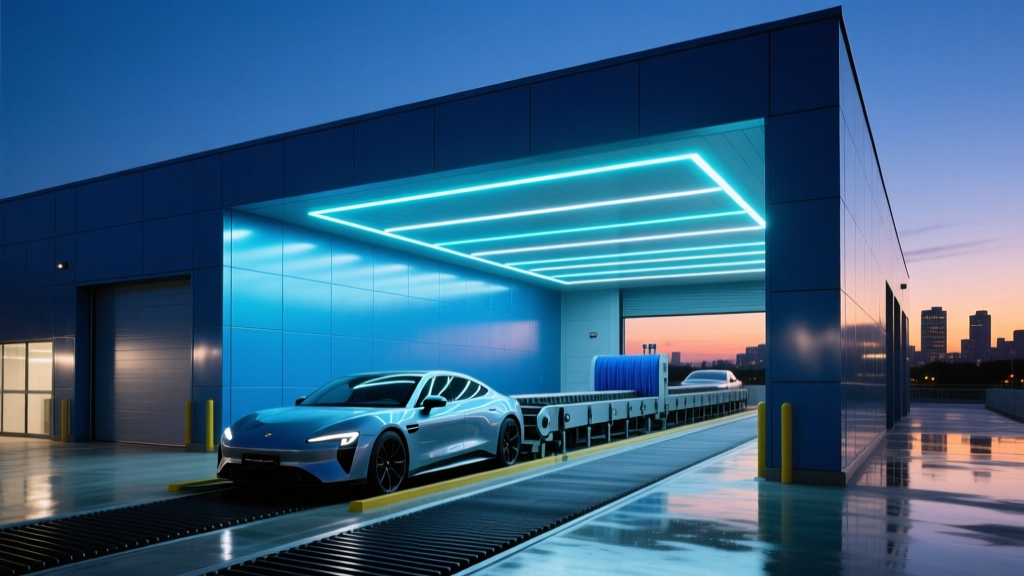
In-Bay Automatic (IBA) & Self-Serve Bay Breakdown
For investors with lower capital or smaller real estate footprints (15,000 to 25,000 sq ft), IBA and self-serve models remain viable, particularly in secondary and tertiary markets.
In-Bay Automatic (Touchless vs. Friction)
An IBA setup relies on machines from brands like PDQ or Ryko. A single IBA bay costs between $150,000 and $220,000 for the equipment package.
- Touchless Systems: Require high-pressure plumbing and specialized chemical injection systems. You will need heavy-duty triplex plunger pumps (such as Cat Pumps) operating at 1,000+ PSI. Chemical costs per vehicle are 20% higher than friction washes to compensate for the lack of mechanical agitation.
- Friction Systems: Utilize foam brushes or cloth mitters. They offer a superior physical clean but carry a higher risk of customer vehicle damage claims, necessitating robust CCTV coverage and specialized insurance riders.
Self-Serve Bays
Self-serve bays are the most capital-efficient, costing $35,000 to $55,000 per bay for the boom hardware, pumps, and coin/card acceptors. However, the ROI timeline is the longest, and revenue is highly susceptible to weather and local labor competition.
Hidden Capital Expenditures That Destroy Margins
First-time carwash developers frequently underbudget for the infrastructure required to keep the facility compliant and operational.
Water Reclamation Systems
Most jurisdictions now mandate water reclamation for express tunnels. A commercial system from Aqua Chem or InterClean, which captures, filters, and recycles up to 85% of wash water, costs between $90,000 and $140,000. This includes the underground settling tanks, ozone injection systems (to prevent anaerobic bacteria and odors), and filtration membranes.
Point-of-Sale (POS) and Automation
Modern express tunnels require advanced POS systems (like DRB Systems or Hamilton) integrated with License Plate Recognition (LPR) cameras and automated pay stations. Budget $60,000 to $95,000 for the software licenses, physical kiosks, LPR hardware, and monthly SaaS fees.
Operational Expenditure (OpEx) Comparison Matrix
Understanding how much it costs to build a carwash is only half the equation. The ongoing OpEx dictates your net operating income (NOI). The table below outlines the average cost per vehicle washed across the three primary models in 2026.
| Expense Category | Express Tunnel | In-Bay Automatic | Self-Serve |
|---|---|---|---|
| Chemicals | $0.45 - $0.85 | $0.60 - $1.10 | $0.20 - $0.40 |
| Water & Sewer | $0.30 - $0.50 | $0.50 - $0.80 | $0.40 - $0.60 |
| Electricity & Gas | $0.25 - $0.45 | $0.35 - $0.60 | $0.15 - $0.25 |
| Labor Per Car | $0.80 - $1.50 | $0.10 - $0.20 | $0.00 |
| Total Variable Cost | $1.80 - $3.30 | $1.55 - $2.70 | $0.75 - $1.25 |
Note: Express tunnels have higher labor costs per car due to the need for exit-line attendants and loading crew, but their massive volume drastically reduces fixed-cost burden per vehicle.
Financing the Build: SBA 504 vs. Conventional
Because carwashes are considered 'special-purpose properties' (the real estate is highly customized to the business), conventional commercial real estate lenders often view them as high-risk, demanding 30% to 40% down payments.
The optimal route for most owner-operators is the SBA 504 Loan Program. This structure allows you to finance both the real estate and the heavy wash equipment with as little as 10% down. The SBA 504 splits the financing: a conventional bank takes a first lien for 50%, a Certified Development Company (CDC) takes a second lien for 40% at a fixed, below-market rate, and the borrower provides 10% equity. This preserves critical working capital for the first 12 months of marketing and membership acquisition.
Decision Framework: Which Model Fits Your Capital?
Select your build type based on your capital availability, risk tolerance, and daily traffic counts:
- Choose Express Tunnel If: You have $1M+ in liquid capital, access to a high-traffic commuter corridor (25,000+ cars per day), and want to build a recurring-revenue membership business that scales to $3M+ in annual gross revenue.
- Choose In-Bay Automatic If: You are targeting a secondary market, have a smaller parcel (under 1 acre), want a semi-absentee ownership model, and have $300,000 to $500,000 in liquid capital.
- Choose Self-Serve If: You are looking for a passive, low-maintenance real estate play in a rural or high-density urban area where residential driveway washing is restricted, with capital under $200,000.
Accurate cost estimation requires treating a carwash not just as a real estate development, but as a complex water-treatment and automated manufacturing facility. Prioritize geotechnical soil testing and municipal utility capacity verification before committing to any land purchase.
Written by
Elena RodriguezElena Rodriguez is a civil engineer and technical writer specializing in concrete technology, masonry systems, and ASTM/ACI compliance. She earned her B.S. in Civil Engineering from Texas A&M University and spent a decade at a materials testing laboratory, performing over 2,000 concrete compressive strength tests and masonry prism evaluations. Elena is an ACI-certified Field Testing Technician (Grade I) and a member of ASTM Committee C12 on Natural Building Stone. She currently consults on forensic engineering cases involving concrete failures and moisture intrusion. Based in San Antonio, TX, Elena is a proud member of the Society of Women Engineers (SWE) and coaches her daughter's FIRST Robotics team.
More from Elena Rodriguez
View all
Walls & Panels
Cost Analysis: Light Gauge Steel Framing Advantages and Disadvantages
Evaluate light gauge steel framing advantages and disadvantages through a strict cost analysis lens, comparing material, labor, and lifecycle expenses.
Aug 4, 2026

Walls & Panels
Gypsum Board Types: Exact Specifications, Thickness & Dimensions
Compare standard, Type X, and moisture-resistant gypsum board types. Get exact specifications, thicknesses, dimensions, and ASTM standards for your project.
Aug 4, 2026

Fire Resistance
Best Fire-Resistant Outdoor Decking Materials: 2026 Buyer Guide
Discover the best fire-resistant outdoor decking materials for 2026. Compare Class A PVC, aluminum, and hardwood options for WUI compliance and safety.
Aug 4, 2026