How Much Does It Cost to Build a House? 2026 Savings Guide
Discover how much it costs to build a house in 2026 and uncover actionable, expert-backed strategies to slash your construction budget without sacrificing quality.
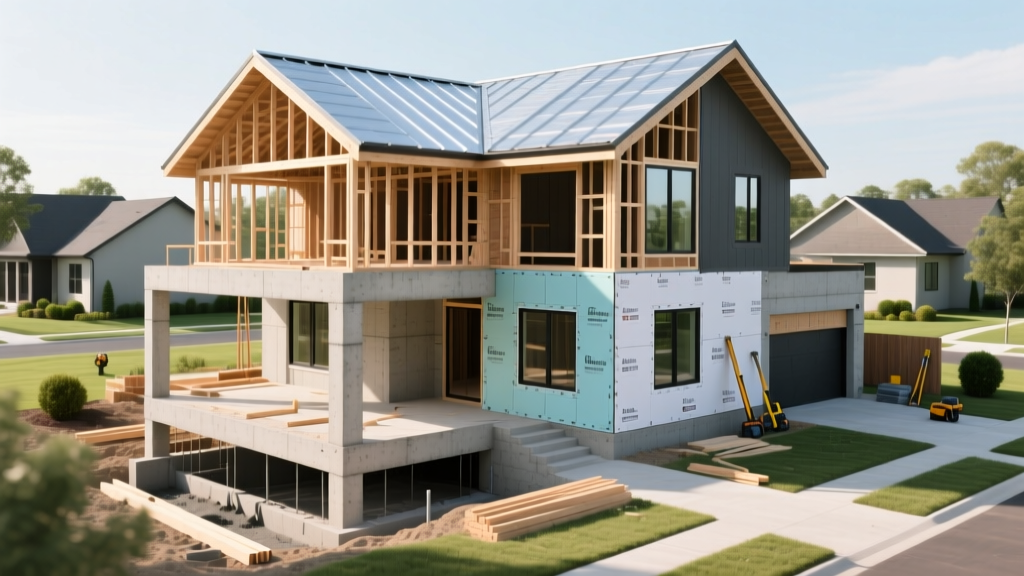
The True Baseline: How Much Does It Cost to Build a House in 2026?
When evaluating how much does it cost to build a house, the national baseline for 2026 sits between $155 and $210 per square foot for standard production builds, and $250 to $400+ per square foot for fully custom architectural homes, according to aggregated data from the U.S. Census Bureau New Residential Construction reports. However, these averages mask the massive variances caused by design choices, material selections, and site conditions. A 2,000-square-foot home can cost $310,000 or $620,000 depending entirely on how you manipulate the variables below.
Material Substitution Matrix: High-End vs. Budget-Smart Alternatives
Material selection is the most visible area for cost reduction, but swapping materials blindly often shifts costs to labor. The matrix below compares premium staples with high-performance, budget-smart alternatives that maintain durability while reducing total installed costs.
| Category | Premium Standard (Cost/Sq Ft Installed) | Budget-Smart Alternative (Cost/Sq Ft Installed) | The Hidden Savings Factor |
|---|---|---|---|
| Exterior Siding | James Hardie Fiber Cement ($9.50 - $13.00) | LP SmartSide Engineered Wood ($6.00 - $8.50) | Hardie requires specialized carbide blades and silica dust mitigation, increasing labor time by 15%. SmartSide cuts like standard lumber. |
| Roofing | Standing Seam Metal ($16.00 - $22.00) | Owens Corning Duration Architectural Shingles ($4.50 - $6.50) | Architectural shingles offer a 30-year warranty and Class A fire rating at a fraction of the structural reinforcement required for heavy metal or slate. |
| Countertops | Custom Fabricated Granite ($90.00 - $140.00) | Prefab Quartz (MSI Calacatta Series, $55.00 - $75.00) | Prefab quartz slabs come with pre-finished bullnose edges, eliminating $1,500+ in custom edge-routing and polishing labor. |
| Interior Trim | Solid Poplar Wood Base/Crown ($7.00 - $10.00/linear ft) | MDF with PVC Wrap ($3.50 - $5.00/linear ft) | Pre-primed MDF trim requires zero filling or sanding of wood grain, cutting painting labor and material costs by 30%. |
| Insulation | Closed-Cell Spray Foam ($2.50 - $3.50/board ft) | Rockwool Mineral Wool Batts + Zip-R Sheathing ($1.80 - $2.20/equiv) | Mineral wool provides superior soundproofing and fire resistance compared to fiberglass, while rigid exterior sheathing breaks thermal bridging without the premium of full-cavity foam. |
For deeper insights on energy-efficient material choices that yield long-term utility savings, refer to the Department of Energy's Efficient Home Design guidelines.
Architectural Footprint: The Perimeter Math That Saves Thousands
The single most expensive mistake in custom home building is designing a complex footprint. Foundation and roof costs do not scale strictly with square footage; they scale with linear perimeter and roof planes.
The Foundation Perimeter Trap
Consider a 2,000-square-foot footprint. A simple 40x50 foot rectangle has a perimeter of 180 linear feet. An L-shaped or U-shaped house of the exact same square footage will easily push the perimeter to 260 linear feet. At an average 2026 cost of $45 per linear foot for poured concrete stem walls and footing, that extra 80 feet of perimeter costs $3,600 in raw concrete and forming labor—before accounting for the additional waterproofing, backfill, and slab edge insulation.
Roof Pitch and Valley Multipliers
Every time your roofline changes direction, you create a valley or a hip. Valleys require specialized woven or metal flashing, increased underlayment, and precise cutting that slows down roofing crews. A complex roof with multiple gables and dormers can increase roofing labor costs by 25% to 40% compared to a simple front-to-back gable or saltbox design. Furthermore, complex rooflines create attic spaces that are difficult to ventilate and insulate, leading to long-term HVAC inefficiencies.
Strategic Phasing: Build Now, Finish Later
If your budget is tight, do not reduce the size of the house; reduce the immediate finish scope. Strategic phasing allows you to secure the building envelope and mechanicals while deferring cosmetic finishes. The National Association of Home Builders (NAHB) notes that phased building is becoming a primary strategy for buyers navigating high interest rates.
- The 'Future Finish' Bonus Room: If building over a garage or leaving a basement unfinished, ensure the space is fully insulated, drywalled, and primed. Running HVAC ducts to these spaces later requires tearing out ceilings.
- Plumbing Rough-Ins: Spend $350 to run a 2-inch PVC drain line and cap it behind the drywall in a future wet bar or bathroom zone. Breaking a concrete slab to add a drain later will cost $2,500+.
- Electrical Subpanels: Pull 12/2 Romex and install a dedicated 20-amp circuit to future workshop or media room zones ($150-$250). Upgrading the main service panel from 200-amp to 400-amp during initial construction costs only $800 more, whereas a post-construction upgrade costs $3,000+.
- Landscaping and Hardscaping: Defer all non-essential landscaping. Focus only on final grading and hydroseeding to prevent soil erosion and satisfy municipal certificate of occupancy requirements. Install patios and retaining walls in year two or three.
Labor & Contracting: Negotiating the Bid
How you structure your contract with the general contractor (GC) dictates your exposure to cost overruns. In 2026, material volatility requires specific contractual safeguards.
- Avoid 'Cost-Plus' Without a Cap: A cost-plus contract (where you pay for materials/labor plus a 15-20% GC fee) incentivizes the builder to use more expensive materials and take longer. If you must use cost-plus, negotiate a Guaranteed Maximum Price (GMP) clause where the builder absorbs overages beyond 5% of the estimate.
- Owner-Furnished Materials (OFM): Negotiate the right to purchase your own finish materials (lighting fixtures, cabinet hardware, appliances). GCs typically mark up these items by 15% to 20% to cover procurement time and warranty liability. Buying direct from wholesale distributors like Ferguson or Build.com saves thousands.
- Winter Building Premiums: In northern climates, builders are desperate for work in January and February. Breaking ground in late winter often yields a 5% to 8% discount on the overall bid compared to the spring/summer rush, easily offsetting the minor costs of concrete blankets and temporary heating.
By rigorously controlling the footprint geometry, selecting materials based on installed labor costs rather than just raw material prices, and strategically phasing non-essential finishes, you can reduce the total cost to build a house by 15% to 22% without compromising the structural integrity or long-term value of the property.
Written by
Marcus ChenMarcus Chen is a licensed structural engineer (PE) and building materials analyst with over 12 years of experience across residential, commercial, and industrial construction. He holds a Master of Science in Civil Engineering from UC Berkeley and spent six years at Thornton Tomasetti before transitioning to independent consulting and technical writing. Marcus specializes in material selection for seismic-prone regions, concrete reinforcement strategies, and lifecycle cost analysis. His work has been cited by the American Concrete Institute (ACI) and the Structural Engineers Association of California (SEAOC). When he is not on a job site or at his desk, you will find him hiking the Sierra Nevada or restoring a 1920s craftsman bungalow in Oakland, CA.
More from Marcus Chen
View all
Construction Cost
How Much Did the Eiffel Tower Cost to Build?
How much did the Eiffel Tower cost to build in 1889? We adjust for inflation and compare its budget to modern skyscraper construction.
Aug 4, 2026

Fire Resistance
What Is a Fire Resistant Material? Testing & Certification Guide
Discover what is a fire resistant material through ASTM and UL testing. Learn how fire ratings, certifications, and assemblies work in construction.
Aug 4, 2026

Construction Cost
How Much Did the Burj Khalifa Cost to Build?
How much did the Burj Khalifa cost to build? We break down the $1.5B project and extract 5 money-saving strategies for your next build.
Jul 30, 2026