How Much Would It Cost to Build a Tennis Court in 2026?
Discover how much it costs to build a tennis court in 2026. Compare asphalt, concrete, and clay surfaces, plus site prep, fencing, and lighting costs.
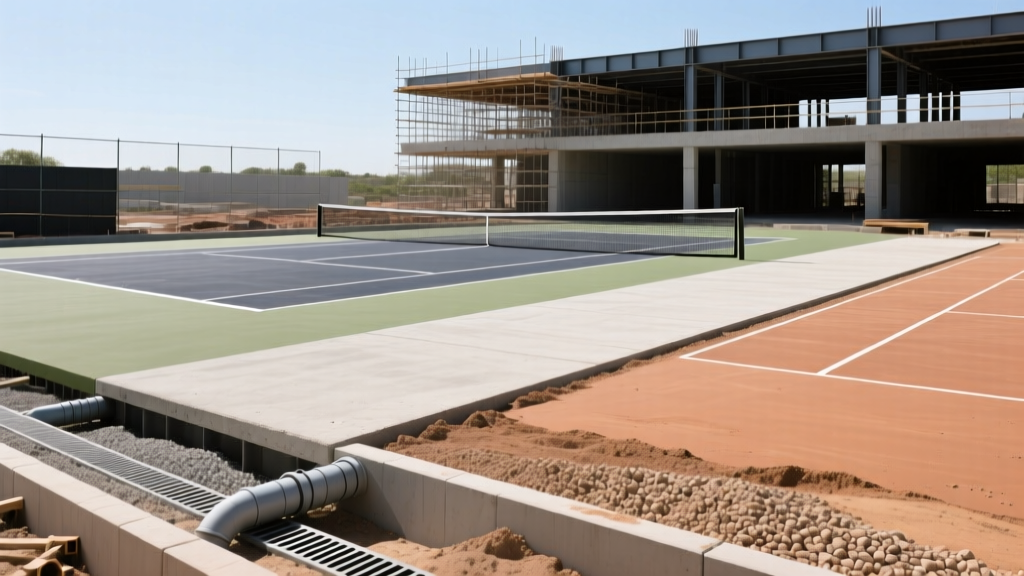
When property owners and facility managers ask how much would it cost to build a tennis court, the answer requires looking far beyond the surface paint. In 2026, the total investment for a single, regulation-sized residential or commercial tennis court ranges from $65,000 to over $150,000. This wide variance is driven by soil conditions, base material engineering, surface type, and auxiliary installations like LED lighting and perimeter fencing.
This cost comparison guide breaks down the exact pricing, material specifications, and long-term lifecycle costs of building a tennis court, ensuring you can budget accurately and avoid catastrophic structural failures.
The Baseline: Dimensions and Site Preparation
Before comparing surface materials, you must account for the footprint. While the actual doubles play area is 36 feet by 78 feet, the United States Tennis Association (USTA) mandates a minimum total site footprint of 108 feet by 54 feet, with a recommended standard of 120 feet by 60 feet to allow for safe player run-off.
Site preparation (earthwork) is the most unpredictable cost variable. A perfectly flat, stable site with sandy loam soil might only require $12,000 in clearing and grading. However, a sloped site with expansive clay or bedrock can push excavation, retaining walls, and laser-grading costs past $35,000.
Never build a perfectly flat court. The American Sports Builders Association (ASBA) requires a minimum slope of 0.83% (1 inch in 10 feet) to a maximum of 1% for proper drainage. This slope must be cut into the base material, not achieved by adding extra surfacing material on top.
Surface Material Cost Comparison Matrix
The surface system dictates the playability, maintenance schedule, and initial capital outlay. Below is a 2026 cost comparison of the five primary tennis court surfaces.
| Surface Type | Total Build Cost (Avg) | Base Requirement | Lifespan Before Major Rehab |
|---|---|---|---|
| Asphalt + Acrylic | $65,000 - $85,000 | 4-6" Asphalt over aggregate | 8-12 Years |
| Post-Tensioned Concrete | $85,000 - $115,000 | 5" PT Concrete slab | 20-25 Years |
| Har-Tru (Green Clay) | $70,000 - $95,000 | Crushed limestone base | Indefinite (Annual top-dress) |
| Modular Polypropylene Tile | $90,000 - $130,000 | Asphalt or Concrete | 15 Years |
| Synthetic Turf (Sand-filled) | $75,000 - $100,000 | Asphalt or Concrete | 10-12 Years |
Hard Court Showdown: Asphalt vs. Post-Tensioned Concrete
Over 80% of hard courts in North America are built on either an asphalt or concrete base, topped with an acrylic color coating system. The choice between the two fundamentally alters your long-term cost of ownership.
Asphalt Base Construction
Asphalt is the traditional, lower-initial-cost option. A proper asphalt base requires a 4-to-6-inch layer of hot-mix asphalt over a compacted aggregate sub-base. The primary vulnerability of asphalt is oxidation. Over time, UV exposure and water penetration cause the asphalt binder to dry out, leading to structural cracking. In 2026, resurfacing an asphalt court (filling cracks, applying new acrylic) costs between $8,000 and $14,000 and must be done every 5 to 8 years.
Post-Tensioned Concrete (PT Concrete)
Standard reinforced concrete (rebar) is highly prone to cracking due to thermal expansion and soil movement, which will telegraph through the acrylic surface and ruin the court. The industry standard for premium concrete courts is Post-Tensioned (PT) concrete. PT concrete uses high-strength steel cables encased in plastic sheathing. After the concrete cures, these cables are tensioned using hydraulic jacks, compressing the slab and preventing structural cracks from opening.
According to ASBA standards, a "bird bath" is any depression on the court surface that holds water deeper than 1/16 inch (the thickness of a nickel) after one hour of drainage. Ensure your contractor's agreement explicitly includes laser-grading and bird-bath patching with Portland cement/binder mixtures before the final acrylic application. Water pooling will degrade the acrylic and cause premature delamination.
Soft Courts: Har-Tru Clay and Synthetic Turf
For players seeking joint-friendly surfaces with slower ball speeds, soft courts are the preferred choice, though they shift costs from initial construction to ongoing maintenance.
- Har-Tru (Green Clay): Made from crushed metabasalt, Har-Tru courts require a specialized crushed limestone base and an intricate subsurface or overhead irrigation system to maintain moisture. While the surface itself can last indefinitely with proper care, annual maintenance (dragging, rolling, and adding 2-3 tons of new top-dressing) costs $2,500 to $4,000 per year. Furthermore, Har-Tru courts must be winterized in freezing climates, adding $1,500 to seasonal costs.
- Synthetic Turf: Sand-filled synthetic turf provides a cushioned, fast-drying surface ideal for residential settings. It requires a hard base (asphalt or concrete) beneath it. The primary cost factor here is the specialized silica sand infill, which must be brushed and replenished periodically to maintain consistent ball bounce and footing.
Essential Add-Ons: Fencing, Lighting, and Equipment
The court surface is only half the equation. Perimeter containment and visibility systems represent a massive portion of the total budget.
Fencing Specifications
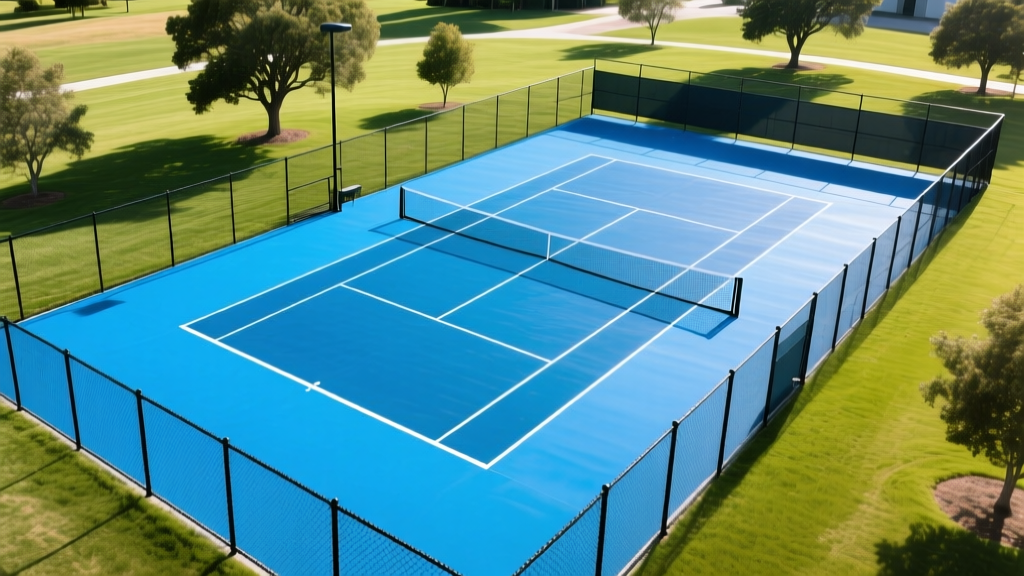
A standard 120' x 60' footprint requires 360 linear feet of fencing. The industry standard is 10-foot-high, 2-inch mesh chain-link. To prevent glare and improve aesthetics, black or dark green vinyl-coated chain-link (meeting ASTM F668 standards) is heavily preferred over galvanized steel. Expect to pay $28 to $38 per linear foot for materials and installation, bringing total fencing costs to $10,000 - $13,600. Include an additional $1,500 for a 4-foot wide double-gate system for equipment access.
LED Lighting Systems
If you plan to play at night, modern LED lighting is mandatory for energy efficiency and light spill reduction. A standard residential court requires four 20-foot to 30-foot poles, each equipped with specialized asymmetric LED fixtures designed to illuminate the court evenly without blinding players looking up for lobs. A high-quality 4-pole LED system (delivering roughly 30-40 foot-candles of illumination) costs between $18,000 and $28,000, including trenching, electrical wiring, and concrete pole footings.
15-Year Lifecycle Cost Analysis
To truly understand how much it costs to build and maintain a tennis court, you must look at the 15-year total cost of ownership (TCO). This metric exposes the hidden expenses of cheaper initial builds.
| Court Type | Initial Build | 15-Year Maintenance | 15-Year TCO |
|---|---|---|---|
| Asphalt Acrylic | $75,000 | $24,000 (2 resurfacings) | $99,000 |
| PT Concrete Acrylic | $100,000 | $12,000 (1 resurfacing) | $112,000 |
| Har-Tru Clay | $85,000 | $52,500 (Annual care) | $137,500 |
Decision Framework: Which Court Fits Your Project?
Use this framework to finalize your construction specifications based on your local environment and budget constraints:
- Choose Post-Tensioned Concrete if: Your site has expansive clay soils, high clay content, or is located in a region with severe freeze-thaw cycles. The upfront premium prevents catastrophic slab heaving that would destroy an asphalt base.
- Choose Asphalt if: You are building on stable, well-draining sandy or gravelly soils, and your primary goal is minimizing the initial capital expenditure while accepting a 5-to-8-year resurfacing cycle.
- Choose Har-Tru Clay if: You are building a multi-court commercial facility or country club where daily maintenance staff is already on payroll, and your target demographic prefers traditional, low-impact tournament play.
- Choose Modular Tile if: You are retrofitting an existing, heavily cracked concrete pad (like an old basketball court) where traditional acrylic resurfacing is impossible. The interlocking tiles bridge existing cracks and provide immediate playability.
Building a tennis court is a major civil engineering project disguised as a recreational amenity. By prioritizing subsurface drainage, laser-graded base materials, and climate-appropriate structural engineering, you ensure the court performs flawlessly for decades, maximizing the return on your investment.
Written by
Marcus ChenMarcus Chen is a licensed structural engineer (PE) and building materials analyst with over 12 years of experience across residential, commercial, and industrial construction. He holds a Master of Science in Civil Engineering from UC Berkeley and spent six years at Thornton Tomasetti before transitioning to independent consulting and technical writing. Marcus specializes in material selection for seismic-prone regions, concrete reinforcement strategies, and lifecycle cost analysis. His work has been cited by the American Concrete Institute (ACI) and the Structural Engineers Association of California (SEAOC). When he is not on a job site or at his desk, you will find him hiking the Sierra Nevada or restoring a 1920s craftsman bungalow in Oakland, CA.
More from Marcus Chen
View all
Construction Cost
How Much Did the Eiffel Tower Cost to Build?
How much did the Eiffel Tower cost to build in 1889? We adjust for inflation and compare its budget to modern skyscraper construction.
Aug 4, 2026

Fire Resistance
What Is a Fire Resistant Material? Testing & Certification Guide
Discover what is a fire resistant material through ASTM and UL testing. Learn how fire ratings, certifications, and assemblies work in construction.
Aug 4, 2026

Construction Cost
How Much Did the Burj Khalifa Cost to Build?
How much did the Burj Khalifa cost to build? We break down the $1.5B project and extract 5 money-saving strategies for your next build.
Jul 30, 2026