How Much Did It Cost to Build Caesars Palace? Financing Breakdown
Explore how much it cost to build Caesars Palace, from its $19M origin to $1B expansions, and learn modern resort construction financing strategies.
The Original 1966 Build: Jay Sarno’s $19 Million Vision
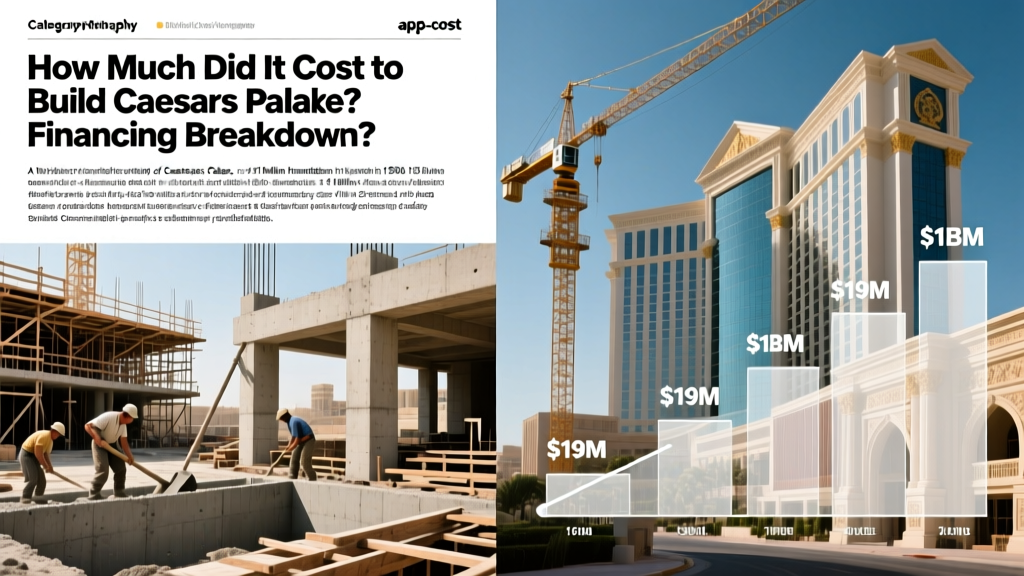
When analyzing the financial history of mega-resorts, the most common question is: how much did it cost to build Caesars Palace? The original construction, completed in 1966 by developer Jay Sarno, cost exactly $19 million. Adjusted for inflation, that equates to roughly $175 million in 2026 dollars. However, the historical cost is only a fraction of the total capital deployed. Today, the cumulative construction and expansion costs for the 85-acre, 3,960-room property exceed $2.5 billion.
Sarno’s initial $19 million was not financed through traditional commercial banks. In the 1960s, mainstream financial institutions considered Las Vegas casino construction a high-risk, morally questionable venture. Instead, Sarno secured a loan from the Teamsters Central States Pension Fund. This historical precedent highlights a core tenet of hospitality construction financing: when traditional senior debt is unavailable due to perceived asset-class risk, developers must turn to alternative capital stacks, private credit, or joint ventures.
The Expansion Era: Funding the Colosseum and Octavius Tower
The true cost of Caesars Palace is found in its relentless, multi-decade expansion phases. As the Las Vegas Strip shifted from a mob-influenced gambling hub to a corporate entertainment destination, the financing mechanisms evolved from opaque pension loans to sophisticated corporate bonds and joint ventures.
Key Expansion Milestones and Capital Deployed
- The Centurion Tower (1970s): Added 600 rooms. Financed through retained earnings and secondary pension fund draws, costing approximately $15 million at the time.
- The Roman Tower (1992): A $100 million+ expansion that signaled the shift toward luxury, non-gaming amenities, financed via early corporate high-yield bond issuances.
- The Colosseum (2003): Costing $95 million, this 4,100-seat entertainment venue was not financed solely on Caesars' balance sheet. It was built via a Joint Venture (JV) with Anschutz Entertainment Group (AEG). AEG provided the operational expertise and shared the capital expenditure (CapEx) burden, mitigating risk for the parent company.
- Octavius Tower (2012): The most expensive single addition, costing $960 million. This 665-room luxury tower was funded through a mix of corporate debt, operating cash flow, and mezzanine financing during a highly volatile post-2008 credit market.
| Project Phase | Year Completed | Original CapEx | 2026 Adjusted CapEx | Primary Financing Vehicle |
|---|---|---|---|---|
| Original Resort | 1966 | $19,000,000 | $175,000,000 | Teamsters Pension Loan |
| Centurion Tower | 1973 | $15,000,000 | $102,000,000 | Retained Earnings / Debt |
| Roman Tower | 1992 | $100,000,000 | $215,000,000 | Corporate High-Yield Bonds |
| The Colosseum | 2003 | $95,000,000 | $158,000,000 | Joint Venture (AEG) |
| Octavius Tower | 2012 | $960,000,000 | $1,280,000,000 | Corporate Debt / Mezzanine |
The Sale-Leaseback Pivot: Unlocking Real Estate Capital
To understand modern resort financing, one must look at how Caesars Palace restructured its balance sheet in the late 2010s. According to data from the UNLV Center for Gaming Research, the heavy debt load from the 2008 leveraged buyout and subsequent expansions nearly bankrupted the operator. The solution was a massive structural pivot: separating the Operating Company (OpCo) from the Property Company (PropCo).
Caesars Entertainment spun off its real estate assets, including the land and physical structures of Caesars Palace, into a Real Estate Investment Trust (REIT) named VICI Properties. As noted in VICI Properties' corporate filings, this sale-leaseback transaction generated billions in immediate liquidity. Caesars Entertainment now pays rent to VICI to operate the resort. For modern commercial developers, this OpCo/PropCo separation is a masterclass in unlocking trapped equity to fund new construction or pay down high-interest senior debt.
Financing Insight: The OpCo/PropCo Strategy
If you are developing a large-scale hospitality or entertainment venue, consider bifurcating your corporate structure. By placing the physical real estate in a PropCo (which can secure lower-interest, long-term mortgage debt based on hard assets) and the business operations in an OpCo (which relies on cash-flow-based credit facilities), you optimize your weighted average cost of capital (WACC) and protect the real estate from operational liabilities.
Modern Commercial Construction Financing Framework
If a developer were to build a comparable 500-room luxury resort and entertainment complex in 2026, the $1.2 billion price tag would require a meticulously structured capital stack. According to development frameworks published by the Urban Land Institute (ULI), modern hospitality construction relies on a layered approach to balance risk and return.
The 2026 Hospitality Capital Stack
- Senior Construction Debt (55% - 65% LTV): Typically priced at SOFR + 300 to 450 basis points. This is the cheapest capital but requires rigorous pre-leasing, anchor tenant commitments (e.g., a branded hotel flag like Marriott or Hilton), and a guaranteed maximum price (GMP) contract with the general contractor.
- Mezzanine Debt (10% - 15%): Subordinate to the senior lender, carrying higher interest rates (10% - 14%). This bridges the gap between the bank's loan-to-value limit and the developer's equity.
- Preferred Equity (10% - 15%): Investors who take a priority claim on cash flow over common equity but sit below all debt in the capital stack. Target returns usually range from 12% to 16%.
- Sponsor Common Equity (15% - 20%): The developer's "skin in the game." This is the most expensive capital, targeting unlevered IRRs of 18%+, but it absorbs the first-loss position if the project faces cost overruns.
Execution Matrix: Choosing the Right Capital Partner
Selecting the right financing partner dictates the design, timeline, and ultimate profitability of your build. Below is a decision matrix for mid-to-large scale commercial hospitality projects.
| Capital Source | Best For | Cost of Capital (2026) | Key Developer Trade-off |
|---|---|---|---|
| Traditional Bank Construction Loan | Stabilized assets with strong pre-leasing and experienced sponsors. | SOFR + 3.5% | Strict covenants, personal guarantees, and rigid draw schedules. |
| Private Credit / Debt Fund | Complex builds, value-add renovations, or sponsors needing speed/flexibility. | SOFR + 6.0% | Higher interest expense, but fewer covenant restrictions and faster closing. |
| Joint Venture (e.g., AEG, Live Nation) | Entertainment-heavy builds requiring specialized operational expertise. | Equity Split (IRR Hurdle) | Dilution of ownership and shared control over venue programming. |
| Sale-Leaseback (REIT) | Developers seeking to recycle capital into new projects immediately post-stabilization. | Cap Rate Yield (6.5% - 8%) | Loss of long-term real estate appreciation; locked into long-term NNN lease. |
Frequently Asked Questions
How do construction draw schedules work for mega-resorts?
For projects exceeding $100 million, senior lenders do not disburse funds upfront. Instead, they use a monthly draw schedule tied to the percentage of completion, verified by an independent third-party engineer. Retainage (typically 5% to 10% of each draw) is held back until substantial completion to ensure subcontractors are paid and lien waivers are secured.
Can I use EB-5 immigrant investor funding for hotel construction?
Yes. The EB-5 Immigrant Investor Program is frequently used in U.S. hospitality construction to fund the mezzanine or preferred equity tranches. Developers must prove that the project will create at least 10 full-time jobs per investor. This capital is often cheaper than traditional mezzanine debt but requires extensive USCIS compliance and longer lock-up periods.
What happens if a resort construction project runs out of capital?
If a project exhausts its capital stack before completion, the senior lender will typically issue a default notice. The developer must either inject additional unencumbered equity, secure a high-cost rescue loan, or surrender the project to the lender via a deed in lieu of foreclosure. This is why maintaining a 10% to 15% hard-cost contingency reserve is mandatory in modern commercial estimating.
Written by
Priya KapoorPriya Kapoor is a real estate market analyst and construction economics researcher with expertise in housing affordability, development feasibility, and infrastructure investment. She holds a Master of Regional Planning from Cornell University and previously worked as a senior analyst at CBRE's Investment Properties group, where she modeled returns for $4B in mixed-use development pipelines. Priya now runs an independent research practice advising developers, municipalities, and REITs on construction cost forecasting and market timing. She publishes the quarterly "BuildMat Market Pulse" report tracking material price indices across 12 commodity categories. Based in Austin, TX, Priya serves on the board of Habitat for Humanity Austin and is a marathon runner.
More from Priya Kapoor
View all
Construction Cost
Cost to Build a 1600 Sq Ft Home in 2026: Full Breakdown
Accurate 2026 cost to build a 1600 sq ft home—material, labor, and regional pricing breakdowns included. Plan your budget with real-time estimates.
Aug 11, 2026

Wood & Lumber
Name the Types of Wood for Pressure Treatment and Preservation
Learn how to name the types of wood best suited for pressure treatment. Compare species treatability, chemical retention levels, and 2026 preservation costs.
Aug 4, 2026

Stone & Masonry
Stone Veneer Suppliers Lindenhurst: 2026 Cost Analysis
Analyze 2026 stone veneer costs in Lindenhurst, NY. Compare local supplier pricing, delivery fees, and Suffolk County installation labor rates.
Aug 4, 2026