True Cost to Build Built in Bookshelves: Budget Planner
Discover the true cost to build built in bookshelves. Compare MDF, plywood, and solid wood pricing, plus labor rates and hardware budgets for your project.
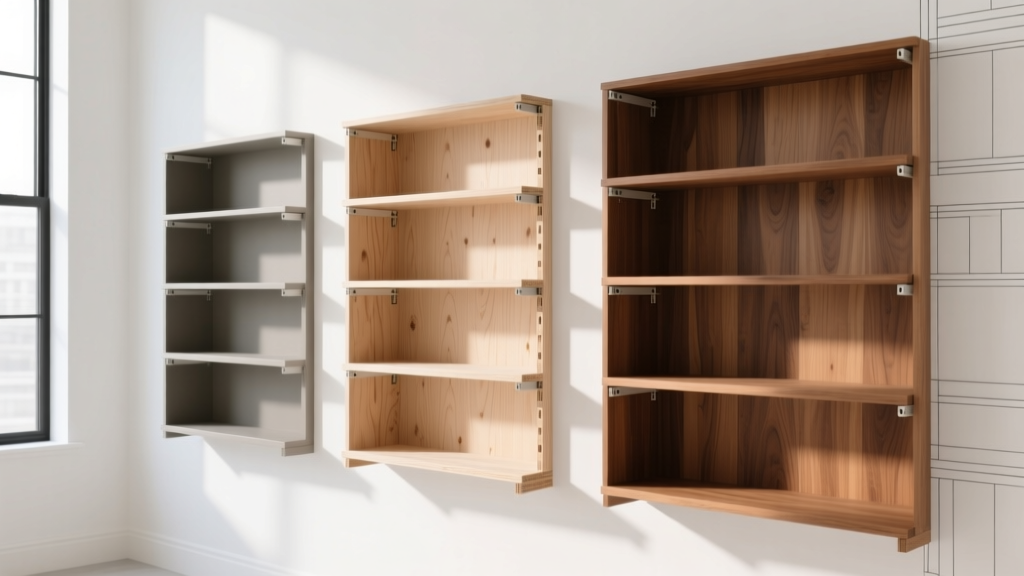
The Anatomy of Built-In Bookshelf Pricing
Estimating the cost to build built in bookshelves requires moving beyond simple square-footage averages. Unlike freestanding furniture, built-ins are architectural elements that demand precise integration with your home's existing framing, electrical systems, and trim profiles. The national average for custom built-in cabinetry ranges from $150 to $300 per linear foot, but this metric often obscures the actual material and labor variables that dictate your final budget.
Baseline Budget Expectations (10-Foot Wide x 8-Foot Tall Unit)
- DIY Material Cost (MDF/Paint Grade): $600 – $950
- DIY Material Cost (Cabinet Plywood/Stain Grade): $1,200 – $1,800
- Professional Installation (Labor + Materials): $3,500 – $7,500+
To build an accurate budget, you must deconstruct the project into four distinct cost centers: sheet goods (carcass and shelving), face frame lumber, hardware/lighting, and finish materials. According to the USDA Forest Products Laboratory Wood Handbook, the structural properties of your chosen sheet goods will directly dictate the required thickness, support spacing, and ultimately, the total board footage required to prevent shelf sag.
Material Matrix: MDF vs. Plywood vs. Hardwood
The single largest budget variable is the core material. Your choice here dictates not only the raw material cost but also the cost of edge banding, fasteners, and finishing supplies.
| Material | Avg. Cost (4x8 Sheet) | Max Span (3/4" Thick) | Best Application |
|---|---|---|---|
| 3/4" MDF (Medium Density Fiberboard) | $45 - $65 | 28 - 32 inches | Painted finishes, budget-conscious DIY |
| 3/4" Cabinet-Grade Plywood (Birch/Oak) | $95 - $140 | 36 - 40 inches | Stained finishes, heavy book loads |
| Solid Hardwood (Poplar - Paint Grade) | $3.50 - $5.00 / bd ft | 30 - 34 inches | Face frames, crown molding, baseboards |
| Solid Hardwood (Walnut/White Oak) | $9.00 - $16.00+ / bd ft | 36 - 42 inches | Premium stain-grade shelving and frames |
The Hidden Cost of Sheet Goods: Edge Banding and Veneers
When calculating the cost to build built in bookshelves using plywood or MDF, beginners frequently forget edge banding. Raw sheet goods expose the layered plywood edge or the fuzzy MDF core, which must be covered for a finished look. Iron-on PVC edge banding costs roughly $0.50 to $0.80 per linear foot, while real wood veneer tape (like FastCap) costs $1.20 to $2.50 per linear foot. For a standard 10-foot unit with 15 shelves, you will need approximately 150 linear feet of banding, adding $75 to $300 to your material budget, plus the cost of a specialized edge-banding trimmer tool ($25-$40).
Labor vs. DIY: Where Your Budget Actually Goes
Professional carpenters and custom cabinet makers typically charge between $75 and $150 per hour, or bid projects at a fixed rate of $200 to $350 per linear foot. A 10-foot wide, floor-to-ceiling built-in requires roughly 25 to 40 hours of skilled labor for cutting, assembly, scribing to uneven walls, and finishing.
No wall is perfectly plumb, and no floor is perfectly level. Professional bids include 'scribing'—the process of custom-cutting the side panels and filler strips to match the exact undulations of your drywall. If you are DIYing, budget an extra 15% for trim and filler pieces to hide gaps, and invest in a high-quality scribing tool and a bevel gauge. Failing to account for out-of-plumb walls is the number one cause of blown budgets and ruined materials in built-in projects.
If you choose the DIY route to reduce the cost to build built in bookshelves, you must factor in tool acquisition. Assuming you already own a miter saw and drill, you will still need a track saw or table saw for breaking down sheet goods ($300-$500), a Kreg pocket hole jig system ($50-$120), and an edge-banding iron. As detailed in guides from The Family Handyman, building the carcass in modular sections (e.g., three 32-inch wide boxes) in your garage and assembling them in place drastically reduces the need for expensive, space-consuming equipment in the room itself.
Hardware, Lighting, and Finish Budgets
The 'invisible' costs of built-ins often derail budgets. High-end hardware and integrated lighting transform basic boxes into custom architectural features.
- Shelf Supports: Standard metal pegs cost $0.10 each. Upgrading to hidden shelf pins or brass spoon rests costs $0.75 to $1.50 per shelf. For a 40-shelf unit, budget $40 to $60.
- Integrated Lighting: Routing a 1/2-inch dado into the underside of each shelf for 24V COB LED strip lights requires aluminum channels with snap-in polycarbonate diffusers ($3-$5 per foot) and the LED strips themselves ($2-$4 per foot). Budget $250-$400 for a fully illuminated 10-foot unit, plus $100 for a dimmable LED driver and transformer concealment box.
- Paint and Primer: MDF acts like a sponge. You must seal it with a shellac-based primer like Zinsser B-I-N ($25/quart) to prevent swelling. For the topcoat, use a self-leveling alkyd urethane, such as Sherwin-Williams Emerald Urethane Trim Enamel ($95/gallon), which sprays and brushes like oil but cleans up with water. Budget $150-$200 for primer and paint for a standard 10-foot unit.
- Fasteners and Glue: Titebond III wood glue, 2-inch pocket screws, and 18-gauge brad nails. Budget $45.
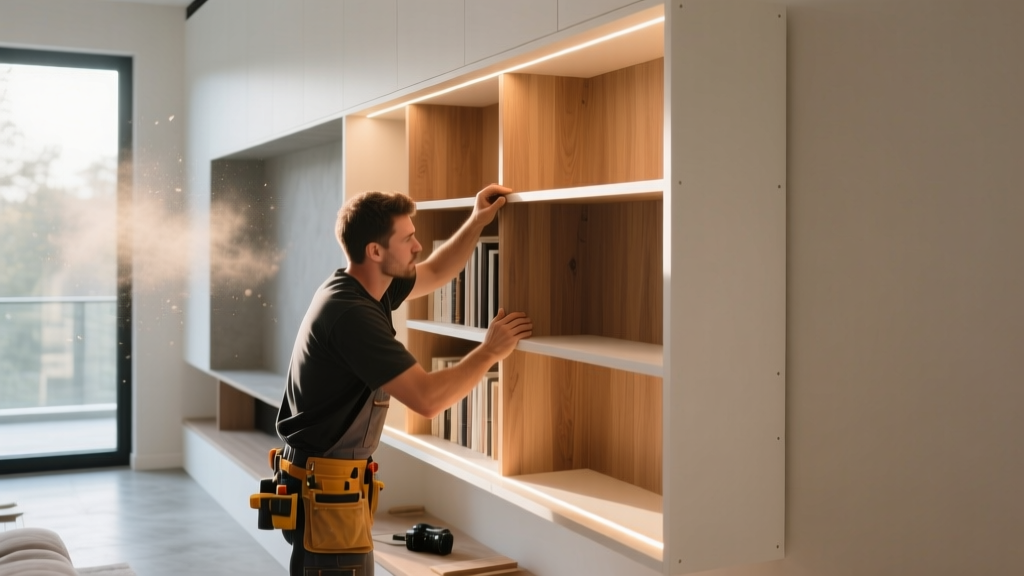
Step-by-Step Budgeting Framework for a 10-Foot Wall
To synthesize these variables, here is a precise budgeting framework for a 10-foot wide, 8-foot tall painted built-in unit featuring a 30-inch lower cabinet base with doors, and open shelving above.
- Carcass Material (3/4" MDF): 6 sheets @ $55 = $330
- Face Frame & Trim (Poplar): 60 board feet @ $4.00 = $240
- Base Cabinet Doors (Custom MDF Shaker): 4 doors outsourced @ $85 each = $340
- Edge Banding & Adhesives: PVC tape and contact cement = $65
- Hardware (Blum soft-close hinges & pulls): 4 pairs @ $15/pair + pulls = $90
- Lighting (LED strips, channels, driver): Complete kit = $310
- Finishing (BIN Primer + Urethane Enamel): $160
- Consumables (Sandpaper, brads, pocket screws): $65
This framework yields a high-end, custom-looking result. To reduce this cost to the $800-$900 range, eliminate the integrated lighting, build your own doors from MDF and poplar stiles, and use standard butt-hinges instead of premium concealed hardware.
Common Budget Traps and How to Avoid Them
1. Ignoring the Sagulator
Woodworkers use a mathematical concept called the 'Sagulator' to calculate shelf deflection. A 3/4-inch MDF shelf loaded with 30 pounds of books per linear foot will visibly sag if the span exceeds 30 inches. If you design your built-ins with 36-inch wide bays using MDF, you will eventually need to retrofit them with hardwood nosing or metal stiffeners, destroying your initial budget and aesthetic. Always design bays to 30-32 inches wide when using MDF, or upgrade to plywood for wider spans.
2. Baseboard and HVAC Interference
Removing existing baseboards to allow the built-in carcass to sit flush against the drywall is mandatory. However, if your room contains baseboard HVAC radiators, floor vents, or return air grilles, you must budget for custom toe-kick venting and HVAC rerouting. An HVAC professional will charge $300-$600 to reroute floor ducts into the toe-kick space of your new cabinetry using specialized transition boots.
3. Electrical Code Violations
Integrating lighting means dealing with electrical codes. You cannot simply bury a junction box behind a fixed shelf. The National Electrical Code (NEC) requires junction boxes to remain accessible. Budget $150-$250 for an electrician to install a recessed, accessible outlet inside one of the lower base cabinets to plug in your LED transformer, ensuring your installation passes local inspections and doesn't become a fire hazard.
By meticulously calculating material spans, accounting for wall irregularities, and selecting finishes engineered for cabinetry rather than standard drywall, you can accurately forecast the cost to build built in bookshelves and avoid the financial surprises that plague poorly planned remodeling projects.
Written by
Marcus ChenMarcus Chen is a licensed structural engineer (PE) and building materials analyst with over 12 years of experience across residential, commercial, and industrial construction. He holds a Master of Science in Civil Engineering from UC Berkeley and spent six years at Thornton Tomasetti before transitioning to independent consulting and technical writing. Marcus specializes in material selection for seismic-prone regions, concrete reinforcement strategies, and lifecycle cost analysis. His work has been cited by the American Concrete Institute (ACI) and the Structural Engineers Association of California (SEAOC). When he is not on a job site or at his desk, you will find him hiking the Sierra Nevada or restoring a 1920s craftsman bungalow in Oakland, CA.
More from Marcus Chen
View all
Construction Cost
How Much Did the Eiffel Tower Cost to Build?
How much did the Eiffel Tower cost to build in 1889? We adjust for inflation and compare its budget to modern skyscraper construction.
Aug 4, 2026

Fire Resistance
What Is a Fire Resistant Material? Testing & Certification Guide
Discover what is a fire resistant material through ASTM and UL testing. Learn how fire ratings, certifications, and assemblies work in construction.
Aug 4, 2026

Construction Cost
How Much Did the Burj Khalifa Cost to Build?
How much did the Burj Khalifa cost to build? We break down the $1.5B project and extract 5 money-saving strategies for your next build.
Jul 30, 2026