Cost to Build a Campground: 2026 Financing & ROI Guide
Explore the true cost to build a campground in 2026. This financing guide breaks down per-pad CapEx, SBA and USDA loans, and lender ROI requirements.
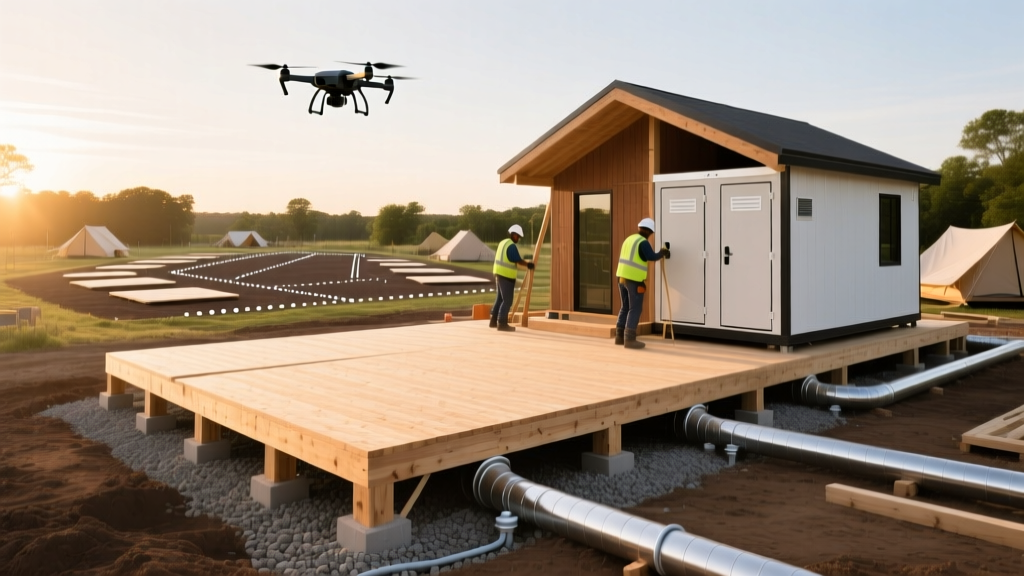
The True Cost to Build a Campground: Capital Expenditure Breakdown
Calculating the accurate cost to build a campground requires moving beyond generic per-acre estimates and focusing on per-pad infrastructure hard costs. In 2026, developers face a landscape where material stabilization has offset some inflation, but specialized labor for utility trenching and environmental compliance remains a premium expense. Ground-up campground development typically ranges from $15,000 to $45,000 per developed site, excluding raw land acquisition.
2026 Baseline CapEx Metrics
- Raw Land Prep (Clearing/Grading): $4,500 - $8,000 per acre
- Road Construction (Class II Base + Asphalt): $120 - $180 per linear foot
- Utility Trenching (Water/Sewer/Electric): $65 - $95 per linear foot
- Bathhouse Construction: $350 - $500 per square foot
To understand where your capital will be deployed, evaluate the cost matrix across different site typologies. Luxury glamping and premium concrete RV pads demand significantly higher upfront capital but yield superior Average Daily Rates (ADR) and lower long-term maintenance.
| Site Typology | Pad Dimensions & Material | Utility Specifications | Est. Cost Per Pad |
|---|---|---|---|
| Standard Tent Site | 20x30 ft, compacted gravel | Shared water spigot, no electric | $2,500 - $4,500 |
| Premium RV Pull-Through | 20x60 ft, poured concrete | 50/30/20 Amp, dedicated water/sewer | $18,000 - $24,000 |
| Luxury Glamping Deck | 16x16 ft, composite decking | 30 Amp, dedicated water, smart lock | $15,000 - $22,000 |
| Cabin/ Park Model Pad | 40x60 ft, engineered gravel base | 100 Amp panel, municipal sewer tie-in | $28,000 - $38,000 |
Strategic Financing Vehicles for Campground Development
Traditional commercial real estate (CRE) lenders often misclassify campgrounds as high-risk hospitality ventures, resulting in punitive interest rates or low loan-to-value (LTV) ratios. Successful developers leverage specialized government-backed programs designed for outdoor recreation and rural development.
SBA 7(a) Loans for Ground-Up and Acquisition
The SBA 7(a) loan program remains the premier financing vehicle for campground development, offering loans up to $5 million. For ground-up construction, lenders typically require a 15% to 20% equity injection, while acquiring an existing, cash-flowing campground may only require 10% down. The primary advantage is the amortization period: SBA loans allow for 25-year fully amortized terms on real estate, drastically lowering monthly debt service and improving early-stage cash flow.
USDA Business & Industry (B&I) Loan Guarantees
If your target parcel is located in a rural area with a population under 50,000, the USDA Business & Industry (B&I) Loan Guarantee program is highly advantageous. The USDA guarantees up to 80% of the loan, incentivizing local community banks to lend on specialized outdoor hospitality projects. B&I loans require rigorous environmental assessments and a demonstrable job creation narrative, but they offer highly competitive rates and flexible collateral structures that include business assets and receivables.
Best for Land Acquisition
SBA 504 Loan: Ideal for purchasing heavy acreage. Requires 10% down, fixed-rate real estate financing, but cannot be used for working capital or site grading.
Best for Infrastructure
Equipment Financing: Use specialized lenders for above-ground assets like modular bathhouses, solar arrays, and heavy grading equipment to preserve CRE borrowing capacity.
Best for Rural Expansion
USDA B&I: Unmatched for rural resorts. Combines real estate, working capital, and infrastructure into a single guaranteed facility.
Infrastructure Hard Costs: Where Budgets Bleed
The most common failure mode in campground pro formas is underestimating subterranean infrastructure. Compliance with NFPA 1194 (Standard for Recreational Vehicle Parks and Campgrounds) dictates strict spacing, utility separation, and fire lane requirements that drastically alter site density.
- Electrical Pedestals: Do not use residential meter bases. Specify RV-rated pedestals like the Milbank 4009-87596 (50/30/20 Amp configuration). Budget $900 to $1,250 per unit, including the trenching and copper wiring back to the main switchgear.
- Sewer Disposal: If municipal sewer is unavailable, engineered septic systems or modular wastewater treatment plants (WWTP) are required. A 50-site park may require a $150,000 to $250,000 aerobic treatment unit, which must be factored into the initial CapEx.
- Stormwater Management: Impervious surfaces (concrete pads, asphalt roads) trigger strict EPA and local runoff regulations. Budget $15,000 to $30,000 for engineered retention ponds and bioswales per 5 acres of development.
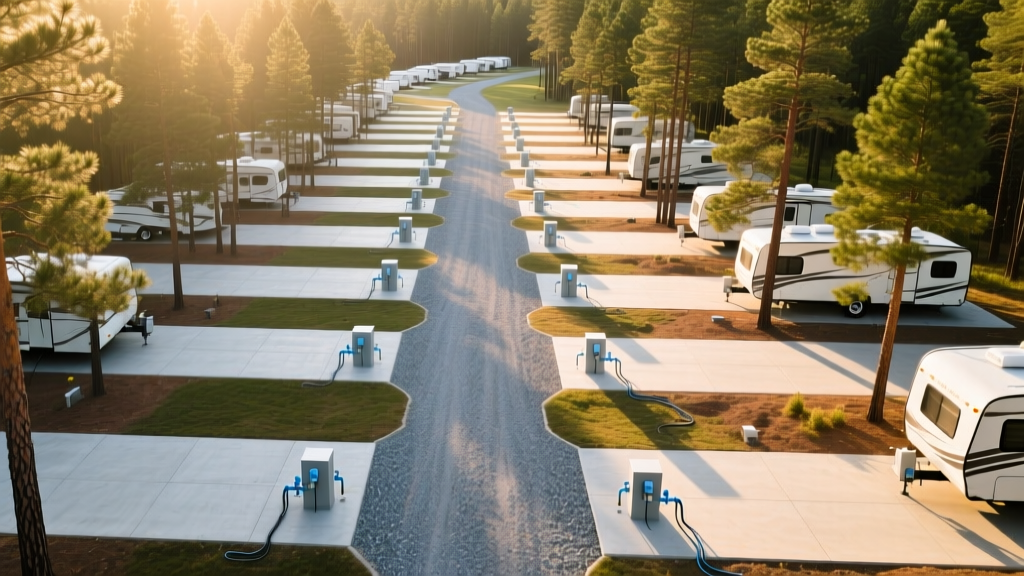
Pro Forma Metrics: What Lenders Demand in 2026
Securing capital requires presenting a pro forma that aligns with institutional risk models. Lenders evaluating the cost to build a campground will scrutinize your Debt Service Coverage Ratio (DSCR) and capitalization rates. Follow the SBA business plan guidelines to ensure your financial projections meet federal underwriting standards.
"Lenders in the outdoor hospitality sector require a minimum DSCR of 1.25x to 1.35x. If your Year 2 projected Net Operating Income (NOI) is $200,000, your maximum allowable annual debt service is $153,000. Developers who artificially inflate occupancy rates past 65% in Year 1 projections will face immediate rejection from SBA preferred lenders."
To build a resilient financial model, base your revenue projections on a blended ADR (Average Daily Rate). In 2026, premium RV sites command $85 to $120 per night, while luxury glamping tents push $200 to $350 per night. Factor in a 30% operating expense ratio for property management, utilities, insurance, and reservation software fees (e.g., Campspot or RoverPass).
Phased Development Strategy to Mitigate Risk
Rather than securing a massive $4M loan to build 100 pads simultaneously, sophisticated developers utilize a phased infrastructure approach. This reduces initial debt service and allows the market to dictate future site typologies.
- Phase 1: Core Infrastructure & Anchor Sites (Months 1-8)
Install the main arterial roads, primary water/sewer mains, and the bathhouse. Develop 25 to 30 premium RV pads to generate immediate cash flow and establish an operational track record. - Phase 2: Stabilization & Refinancing (Months 9-18)
Once Phase 1 reaches 60% stabilized occupancy, utilize the established NOI to secure a cash-out refinance or a secondary construction draw. Use this capital to fund Phase 2. - Phase 3: High-Margin Additions (Months 19-24)
Deploy Phase 2 capital into high-yield, low-impact assets like glamping domes, cabin rentals, and amenity upgrades (dog parks, outdoor amphitheaters) that drive ancillary revenue without requiring heavy subterranean utility work.
By aligning your capital stack with a phased development timeline, you protect your equity, satisfy lender DSCR requirements, and ensure the final cost to build a campground yields a sustainable, high-margin outdoor hospitality asset.
Written by
Elena RodriguezElena Rodriguez is a civil engineer and technical writer specializing in concrete technology, masonry systems, and ASTM/ACI compliance. She earned her B.S. in Civil Engineering from Texas A&M University and spent a decade at a materials testing laboratory, performing over 2,000 concrete compressive strength tests and masonry prism evaluations. Elena is an ACI-certified Field Testing Technician (Grade I) and a member of ASTM Committee C12 on Natural Building Stone. She currently consults on forensic engineering cases involving concrete failures and moisture intrusion. Based in San Antonio, TX, Elena is a proud member of the Society of Women Engineers (SWE) and coaches her daughter's FIRST Robotics team.
More from Elena Rodriguez
View all
Walls & Panels
Cost Analysis: Light Gauge Steel Framing Advantages and Disadvantages
Evaluate light gauge steel framing advantages and disadvantages through a strict cost analysis lens, comparing material, labor, and lifecycle expenses.
Aug 4, 2026

Walls & Panels
Gypsum Board Types: Exact Specifications, Thickness & Dimensions
Compare standard, Type X, and moisture-resistant gypsum board types. Get exact specifications, thicknesses, dimensions, and ASTM standards for your project.
Aug 4, 2026

Fire Resistance
Best Fire-Resistant Outdoor Decking Materials: 2026 Buyer Guide
Discover the best fire-resistant outdoor decking materials for 2026. Compare Class A PVC, aluminum, and hardwood options for WUI compliance and safety.
Aug 4, 2026