Cost to Build a House in Arizona: 2026 Money-Saving Strategies
Discover actionable strategies to lower the cost to build a house in Arizona. Learn climate-specific material swaps, foundation hacks, and 2026 pricing.
The True Baseline: 2026 Arizona Construction Costs
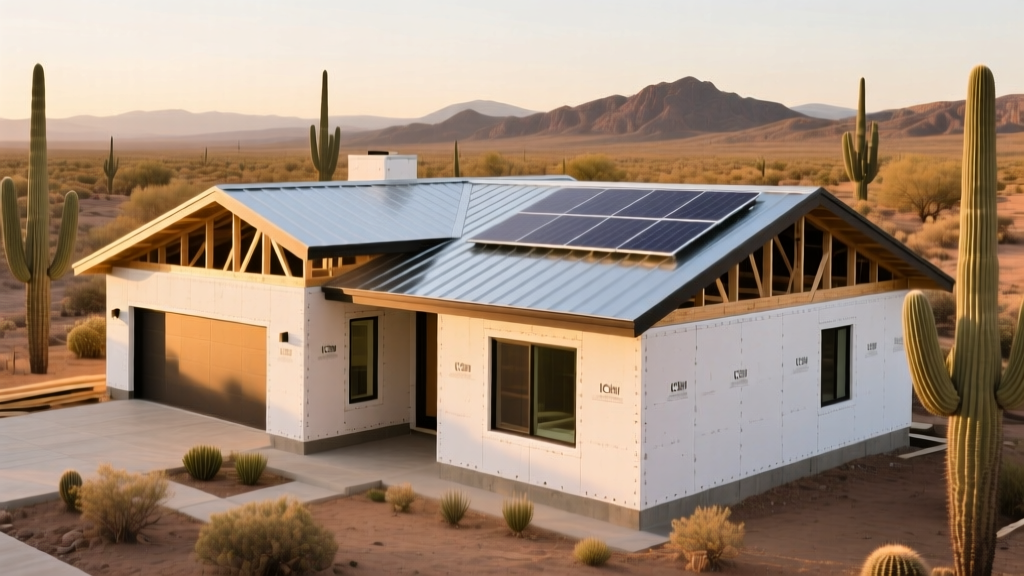
In 2026, the baseline cost to build a house in Arizona ranges from $165 to $245 per square foot for a custom, site-built home, according to regional adjustments tracked by the National Association of Home Builders (NAHB). However, generic national averages fail to account for the Sonoran Desert's extreme thermal dynamics and unique geological profile. To effectively manage your budget, you must shift your focus from national cost-per-square-foot metrics to climate-specific material performance and local labor scheduling. The most successful Arizona builds do not just cut upfront material costs; they strategically reallocate budget toward passive cooling and soil mitigation to prevent catastrophic long-term expenses.
The Caliche Foundation Trap: Post-Tension vs. Traditional Slabs
One of the most expensive surprises for out-of-state builders and homeowners in Maricopa and Pinal counties is caliche—a hardened, concrete-like layer of calcium carbonate found just below the topsoil. Excavating caliche for traditional trench footings burns through heavy equipment teeth and requires specialized rock-breaking attachments, adding $4 to $7 per linear foot in excavation premiums.
The Money-Saving Strategy: Specify a post-tension (PT) slab foundation. Instead of digging deep grade beams through the caliche, a PT slab uses high-strength steel cables tensioned to 33,000 psi after the concrete cures. This compresses the slab, making it highly resistant to the expansive soil movement common in Arizona. On a 2,500-square-foot footprint, a PT slab typically saves $3,500 to $6,000 compared to a traditional stiffened raft foundation requiring deep caliche excavation.
Climate-Driven Envelope Swaps That Slash Long-Term Costs
Arizona falls primarily into IECC Climate Zones 2 and 3, where cooling loads dominate. The Building America Solution Center emphasizes that thermal bridging and solar heat gain are the primary culprits behind inflated utility bills in the Southwest. Upgrading your building envelope yields a faster ROI in Arizona than almost anywhere else in the country.
Window Specifications: SHGC Over U-Factor
In northern climates, buyers obsess over a window's U-factor (insulation value). In Arizona, your priority must be the Solar Heat Gain Coefficient (SHGC). Standard dual-pane Low-E windows often carry an SHGC of 0.35 to 0.40, which allows too much solar radiation into the home. Specify Low-E3 or Low-E4 glazing with an SHGC of 0.22 or lower. The upfront premium is roughly $40 to $60 per window, but it reduces peak HVAC load by up to 12%, allowing you to install a smaller, cheaper air conditioning unit.
| Envelope Upgrade | Upfront Cost Premium (2,500 sq ft) | 10-Year Energy Savings | Payback Period |
|---|---|---|---|
| Low-E3 Windows (SHGC ≤ 0.22) | $1,200 - $1,800 | $2,400 - $3,100 | 4.5 Years |
| Huber Zip-R Continuous Wall Insulation | $3,500 - $4,800 | $1,800 - $2,200 | 12 Years |
| Open-Cell Spray Foam (R-38 Ceiling) | $2,500 - $3,200 | $3,500 - $4,500 | 6 Years |
HVAC Right-Sizing and the SEER2 Mandate
A common, costly mistake in Arizona custom builds is allowing HVAC contractors to use "rules of thumb" (e.g., 1 ton of cooling per 500 square feet). This leads to massive oversizing. An oversized unit will "short-cycle"—turning on and off rapidly. Short-cycling fails to dehumidify the air, causes premature compressor burnout, and spikes electricity usage.
Actionable Step: Mandate a strict ACCA Manual J load calculation before purchasing equipment. Furthermore, while the federal minimum SEER2 rating is 14.3, aim for a 16+ SEER2 variable-speed heat pump. Check the Arizona Public Service (APS) or SRP rebate portals prior to finalizing your HVAC bid, as local utilities frequently offer $400 to $800 instant rebates for high-efficiency variable-speed units that effectively offset the upgrade cost.
Water Mandates: Xeriscaping vs. Hardscaping Economics
The Arizona Department of Water Resources (ADWR) enforces strict outdoor water use regulations, particularly in Active Management Areas (AMAs) like Phoenix and Tucson. Budgeting for traditional turf is not just an ongoing water expense; it often violates municipal landscaping codes for new builds.
Desert Landscaping Cost Matrix
- Basic Xeriscaping (Decomposed granite, native boulders, minimal plants): $6 - $9 per sq. ft. Lowest maintenance, but offers zero ambient cooling.
- Artificial Turf: $11 - $16 per sq. ft. Hidden Cost: Synthetic turf can reach surface temperatures of 150°F+ in July, radiating heat against your home's exterior and increasing your cooling load.
- Strategic Shade Hardscaping: $14 - $22 per sq. ft. Combining permeable pavers with native, low-water shade trees (like the Desert Museum Palo Verde) on the west and south elevations. This provides the highest ROI by physically blocking solar radiation from hitting your stucco and windows.
Summer Construction Realities: Beating the Heat Premium
The timing of your build drastically alters the cost to build a house in Arizona. Pouring concrete and framing during the peak summer months (June through August) introduces severe "heat premiums." When ambient temperatures exceed 100°F, concrete cures too quickly, leading to structural cracking. To combat this, ready-mix suppliers charge $50 to $100 extra per cubic yard for chilled water or flaked ice in the mix. Additionally, labor crews require night-shift scheduling, which incurs 15% to 20% labor premiums for temporary lighting and hazard pay.
Expert Scheduling Tip: To optimize your budget, schedule your site work, foundation, and framing phases between November and February. Save the interior drywall, cabinetry, and flooring installations for the peak summer months when your crew can work comfortably indoors under temporary AC or evaporative coolers.
Frequently Asked Questions
Is it cheaper to build or buy an existing home in Arizona right now?
In 2026, buying an existing home in the Phoenix metropolitan area is generally cheaper per square foot than building custom, primarily due to the inflated cost of land acquisition and site-prep. However, older Arizona homes (built before 2015) often feature single-pane windows, R-13 wall insulation, and 10-SEER AC units. When you factor in the $30,000 to $50,000 required to retrofit an older home's envelope and HVAC to modern efficiency standards, the gap between building new and buying old narrows significantly.
Do I need a vapor barrier in my Arizona walls?
No. Installing a Class I vapor retarder (like polyethylene sheeting) on the interior side of your walls is a catastrophic mistake in Arizona. Because your AC runs constantly, the interior of your home is cold and dry, while the exterior is hot and humid during the monsoon season. Moisture will drive from the outside in. If it hits an interior vapor barrier, it will condense inside your wall cavity, causing black mold and wood rot. Use a vapor-permeable house wrap (like Tyvek) on the exterior and standard latex paint on the interior drywall to allow the wall assembly to dry.
Written by
Marcus ChenMarcus Chen is a licensed structural engineer (PE) and building materials analyst with over 12 years of experience across residential, commercial, and industrial construction. He holds a Master of Science in Civil Engineering from UC Berkeley and spent six years at Thornton Tomasetti before transitioning to independent consulting and technical writing. Marcus specializes in material selection for seismic-prone regions, concrete reinforcement strategies, and lifecycle cost analysis. His work has been cited by the American Concrete Institute (ACI) and the Structural Engineers Association of California (SEAOC). When he is not on a job site or at his desk, you will find him hiking the Sierra Nevada or restoring a 1920s craftsman bungalow in Oakland, CA.
More from Marcus Chen
View all
Construction Cost
How Much Did the Eiffel Tower Cost to Build?
How much did the Eiffel Tower cost to build in 1889? We adjust for inflation and compare its budget to modern skyscraper construction.
Aug 4, 2026

Fire Resistance
What Is a Fire Resistant Material? Testing & Certification Guide
Discover what is a fire resistant material through ASTM and UL testing. Learn how fire ratings, certifications, and assemblies work in construction.
Aug 4, 2026

Construction Cost
How Much Did the Burj Khalifa Cost to Build?
How much did the Burj Khalifa cost to build? We break down the $1.5B project and extract 5 money-saving strategies for your next build.
Jul 30, 2026