Cost to Build a House in Colorado: 2026 Size & Scope Calculator
Calculate the 2026 cost to build a house in Colorado. Break down regional pricing, snow load framing, expansive soil foundations, and WUI codes.
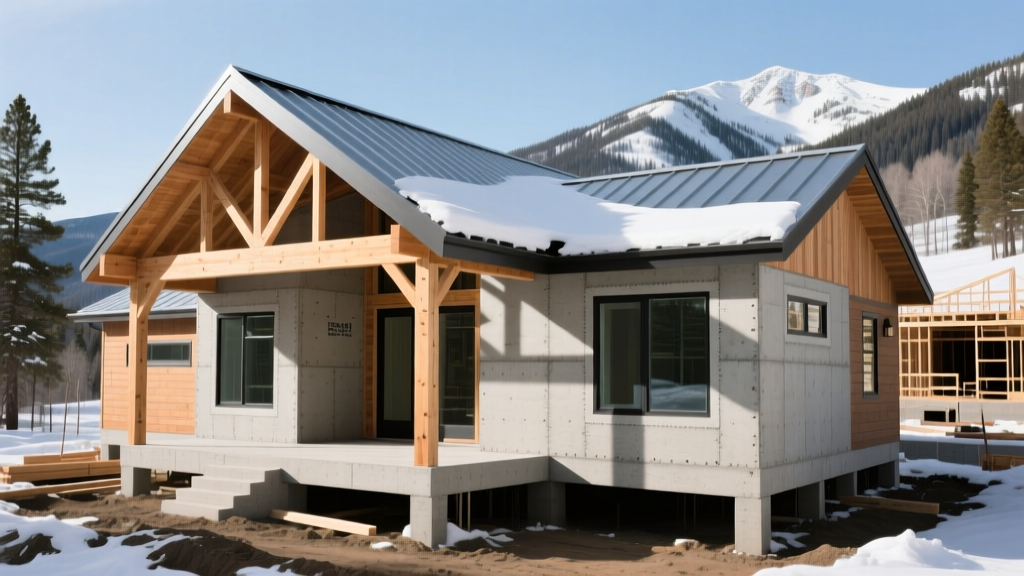
The Colorado Construction Cost Matrix: Regional Base Rates
Estimating the cost to build a house in Colorado requires abandoning the national average. The state's extreme topographical and climatic shifts create three distinct construction micro-economies. According to regional tracking by the U.S. Census Bureau and local builder associations, labor availability and material transport logistics dictate baseline pricing before any site-specific engineering is applied.
| Region | Key Markets | 2026 Base Cost (Per Sq Ft) | Primary Cost Drivers |
|---|---|---|---|
| Front Range | Denver, Boulder, Colorado Springs | $235 - $295 | Expansive soils, high permit fees, labor competition |
| Mountain / Resort | Summit, Eagle, Pitkin, Routt | $385 - $550+ | Extreme snow loads, WUI codes, remote logistics |
| Plains / Western Slope | Grand Junction, Pueblo, Eastern Plains | $190 - $245 | Standard foundations, lower impact fees, wind mitigation |
Size & Scope Calculator: Breaking Down the Square Footage
When running a size and scope calculation for a Colorado build, economies of scale apply heavily to the interior envelope, but site work remains a fixed, high-cost variable. A 3,500-square-foot home does not cost proportionally less per square foot than a 2,000-square-foot home if both require the same deep-pier foundation engineering.
2026 Cost Allocation for a 2,500 Sq Ft Front Range Build
Based on current data mirroring the National Association of Home Builders (NAHB) construction cost surveys, adjusted for Colorado's regional multipliers, here is how a $625,000 ($250/sq ft) budget allocates across the build phases:
- Site Work & Foundation (14% | $87,500): Excavation, soil engineering, drilled piers, and flatwork.
- Framing & Exterior Shell (22% | $137,500): Lumber, engineered trusses, roof decking, windows, and siding.
- Major Systems (MEP) (15% | $93,750): HVAC (including ERV systems for tight envelopes), plumbing, and electrical.
- Interior Finishes (28% | $175,000): Drywall, flooring, cabinetry, trim, and paint.
- Soft Costs & Permits (11% | $68,750): Architectural plans, structural engineering, tap fees, and municipal permits.
- Builder Margin & Contingency (10% | $62,500): Overhead, profit, and a 5% material escalation buffer.
Critical Colorado Scope Variables (The Hidden Multipliers)
Standard online calculators fail in Colorado because they ignore geotechnical and climatic mandates. Your scope must account for these three non-negotiable engineering requirements.
1. Expansive Soil & Foundation Engineering
The Front Range and parts of the Western Slope sit atop Pierre Shale and bentonite clay. When wet, these soils can expand upward with enough force to crack standard slab-on-grade foundations.
The Fix: Structural engineers will mandate a drilled pier (caisson) and structural grade beam foundation. Concrete piers are drilled 15 to 30 feet down to stable bedrock or load-bearing strata, and a suspended structural floor is poured above the expansive soil, leaving a 2-to-4-inch void.
Cost Impact: Adds $18 to $28 per square foot of footprint area compared to a standard monolithic slab.
2. High-Altitude Snow Load & Roof Framing
The International Residential Code (IRC) maps dictate ground snow loads. While Denver sits at a manageable 20-30 psf (pounds per square foot), mountain towns like Breckenridge or Vail require engineering for 100 to 130 psf.
The Fix: Standard 2x6 trusses at 24" O.C. will fail inspection. You must scope 2x10 or 2x12 roof rafters at 16" O.C., reinforced with LVL (Laminated Veneer Lumber) ridge beams and heavy-duty hurricane ties. Many mountain builders opt for Structural Insulated Panels (SIPs) for the roof to handle the loads while achieving the R-40+ insulation required by high-altitude energy codes.
Cost Impact: Adds $12,000 to $25,000 to the framing and roofing budget for a 2,500 sq ft home.
3. Wildfire Mitigation (WUI Code Compliance)
If your lot is in a designated Wildland-Urban Interface (WUI) zone—which covers vast swaths of Jefferson, Boulder, and El Paso counties—you must comply with strict ignition-resistant building codes. The Colorado State Forest Service outlines the necessity of creating defensible space, which directly impacts material selection.
The Fix: Scope a Class A fire-rated roof (standing seam metal or concrete tile), fully enclosed eaves to prevent ember intrusion, and dual-pane tempered glass windows. You must also budget for a 5-foot non-combustible "ember-resistant zone" immediately surrounding the foundation, utilizing crushed rock or poured concrete instead of wood mulch.
Cost Impact: Upgrades to WUI-compliant exterior materials typically add $25,000 to $40,000 to the exterior envelope budget.
Before purchasing land, verify the municipal water and sewer tap fees. In several Front Range and mountain municipalities, a single 3/4-inch water tap fee can range from $15,000 to over $35,000. This is a hard, upfront soft cost that does not yield any physical square footage.
Step-by-Step: Calculating Your Specific Build
Use this sequential framework to build your custom size and scope estimate:
- Establish the Base Envelope: Multiply your target heated square footage by the regional base rate (e.g., 2,500 sq ft × $250 = $625,000).
- Apply the Topography Multiplier: If building on a slope greater than 15%, add 8-12% for stepped foundations, retaining walls, and specialized excavation equipment access.
- Calculate Geotechnical Adders: Review the county soils map. If in an expansive soil zone, add $22/sq ft of the *footprint* (not total heated space) for drilled piers.
- Factor in Energy Code Upgrades: Colorado's adoption of the 2021 IECC (with local amendments) requires tighter envelopes. Add $8,000-$12,000 for continuous exterior insulation (e.g., 2-inch polyiso board) and ERV/HRV mechanical ventilation systems.
- Sum the Soft Costs: Calculate 12% of your hard construction costs for architectural design, structural engineering, surveys, and municipal building permits.
Expert Verdict: Where to Allocate Your Budget
When finalizing your scope calculator inputs, prioritize spending on the structural shell and geotechnical engineering. In Colorado, the climate and soil will actively attempt to destroy a poorly engineered foundation and envelope. Skimping on drilled piers to afford higher-end quartz countertops is a catastrophic misallocation of capital. Conversely, interior finishes like flooring, lighting fixtures, and cabinet hardware can be easily upgraded over time. Lock in a heavily reinforced, hyper-insulated shell first, and let the interior finishes flex to accommodate the remainder of your financing.
Written by
Priya KapoorPriya Kapoor is a real estate market analyst and construction economics researcher with expertise in housing affordability, development feasibility, and infrastructure investment. She holds a Master of Regional Planning from Cornell University and previously worked as a senior analyst at CBRE's Investment Properties group, where she modeled returns for $4B in mixed-use development pipelines. Priya now runs an independent research practice advising developers, municipalities, and REITs on construction cost forecasting and market timing. She publishes the quarterly "BuildMat Market Pulse" report tracking material price indices across 12 commodity categories. Based in Austin, TX, Priya serves on the board of Habitat for Humanity Austin and is a marathon runner.
More from Priya Kapoor
View all
Construction Cost
Cost to Build a 1600 Sq Ft Home in 2026: Full Breakdown
Accurate 2026 cost to build a 1600 sq ft home—material, labor, and regional pricing breakdowns included. Plan your budget with real-time estimates.
Aug 11, 2026

Wood & Lumber
Name the Types of Wood for Pressure Treatment and Preservation
Learn how to name the types of wood best suited for pressure treatment. Compare species treatability, chemical retention levels, and 2026 preservation costs.
Aug 4, 2026

Stone & Masonry
Stone Veneer Suppliers Lindenhurst: 2026 Cost Analysis
Analyze 2026 stone veneer costs in Lindenhurst, NY. Compare local supplier pricing, delivery fees, and Suffolk County installation labor rates.
Aug 4, 2026