Cost to Build House in Iowa: 2026 Regional Price Analysis
Analyze the cost to build house in Iowa across metro and rural markets. Get 2026 pricing, frost-depth foundation specs, and climate-zone material guides.
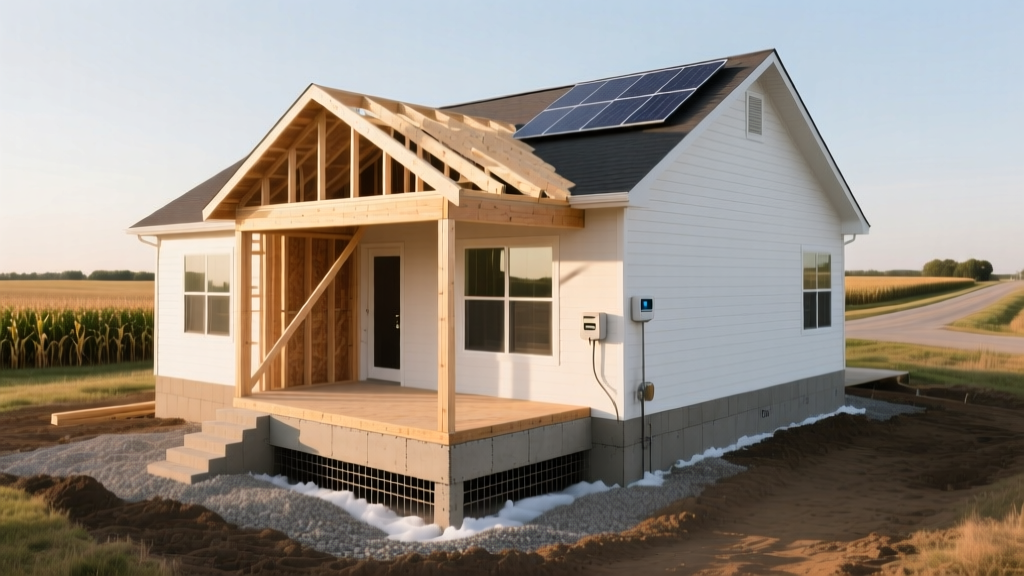
Calculating the exact cost to build house in Iowa requires moving beyond national averages and analyzing the specific geological, climatic, and labor variables unique to the Midwest. While the national average for custom home construction hovers around $185 to $250 per square foot, Iowa's regional pricing operates on a different spectrum. In 2026, the statewide baseline for a standard custom build ranges from $150 to $220 per square foot, heavily dictated by your proximity to major metro hubs like Des Moines or Cedar Rapids, and the specific soil composition of your build site.
Iowa 2026 Construction Baseline Metrics
- Average Cost per Sq. Ft.: $150 (Rural) to $240 (Metro Suburbs)
- Total Cost (2,000 Sq. Ft. Home): $300,000 - $480,000
- Average Build Time: 7 to 9 months (weather-dependent)
- Primary Climate Zone: IECC Zone 5 (Mandates high R-value envelopes)
Regional Price Breakdown Across Iowa Markets
The cost to build house in Iowa fluctuates significantly depending on the county. Metro areas command higher labor premiums and stricter municipal permitting fees, while rural zones offer cheaper land but incur higher logistical costs for material transport and utility hookups. According to recent regional building permit data tracked by the U.S. Census Bureau, central Iowa continues to see the highest concentration of new single-family starts, driving localized labor demand.
| Region / Market | Cost per Sq. Ft. | 2,000 Sq. Ft. Total | Key Cost Drivers |
|---|---|---|---|
| Des Moines Metro (Polk, Dallas) | $185 - $240 | $370k - $480k | High labor demand, strict zoning, premium subdivision HOAs |
| Ames / Story County | $175 - $225 | $350k - $450k | University-driven contractor premiums, student housing spillover |
| Cedar Rapids / Coralville | $170 - $215 | $340k - $430k | Flood zone mitigation, elevated foundation requirements |
| Quad Cities / Davenport | $160 - $205 | $320k - $410k | Cross-state contractor competition, moderate material costs |
| Rural / Western Iowa | $145 - $185 | $290k - $370k | Lower labor rates, high transport fees, well/septic installs |
Iowa-Specific Construction Variables: The Hidden Costs
Out-of-state builders often underestimate the geological and climatic hurdles inherent to the Midwest. When estimating the cost to build house in Iowa, you must account for these localized structural requirements.
1. Frost Depth and Foundation Engineering
Iowa experiences severe winter freezes, meaning shallow foundations are guaranteed to suffer from frost heave. The Iowa State Building Code mandates a minimum frost depth of 42 inches in central regions and up to 48 inches in northern counties. For a standard 2,000-square-foot footprint, digging 48-inch trenches rather than the 30-inch trenches common in southern states adds approximately $4,500 to $7,000 to your excavation and concrete budget. Many custom builders in northern Iowa now recommend Insulated Concrete Forms (ICFs) for foundation walls, which cost about 10% more upfront than traditional poured concrete but drastically reduce basement heat loss and protect against frost penetration.
2. Soil Composition and Site Preparation
Soil conditions dictate your site prep budget. Central and Northern Iowa are dominated by glacial till, which is highly stable but often contains dense clay pockets that require specialized drainage grading. Western Iowa, particularly around Council Bluffs, features loess soil. Loess is highly erodible and prone to settling when wet. Building on loess requires deep soil borings and potentially helical piers to anchor the foundation, adding $8,000 to $15,000 to the site prep phase. Always budget $1,500 to $2,500 for a geotechnical soil bearing capacity test before finalizing your foundation design.
Areas surrounding the Cedar River corridor contain expansive clay soils that swell significantly during spring thaws. If your geotechnical report identifies high-plasticity clay, your structural engineer will likely specify a stiffened raft slab or deep-drilled concrete piers to prevent foundation cracking. Do not skip the $2,000 soil test to save money; foundation repairs in these zones routinely exceed $30,000.
Material Selection for IECC Climate Zone 5
Nearly 90% of Iowa falls under the International Energy Conservation Code (IECC) Climate Zone 5, characterized by brutal winters and humid summers. The National Association of Home Builders consistently highlights that envelope efficiency is the highest ROI investment in cold-climate zones. Your material budget must reflect these thermal demands.
Insulation and Framing Standards
Standard 2x4 framing with R-13 fiberglass batts is obsolete in Iowa. To meet modern energy codes and ensure comfort, specify 2x6 exterior walls framed at 16 inches on center. This allows for R-21 closed-cell spray foam or high-density fiberglass batts, combined with R-5 to R-10 continuous exterior insulation (such as Owens Corning FOAMULAR XPS boards). For the attic, mandate R-49 to R-60 blown-in cellulose or spray foam to prevent ice damming, a pervasive issue in Iowa when heat escapes through poorly insulated roof decks and melts snow on the shingles.
Exterior Siding Durability
Iowa's temperature swings (ranging from -20°F in January to 100°F in August) and high wind events destroy inferior siding. Vinyl siding becomes brittle and cracks in extreme cold. For long-term durability, fiber cement siding (like James Hardie HardiePlank) or engineered wood (like LP SmartSide) are the regional standards. HardiePlank installation in Iowa currently runs $11 to $15 per square foot installed. It resists wind-driven hail and does not expand/contract at the extreme rates of vinyl, preserving your exterior paint and caulking.
Labor Rates and Contractor Availability
Labor accounts for roughly 40% to 50% of your total build cost. In the Des Moines and Ames corridors, a tight housing market has pushed skilled trades (electricians, plumbers, HVAC technicians) to premium rates. Expect to pay $85 to $125 per hour for licensed mechanical trades in Polk and Story counties. In rural areas, hourly rates drop to $65 to $90, but you will face scheduling delays. Rural contractors often juggle agricultural building projects (like pole barns and grain bins) alongside residential builds, meaning your timeline could stretch from 7 months to 11 months if you are not locked into a strict contract with liquidated damages for delays.
Step-by-Step Budget Allocation Framework
When securing construction financing from local Iowa lenders (like Bank Iowa or regional credit unions), they will require a detailed draw schedule. Use this baseline percentage breakdown for a standard custom home in Iowa to structure your budget:
- Site Work & Foundations (15% - 18%): Includes deep frost footings, soil testing, well/septic (if rural), and driveway grading.
- Framing & Exterior Envelope (22% - 25%): Lumber packages, roof trusses, architectural shingles, and fiber cement siding.
- Mechanicals (18% - 20%): High-efficiency gas furnace (95%+ AFUE), central AC, plumbing rough-ins, and electrical.
- Interior Finishes (25% - 28%): Drywall, hardwood or LVP flooring, cabinetry, and trim work.
- Permits, Fees & Insurance (5% - 7%): Municipal tap fees, builder's risk insurance, and final inspections.
- Contingency Reserve (10%): Non-negotiable for weather delays and material price fluctuations.
Frequently Asked Questions
Can I build a house in Iowa during the winter?
Yes, but it alters your cost structure. Winter builds (December through March) require ground-thawing equipment, concrete blankets, and heated enclosures for drywall mudding and painting. This adds $5,000 to $10,000 in temporary heating and winterization fees. However, you may secure a 5% to 8% discount on labor, as contractors are desperate to keep their crews employed during the off-season.
Are there agricultural zoning exemptions that lower costs?
If you are building on land zoned exclusively for agricultural use outside city limits, you may bypass certain municipal building codes and permit fees, relying instead on county inspections. However, the Iowa State University Extension warns that bypassing strict residential codes can lead to structural failures in high-wind events. Always ensure your county inspector verifies your wind-load and snow-load calculations, regardless of zoning exemptions.
How do I handle radon mitigation in my Iowa build?
Iowa has some of the highest naturally occurring radon levels in the United States due to its glacial soil deposits. Do not treat radon as an afterthought. Install a passive radon mitigation system (a layer of gravel under the slab, a vapor barrier, and a vent pipe routed through the roof) during the foundation phase. It costs less than $800 during new construction, compared to $2,500+ to retrofit an active system into an existing slab later.
Written by
Priya KapoorPriya Kapoor is a real estate market analyst and construction economics researcher with expertise in housing affordability, development feasibility, and infrastructure investment. She holds a Master of Regional Planning from Cornell University and previously worked as a senior analyst at CBRE's Investment Properties group, where she modeled returns for $4B in mixed-use development pipelines. Priya now runs an independent research practice advising developers, municipalities, and REITs on construction cost forecasting and market timing. She publishes the quarterly "BuildMat Market Pulse" report tracking material price indices across 12 commodity categories. Based in Austin, TX, Priya serves on the board of Habitat for Humanity Austin and is a marathon runner.
More from Priya Kapoor
View all
Construction Cost
Cost to Build a 1600 Sq Ft Home in 2026: Full Breakdown
Accurate 2026 cost to build a 1600 sq ft home—material, labor, and regional pricing breakdowns included. Plan your budget with real-time estimates.
Aug 11, 2026

Wood & Lumber
Name the Types of Wood for Pressure Treatment and Preservation
Learn how to name the types of wood best suited for pressure treatment. Compare species treatability, chemical retention levels, and 2026 preservation costs.
Aug 4, 2026

Stone & Masonry
Stone Veneer Suppliers Lindenhurst: 2026 Cost Analysis
Analyze 2026 stone veneer costs in Lindenhurst, NY. Compare local supplier pricing, delivery fees, and Suffolk County installation labor rates.
Aug 4, 2026