Cost to Build a House in Massachusetts: 2026 Budget Guide
Discover the true cost to build a house in Massachusetts in 2026. Break down regional pricing, hidden ledge fees, and Stretch Energy Code budgets.
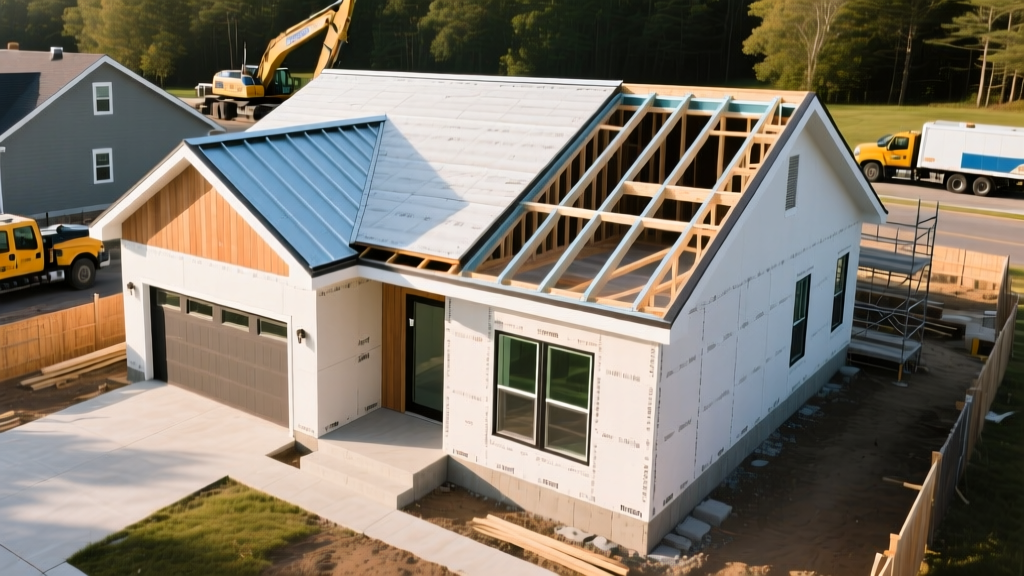
Decoding the Baseline: 2026 Construction Costs per Square Foot
Estimating the cost to build a house in Massachusetts requires moving past national averages, which frequently understate New England's unique labor premiums and regulatory hurdles. As of 2026, the baseline construction cost in the Commonwealth ranges from $275 to $650+ per square foot, excluding land acquisition. This wide variance is driven by the level of customization, site conditions, and municipal energy mandates.
- Production/Tract Homes: $275 – $350 per sq. ft. (Standard finishes, simple rooflines, slab or standard basement foundations).
- Semi-Custom Builds: $375 – $475 per sq. ft. (Upgraded mechanicals, 2x6 advanced framing, mid-tier hardwood, custom cabinetry).
- Full Custom/Luxury: $500 – $750+ per sq. ft. (Architect-designed, premium building envelope, smart home integration, high-end millwork).
According to data tracked by the National Association of Home Builders (NAHB), the Northeast consistently commands a 15% to 22% premium over the national median for residential framing and finishing labor, a gap that has widened due to persistent trade shortages in the Boston-Worcester-Providence corridor.
The "New England Tax": Hidden Budget Killers
Out-of-state builders and first-time developers often blow their budgets by failing to account for three Massachusetts-specific site and regulatory factors.
1. Granite Ledge and Blasting
Massachusetts is defined by glacial till and shallow granite bedrock. If your site requires ledge removal, expect to add $15,000 to $45,000 to your earthwork budget. Blasting requires local fire marshal permits, specialized insurance, and the installation of seismograph monitors on neighboring properties to track vibration. In areas where blasting is prohibited, contractors must use hydraulic hammers or expansive demolition grout (like Dexpan), which triples the time required for excavation.
2. Wetlands Protection Act (WPA) Setbacks
The Massachusetts Wetlands Protection Act enforces strict 100-foot buffer zones around wetlands and 200-foot zones around rivers and vernal pools. If your build site is near these boundaries, budget $5,000 to $12,000 for a licensed wetland scientist to conduct a flagging survey, plus potential mitigation costs if you must apply for a special variance from the local Conservation Commission.
3. Winter Condition Premiums
If your foundation pour or framing phase extends past November, contractors will apply a 5% to 10% "winter condition" surcharge. This covers concrete blankets, ground thawing equipment, heated enclosures, and the reduced productivity associated with sub-freezing temperatures.
Regional Cost Matrix: Building Across the Commonwealth
Massachusetts is not a monolith. Labor rates, staging logistics, and coastal wind-code requirements drastically alter the final ledger.
| Region | Avg. Cost / Sq. Ft. (Semi-Custom) | Primary Budget Drivers |
|---|---|---|
| Greater Boston / MetroWest | $450 - $550 | Extreme labor premiums, tight lot staging, strict municipal zoning delays. |
| Cape Cod & Islands | $475 - $600 | Coastal wind-load engineering, salt-air material corrosion treatments, ferry transport logistics. |
| Central MA (Worcester) | $375 - $450 | Balanced labor market, standard site conditions, moderate permit timelines. |
| Western MA (Berkshires) | $350 - $425 | Lower labor rates offset by long material delivery routes, heavy snow-load roof engineering, well/septic requirements. |
Itemized Budget Breakdown: 2,500 Sq. Ft. Colonial Build
To illustrate capital allocation, here is a targeted budget breakdown for a 2,500 sq. ft. semi-custom, two-story colonial in Central Massachusetts, built to standard 2026 material specifications.
- Site Prep & Earthwork: $32,000 (Includes standard clearing, assuming minor ledge, and septic design).
- Foundation (Poured Concrete w/ Frost Wall): $48,500 (Includes excavation, forming, rebar, and waterproofing).
- Framing & Sheathing: $115,000 (2x6 advanced framing, engineered I-joists, Huber ZIP System sheathing).
- Exterior Envelope (Roof, Siding, Windows): $95,000 (Architectural asphalt shingles, James Hardie fiber cement siding, double-pane fiberglass windows).
- MEP Rough-in (Mechanical, Electrical, Plumbing): $88,000 (Includes ERV system, PEX plumbing, and 200-amp electrical).
- Insulation & Drywall: $42,000 (Open-cell spray foam in roofline, dense-pack cellulose in walls).
- Interior Finishes (Cabinetry, Flooring, Trim): $135,000 (Mid-tier quartz counters, engineered hardwood, custom MDF trim).
- General Conditions & Builder Margin: 18% of total hard costs.
Total Estimated Hard Cost: ~$985,000 (approx. $394/sq. ft.)
Navigating the MA Stretch Energy Code
Over 300 municipalities in Massachusetts have adopted the Stretch Energy Code, which mandates significantly higher thermal performance than the base 780 CMR state building code. The Massachusetts Department of Energy Resources requires new residential builds to achieve a Home Energy Rating System (HERS) index of 55 or less, or be designed as "Net Zero Ready."
Failure to budget for HERS rater fees ($1,500 - $2,500) and blower-door testing iterations is a common oversight. If your framer and insulation contractor do not coordinate on advanced air-sealing details at the rim joists and top plates, you will fail the initial blower-door test, requiring costly retroactive caulking and foam injection before drywall can hang.
Strategic Timeline Planning: Beating the Frost Line
In Massachusetts, time is a highly liquid budget asset. The optimal construction timeline targets a late-April or early-May groundbreaking. This allows the excavation and foundation crew to work through the spring thaw, getting the structure "dried-in" (roof and windows installed) by late August.
A dried-in shell by September allows interior MEP and finishing crews to work through the winter months in a climate-controlled environment, preventing the 15% to 20% schedule delays associated with January and February nor'easters.
Securing your building permit is the primary bottleneck. In high-demand towns like Concord, Lexington, or Nantucket, zoning board approvals and conservation reviews can take 4 to 8 months. Factor a minimum of $8,000 to $15,000 into your soft costs for an expediter or local land-use attorney to navigate municipal planning boards, ensuring your capital isn't tied up in holding costs while waiting for the shovel to hit the dirt.
Written by
Elena RodriguezElena Rodriguez is a civil engineer and technical writer specializing in concrete technology, masonry systems, and ASTM/ACI compliance. She earned her B.S. in Civil Engineering from Texas A&M University and spent a decade at a materials testing laboratory, performing over 2,000 concrete compressive strength tests and masonry prism evaluations. Elena is an ACI-certified Field Testing Technician (Grade I) and a member of ASTM Committee C12 on Natural Building Stone. She currently consults on forensic engineering cases involving concrete failures and moisture intrusion. Based in San Antonio, TX, Elena is a proud member of the Society of Women Engineers (SWE) and coaches her daughter's FIRST Robotics team.
More from Elena Rodriguez
View all
Walls & Panels
Cost Analysis: Light Gauge Steel Framing Advantages and Disadvantages
Evaluate light gauge steel framing advantages and disadvantages through a strict cost analysis lens, comparing material, labor, and lifecycle expenses.
Aug 4, 2026

Walls & Panels
Gypsum Board Types: Exact Specifications, Thickness & Dimensions
Compare standard, Type X, and moisture-resistant gypsum board types. Get exact specifications, thicknesses, dimensions, and ASTM standards for your project.
Aug 4, 2026

Fire Resistance
Best Fire-Resistant Outdoor Decking Materials: 2026 Buyer Guide
Discover the best fire-resistant outdoor decking materials for 2026. Compare Class A PVC, aluminum, and hardwood options for WUI compliance and safety.
Aug 4, 2026