How Much Does It Cost to Build Your Own House? A Detailed Breakdown
Discover exactly how much it costs to build your own house. Get a detailed 2026 breakdown of hard costs, soft costs, and material pricing per phase.
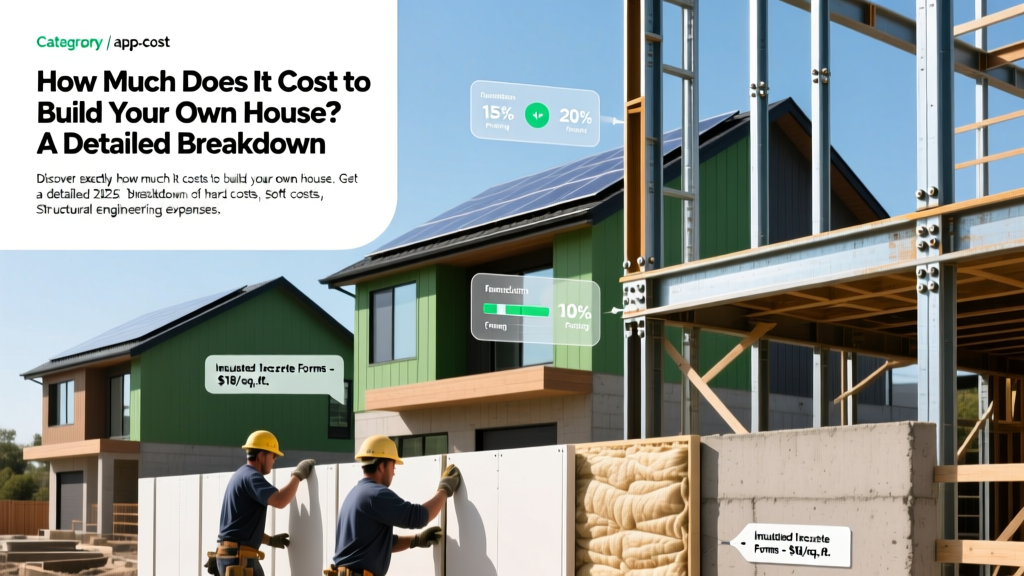
The Baseline: National Averages vs. Custom Owner-Builds
When asking how much does it cost to build your own house, the answer hinges entirely on whether you are acting as an owner-builder managing subcontractors or hiring a general contractor (GC) for a turnkey custom build. According to the National Association of Home Builders (NAHB), the average construction cost for a custom home hovers between $150 and $225 per square foot for production-style builds, but true custom owner-builds typically range from $200 to $350+ per square foot. For a standard 2,500-square-foot home, expect a total hard and soft cost baseline of $500,000 to $875,000.
These figures exclude the cost of land. The variance in this range is driven by three primary factors: regional labor rates, site topography, and the specific material tiers you select. Below is a granular breakdown of where every dollar goes during the construction process.
Phase-by-Phase Hard Cost Breakdown
Hard costs represent the physical materials and labor required to construct the home. The following table outlines the estimated cost distribution for a 2,500-square-foot, single-story custom home with a mid-range finish level in a moderate-cost region.
| Construction Phase | Budget Allocation | Estimated Cost Range | Key Cost Drivers |
|---|---|---|---|
| Site Work & Prep | 6% - 9% | $30,000 - $45,000 | Soil boring, perc tests, grading, utility tap fees |
| Foundation | 8% - 11% | $40,000 - $55,000 | Slab-on-grade vs. poured basement, ICF upgrades |
| Framing & Roof Deck | 16% - 20% | $80,000 - $100,000 | Engineered lumber, roof pitch complexity, truss spans |
| Exterior Finishes | 12% - 15% | $60,000 - $75,000 | Siding material, window glazing, roofing type |
| MEP Systems | 14% - 18% | $70,000 - $90,000 | HVAC type (heat pump vs. gas), electrical panel size |
| Interior Finishes | 25% - 32% | $125,000 - $160,000 | Cabinetry grade, flooring, trim packages, paint |
| Final Landscaping | 4% - 6% | $20,000 - $30,000 | Hardscaping, irrigation, driveway paving |
Deep Dive: Site Work and Foundation Variables
Site preparation is the most volatile line item in any build. A flat, cleared lot with municipal water and sewer access might only cost $15,000 to prep. However, if your land requires a well and septic system, add $25,000 to $40,000. If your soil engineer's geotechnical report reveals expansive clay or bedrock, you may need to blast rock or install deep-drilled concrete piers, which can push foundation costs past $70,000. Always budget a minimum 15% contingency specifically for the dirt-work phase.
Material Tier Matrix: Economy vs. Premium Selections
The interior and exterior finishes dictate the widest swings in your final budget. The matrix below compares specific, real-world material selections across three distinct budget tiers.
| Component | Economy / Builder Grade | Standard / Mid-Range | Premium / Custom |
|---|---|---|---|
| Roofing | 3-Tab Asphalt Shingles ($110/square) |
Architectural Shingles (e.g., GAF Timberline HDZ) ($160/square) |
Standing Seam Metal (e.g., Petersen PAC-150) ($900/square) |
| Siding | Vinyl Siding ($3.50/sq ft installed) |
Fiber Cement (e.g., James Hardie Lap) ($9.00/sq ft installed) |
Stucco & Cedar Shingle Accents ($16.00+/sq ft installed) |
| Windows | Double-Pane Vinyl (e.g., Pella 250 Series) |
Fiberglass/Clad Wood (e.g., Andersen 100 Series) |
Triple-Pane Aluminum-Clad (e.g., Marvin Ultimate) |
| HVAC | Standard Gas Furnace + Central AC (14 SEER2) |
Dual-Fuel Heat Pump System (16 SEER2) |
Geothermal or Multi-Zone VRF (e.g., Bosch IDS 2.0) |
Soft Costs: The Hidden 20% of Your Budget
Owner-builders frequently underestimate soft costs—the administrative, legal, and design fees required before a single shovel hits the dirt. According to Angi's comprehensive housing cost data, soft costs typically consume 15% to 20% of the total project budget.
- Architectural & Engineering Fees: Custom blueprints and structural engineering stamps cost between 8% and 12% of total construction costs ($40,000–$60,000 for a $500k build).
- Permits and Impact Fees: Municipal building permits, electrical reviews, and school/road impact fees range from $8,000 to $25,000 depending on local jurisdiction.
- Land Surveying & Soil Testing: Boundary surveys, topographical maps, and geotechnical soil borings will cost $3,000 to $6,000.
- Construction Loan Interest: If financing the build, a construction-to-permanent loan will accrue interest-only payments during the 9-to-14-month build phase. On a $500,000 loan at 7.5%, expect to pay roughly $35,000 in interest before the home is even completed.
Owner-Builder Margin: Savings vs. Risk
By acting as your own General Contractor, you eliminate the standard 15% to 20% GC management fee, potentially saving $75,000 to $100,000 on a $500,000 build. However, data from the U.S. Census Bureau indicates that owner-built homes often take 30% to 40% longer to complete than GC-managed builds. This extended timeline increases construction loan interest, extends your temporary housing costs, and raises the risk of trade-sequencing errors (e.g., drywallers arriving before HVAC rough-ins are inspected). Only assume the GC role if you possess strong project management skills and have 15-20 hours per week to dedicate to site supervision.
Hidden Cost Traps That Derail Budgets
Beyond the standard line items, specific edge cases routinely destroy construction budgets. Plan for these explicitly:
- Lumber Market Volatility: Framing lumber prices fluctuate weekly based on global supply chains. Lock in your framing package with a local supplier using a fixed-price contract valid for 60 days, rather than relying on daily spot pricing.
- Utility Tap and Meter Fees: Bringing municipal water, sewer, and electricity to a rural lot can trigger massive tap fees. Some rural electric cooperatives charge $1,500 per pole if the transformer is more than 100 feet from the road.
- Change Orders: Every time you alter a design choice after construction begins (e.g., moving a load-bearing wall, upgrading from 8-foot to 10-foot ceilings mid-frame), you pay a premium. Subcontractors charge 20% to 30% above standard rates for change orders due to schedule disruption. Finalize all selections before pouring the foundation.
Actionable Framework: Calculating Your Specific Build
To generate a highly accurate estimate for your specific project, follow this four-step framework:
Step 1: Determine Your Buildable Square Footage
Take your total budget and subtract the cost of land, soft costs (20%), and a 10% contingency fund. Divide the remaining hard-cost budget by $225 (the current national average for mid-range custom builds) to find your maximum buildable square footage.
Step 2: Secure the Geotechnical Report Early
Before purchasing land or finalizing blueprints, pay the $1,500 for a geotechnical soil report. This single document will dictate your foundation type and prevent $30,000 in surprise dirt-work costs later.
Step 3: Solicit 'Shell-Only' vs. 'Turnkey' Bids
When interviewing subcontractors, request itemized bids for the 'dried-in shell' (foundation, framing, roof, windows) separately from the interior finishes. This allows you to act as the GC for the structural phases while potentially hiring a specialized interior finish carpenter for the final 30% of the build.
Step 4: Apply the Regional Multiplier
Adjust your baseline costs using local labor indices. Building in high-cost coastal or metropolitan areas requires a 1.25x to 1.5x multiplier on labor rates, while rural Midwest or Southern builds may allow a 0.85x multiplier. Always verify local prevailing wage requirements if your municipality mandates them for permitted residential construction.
Written by
Priya KapoorPriya Kapoor is a real estate market analyst and construction economics researcher with expertise in housing affordability, development feasibility, and infrastructure investment. She holds a Master of Regional Planning from Cornell University and previously worked as a senior analyst at CBRE's Investment Properties group, where she modeled returns for $4B in mixed-use development pipelines. Priya now runs an independent research practice advising developers, municipalities, and REITs on construction cost forecasting and market timing. She publishes the quarterly "BuildMat Market Pulse" report tracking material price indices across 12 commodity categories. Based in Austin, TX, Priya serves on the board of Habitat for Humanity Austin and is a marathon runner.
More from Priya Kapoor
View all
Construction Cost
Cost to Build a 1600 Sq Ft Home in 2026: Full Breakdown
Accurate 2026 cost to build a 1600 sq ft home—material, labor, and regional pricing breakdowns included. Plan your budget with real-time estimates.
Aug 11, 2026

Wood & Lumber
Name the Types of Wood for Pressure Treatment and Preservation
Learn how to name the types of wood best suited for pressure treatment. Compare species treatability, chemical retention levels, and 2026 preservation costs.
Aug 4, 2026

Stone & Masonry
Stone Veneer Suppliers Lindenhurst: 2026 Cost Analysis
Analyze 2026 stone veneer costs in Lindenhurst, NY. Compare local supplier pricing, delivery fees, and Suffolk County installation labor rates.
Aug 4, 2026