How Much Does It Cost to Build My Own House? 2026 Financing Guide
Discover how much it costs to build my own house in 2026. Explore custom home construction costs, loan types, draw schedules, and hidden site fees.
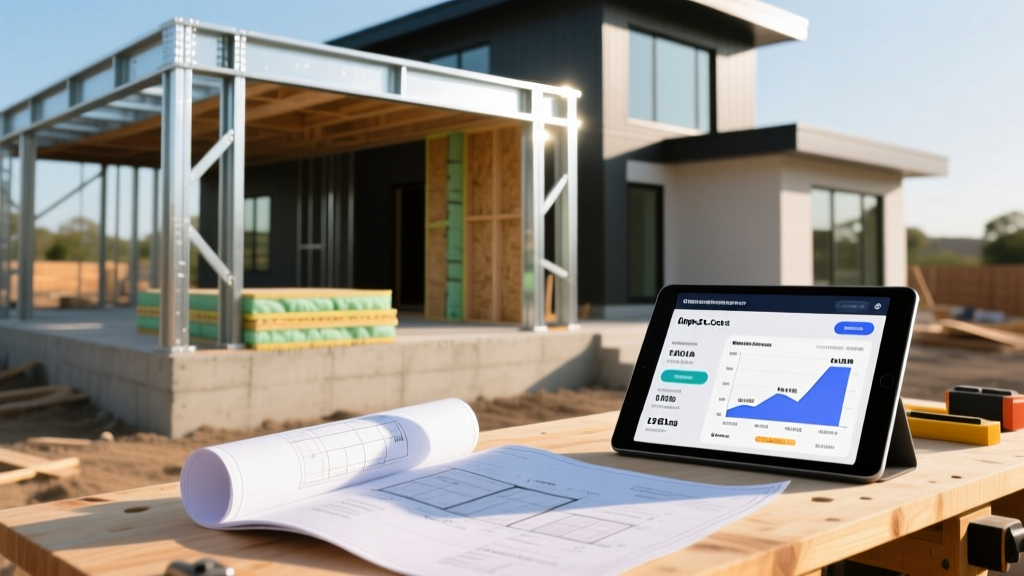
The True Cost Breakdown: What You Actually Pay Per Square Foot
When prospective homeowners ask, "how much does it cost to build my own house," the answer requires separating the physical structure from the land and site work. In 2026, the national average to build a custom, single-family home ranges from $180 to $250 per square foot for the vertical construction alone. This assumes you are acting as an owner-builder or hiring a custom general contractor, which inherently costs more than purchasing a production tract home from a developer.
To understand your baseline, review the 2026 vertical construction cost matrix below. These figures include materials, labor, and contractor overhead, but exclude land acquisition, site preparation, and financing costs.
| Build Type | Cost Per Sq. Ft. (2026) | Total for 2,500 Sq. Ft. | Material & Finish Profile |
|---|---|---|---|
| Semi-Custom / Spec | $150 - $180 | $375,000 - $450,000 | Builder-grade LVP, quartz counters, asphalt shingles, standard HVAC |
| Full Custom (Mid-Range) | $180 - $250 | $450,000 - $625,000 | Hardwood floors, custom cabinetry, metal roofing, high-efficiency heat pumps |
| Luxury / High-End Custom | $300 - $500+ | $750,000 - $1,250,000+ | Imported stone, smart home integration, structural steel, geothermal HVAC |
Financing the Build: Construction Loans vs. Traditional Mortgages
You cannot use a standard 30-year fixed mortgage to buy dirt and build a house. Traditional mortgages require an existing, appraisable structure to serve as collateral. Instead, you must utilize specialized construction financing. According to the Consumer Financial Protection Bureau (CFPB), construction loans are short-term, higher-interest facilities designed specifically to fund the building phase.
Construction-to-Permanent (Single-Close) Loans
This is the most popular route for custom builds. You close on the loan once. During the 9-to-15-month building phase, you pay interest-only on the funds drawn. Once the certificate of occupancy (CO) is issued, the loan automatically converts to a standard 30-year mortgage without requiring a second closing.
2026 Rate Reality: Expect the construction phase interest rate to be variable, typically pegged to the Secured Overnight Financing Rate (SOFR) plus a margin of 2.0% to 3.5%.
Standalone Construction Loans (Two-Close)
With a standalone loan, you secure financing just for the build. Once the house is complete, you must apply for a completely new traditional mortgage to pay off the construction loan. This requires two sets of closing costs and exposes you to interest rate risk if mortgage rates spike while your house is being built.
The Owner-Builder Catch: FHA and VA Restrictions
Many buyers assume they can use an FHA loan (3.5% down) or a VA loan (0% down) to build their own home. This is rarely possible for true owner-builders. FHA and VA construction programs almost universally require the builder to be a licensed, approved general contractor with a proven track record. If you plan to swing the hammer yourself or act as an unlicensed GC, you will likely need a conventional construction loan, which typically requires a 20% to 25% down payment based on the total project cost.
The Draw Schedule: How Lenders Release Your Funds
Lenders do not hand you a $500,000 check on day one. Funds are disbursed in tranches, known as "draws," tied to specific construction milestones. An independent inspector verifies the work before the bank releases the next payment. A standard 5-draw schedule looks like this:
- Draw 1: Foundation & Site Work (15%) - Released after lot clearing, trenching, footings, and foundation walls are poured and inspected.
- Draw 2: Framing & Roof (20%) - Released when the house is "dried in" (framing complete, roof shingled, windows and exterior doors installed).
- Draw 3: Mechanicals & Drywall (25%) - Released after rough plumbing, electrical, and HVAC are installed and pass municipal inspections, followed by drywall hanging and finishing.
- Draw 4: Interior Finishes & Cabinets (20%) - Released upon installation of cabinets, trim, interior doors, flooring, and painting.
- Draw 5: Final Completion (20%) - Released after final appliances are set, landscaping is graded, and the local municipality issues the Certificate of Occupancy.
Hidden Pre-Construction Costs That Derail Budgets
When calculating how much it costs to build my own house, most estimators focus on lumber and concrete. However, site development and municipal fees can silently consume 10% to 15% of your total budget. Factor these specific pre-construction costs into your initial loan request:
- Land Survey & Boundary Marking: $800 - $2,500. Required by the title company and lender to ensure no encroachments.
- Geotechnical Soil Testing (Perc Test & Bearing Capacity): $1,500 - $4,000. Determines if your soil can support a standard foundation or requires expensive engineered helical piers.
- Municipal Impact & Tap Fees: $5,000 - $20,000+. Fees charged by the county or city to connect to public water, sewer, and road infrastructure. In rural areas, substitute this with well drilling ($6,000 - $12,000) and septic system installation ($10,000 - $25,000).
- Builder's Risk Insurance: $1,500 - $3,500. A specialized policy that covers materials on-site against theft, fire, and wind damage during the build phase.
- Temporary Power & Sanitation: $1,200 - $2,000. Pole installation for temporary electricity and portable toilet rentals for your crew.
Actionable Framework: Calculating Your Maximum Loan Amount
To determine exactly what you can afford, lenders use the "Lesser of Cost or Appraised Value" rule. Even if your construction budget is $600,000, if the appraiser determines the finished home will only be worth $550,000 in your specific neighborhood, the lender will base your loan on $550,000.
The 2026 Qualification Formula:
Maximum Loan Amount = (Appraised Value) x (Loan-to-Value Limit, usually 80%)
Required Cash to Close = (Total Land + Build Cost) - (Maximum Loan Amount) + (Closing Costs, approx. 3%)
Furthermore, your Debt-to-Income (DTI) ratio must accommodate the future permanent mortgage payment. According to data tracked by the U.S. Census Bureau regarding new housing characteristics, the median size and cost of new builds continue to shift, meaning buyers must ensure their post-construction property taxes and insurance premiums do not push their DTI above the standard 43% to 45% conventional threshold.
Frequently Asked Questions on Owner-Builder Financing
Can I get a construction loan if I am building the house myself?
Yes, but it is difficult. Most major banks require a licensed general contractor. To secure an "owner-builder construction loan," you typically need to work with local community banks or credit unions, possess a high credit score (720+), and prove you have prior construction or project management experience.
What happens if my construction costs exceed the loan amount?
You are responsible for the overage. Lenders will not increase the loan amount mid-build unless the overage is due to lender-requested changes. This is why a 10% to 15% contingency reserve is mandatory. If your budget is $400,000, secure a loan for $460,000. If you do not use the contingency, it simply reduces your final mortgage principal.
Do I have to pay the mortgage while the house is being built?
No. During the construction phase of a Construction-to-Permanent loan, you only pay interest on the money that has actually been drawn. If your loan is for $500,000 but the bank has only released $100,000 for the foundation, you only pay interest on the $100,000. Full principal and interest payments do not begin until the home is completed and the loan converts to a standard mortgage.
For deeper insights into loan mechanics and underwriting standards, resources like Investopedia's Construction Loan Guide provide excellent baseline definitions, but always consult with a specialized construction loan officer who understands local municipal permitting timelines, as delayed permits are the number one cause of construction loan interest overruns.
Written by
Priya KapoorPriya Kapoor is a real estate market analyst and construction economics researcher with expertise in housing affordability, development feasibility, and infrastructure investment. She holds a Master of Regional Planning from Cornell University and previously worked as a senior analyst at CBRE's Investment Properties group, where she modeled returns for $4B in mixed-use development pipelines. Priya now runs an independent research practice advising developers, municipalities, and REITs on construction cost forecasting and market timing. She publishes the quarterly "BuildMat Market Pulse" report tracking material price indices across 12 commodity categories. Based in Austin, TX, Priya serves on the board of Habitat for Humanity Austin and is a marathon runner.
More from Priya Kapoor
View all
Construction Cost
Cost to Build a 1600 Sq Ft Home in 2026: Full Breakdown
Accurate 2026 cost to build a 1600 sq ft home—material, labor, and regional pricing breakdowns included. Plan your budget with real-time estimates.
Aug 11, 2026

Wood & Lumber
Name the Types of Wood for Pressure Treatment and Preservation
Learn how to name the types of wood best suited for pressure treatment. Compare species treatability, chemical retention levels, and 2026 preservation costs.
Aug 4, 2026

Stone & Masonry
Stone Veneer Suppliers Lindenhurst: 2026 Cost Analysis
Analyze 2026 stone veneer costs in Lindenhurst, NY. Compare local supplier pricing, delivery fees, and Suffolk County installation labor rates.
Aug 4, 2026