Cost to Build a Pool in Florida: 2026 Regional Price Guide
Discover the true cost to build a pool in Florida in 2026. We break down regional pricing, HVHZ codes, soil challenges, and material choices.
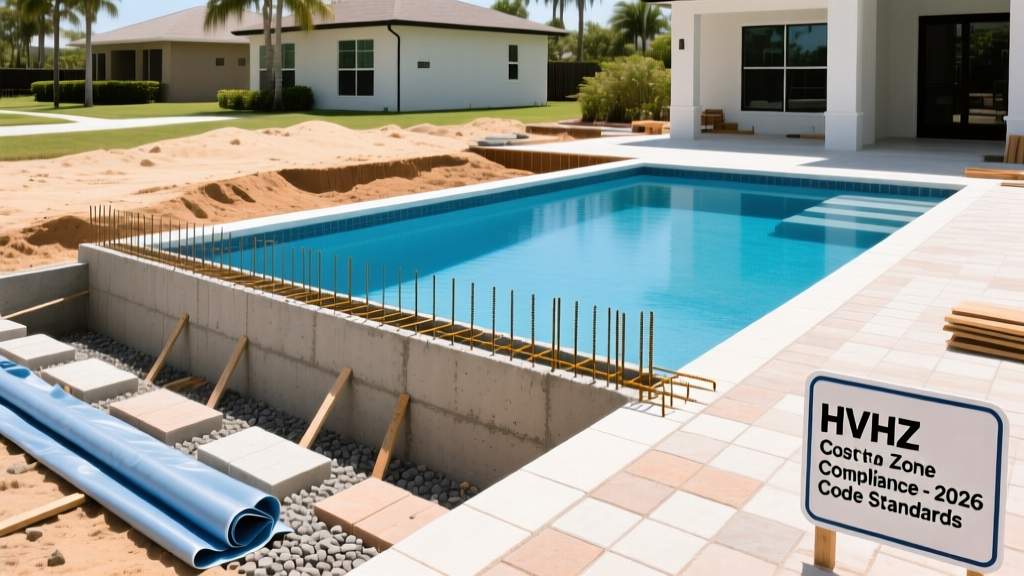
The Baseline: What Does a Pool Actually Cost in Florida?
When calculating the cost to build a pool in Florida, homeowners must look beyond national averages. The Sunshine State presents unique geological and regulatory challenges that directly impact excavation, engineering, and material requirements. As of 2026, the average cost to build a standard 12x24 foot gunite pool in Florida ranges from $65,000 to $110,000. However, this baseline fluctuates wildly depending on your specific county, soil composition, and local building codes.
The Florida Premium: Soil, Water, and Excavation Challenges
National pool cost estimators often fail to account for Florida's subsurface conditions. The state's geology dictates that excavation is rarely a simple 'dig and pour' operation.
Sugar Sand and Muck Layers
Much of Central and South Florida sits on 'sugar sand' or deep organic muck layers. According to the UF/IFAS Extension, these soils lack the cohesive bearing capacity required to support tens of thousands of pounds of water and gunite without shifting. If your soil test reveals deep sand, contractors must over-excavate and backfill with crushed limestone, or install helical piers driven down to the limestone bedrock. This soil remediation typically adds $3,500 to $8,000 to the initial contract.
High Water Table and Dewatering
In many coastal and central counties, the water table sits just a few feet below the surface. Digging a 5-foot-deep pool shell will immediately fill the hole with groundwater. Contractors must deploy continuous dewatering pumps and secure specific permits from local water management districts (such as the SWFWMD or SFWMD). The Florida Department of Environmental Protection strictly regulates groundwater discharge to prevent neighborhood flooding and ecological damage. Expect to pay $1,500 to $3,500 for dewatering operations and permitting.
Regional Cost Breakdown Across Florida (2026)
The cost to build a pool in Florida is heavily dictated by regional labor rates, permit fees, and local engineering mandates. Below is a comparative matrix for a standard 12x24 gunite pool with basic travertine decking.
| Region | Average Cost Range | Primary Cost Drivers |
|---|---|---|
| North FL / Panhandle (Jacksonville, Pensacola) |
$55,000 - $75,000 | Clay soils (easier excavation), lower labor rates, standard engineering codes. |
| Central FL (Orlando, Tampa) |
$65,000 - $95,000 | Sugar sand over-excavation, high water table dewatering, screen enclosure requirements. |
| South FL (Naples, Fort Myers) |
$75,000 - $110,000 | Strict environmental runoff permits, high HOA architectural review fees, premium finishes. |
| Miami-Dade / Broward (HVHZ Zones) |
$85,000 - $140,000+ | High-Velocity Hurricane Zone (HVHZ) engineering, 6,000 PSI concrete, dense rebar spacing. |
Material Selection: Gunite vs. Fiberglass in Florida Climates
While vinyl liner pools dominate the northern United States, they are highly discouraged in Florida. The intense UV degradation and high ground heat cause vinyl liners to become brittle and fail within 5 to 7 years. The Pool & Hot Tub Alliance recommends rigid shell construction for subtropical climates. Here is how the two viable options compare:
Gunite (Dry-Mix Shotcrete)
- Cost: $65,000 - $110,000+
- Durability: 50+ years for the structural shell.
- Florida Advantage: Can be engineered to withstand the shifting sandy soils and meets all HVHZ structural requirements.
- Drawback: Longer construction timeline (60-90 days) and requires a 28-day curing period before plaster application.
Fiberglass
- Cost: $55,000 - $85,000
- Durability: 25-30 years before gelcoat fading or spider-cracking occurs.
- Florida Advantage: Installed in days, not months. The non-porous gelcoat surface resists algae growth in Florida's humid, high-heat environment, reducing chemical costs.
- Drawback: Size limitations (max width ~16 feet due to highway transport limits) and requires massive crane access, which is difficult in densely packed Florida subdivisions.
Mandatory Florida Add-Ons That Inflate the Budget
When budgeting for the cost to build a pool in Florida, you must account for regional necessities that are considered 'optional upgrades' in other states.
1. Screen Enclosures (The Lanai)
In Central and South Florida, a screen enclosure is practically mandatory to keep out palmetto bugs, mosquitoes, and invasive iguanas. Furthermore, Florida building codes require engineered aluminum structures capable of withstanding 130+ mph wind loads. A standard aluminum screen enclosure over a 12x24 pool and deck costs between $12,000 and $22,000, depending on the roof pitch and whether you choose a flat 'box' design or a domed 'picture window' roof.
2. Variable Speed Pumps and Automation
Florida's energy codes mandate the use of variable speed pumps for all new residential pool construction. A high-efficiency unit like the Pentair IntelliFlo3 VSF costs roughly $1,800 to $2,400 installed. Pairing this with a smart automation system (e.g., Hayward OmniLogic) adds another $2,500 to $4,000, but allows you to manage filtration schedules and chemical dosing remotely, which is critical for snowbirds who leave their homes vacant for months.
3. Heat Pumps (Not Gas Heaters)
Because Florida's pool season extends nearly year-round, heating is necessary for winter months. Gas heaters are inefficient for maintaining temperature over long periods. Instead, install an electric heat pump like the Pentair UltraTemp 140. While the upfront cost is higher ($4,500 to $6,500 installed), it costs up to 80% less to operate monthly compared to propane or natural gas heaters.
Navigating Miami-Dade HVHZ Pool Codes
If you are building in Miami-Dade or Broward counties, your pool falls under the High-Velocity Hurricane Zone (HVHZ) regulations. These codes exist to ensure that flying debris during a Category 5 hurricane does not compromise the pool shell, which could lead to catastrophic foundation failure for adjacent structures.
HVHZ Specific Requirements:
- Concrete Strength: Standard 4,000 PSI gunite is insufficient. HVHZ requires a minimum compressive strength of 6,000 PSI.
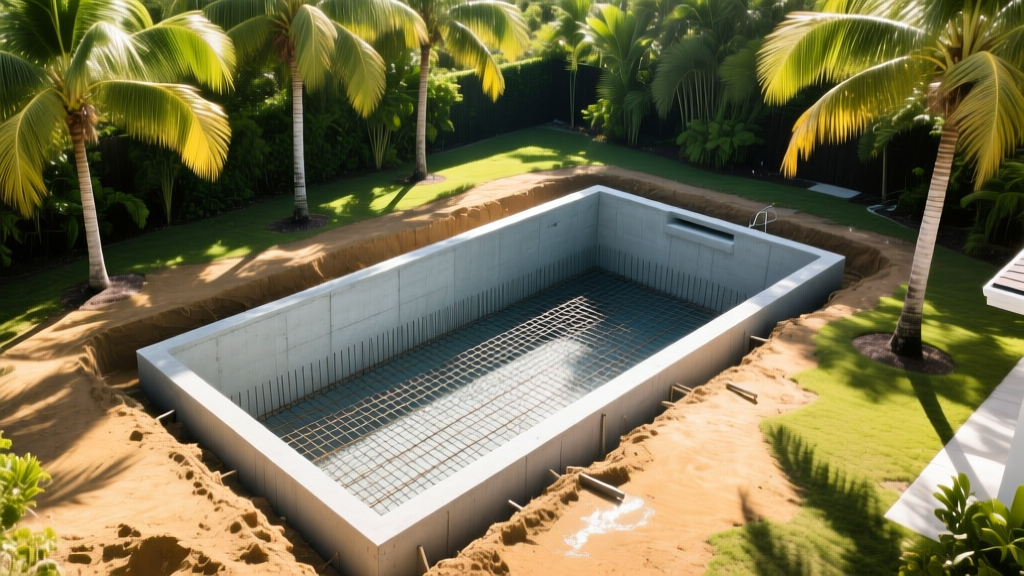
- Rebar Spacing: Standard #3 rebar at 12-inch on-center spacing must be upgraded to 1/2-inch (#4) rebar at 8-inch on-center spacing in both directions.
- Engineering: You must hire a specialized structural engineer to stamp the pool plans, adding $2,500 to $4,000 to your soft costs.
Step-by-Step Florida Pool Construction Timeline
Understanding the timeline helps you manage cash flow and contractor payment schedules. Never pay more than 10-15% upfront.
- Permitting & Engineering (Weeks 1-6): Soil testing, HOA approvals, and county permitting. (Payment: 10% deposit).
- Excavation & Dewatering (Weeks 7-8): Digging the shell and managing groundwater. (Payment: 15% upon completion of dig).
- Steel & Plumbing (Weeks 9-10): Tying the rebar grid and laying rigid PVC Schedule 40 plumbing. County inspection required. (Payment: 20%).
- Gunite Shell & Curing (Weeks 11-15): Shooting the concrete shell and keeping it moist for 28 days. (Payment: 25% after gunite inspection).
- Decking, Tile, & Coping (Weeks 16-18): Installing travertine or cool-deck coping and waterline glass tile. (Payment: 15%).
- Interior Finish & Startup (Weeks 19-20): Applying PebbleTec, filling the pool, and balancing the water chemistry. (Payment: 15% final upon substantial completion).
Frequently Asked Questions
Does a pool increase home value in Florida?
Yes, but the ROI depends on the neighborhood. In premium communities in Naples, Boca Raton, or The Villages, a well-designed pool can yield an 80% to 100% return on investment. In working-class neighborhoods where a pool pushes the home price above the local comps, the ROI may drop to 40% to 50%.
Can I build a pool during Florida's rainy season?
You can, but it is not recommended. Building between June and September means your excavation and gunite phases will likely be delayed by daily torrential downpours. Furthermore, lightning storms frequently halt crane operations and steel tying for safety reasons. The ideal time to break ground is October through February.
What are the ongoing monthly maintenance costs?
Due to high evaporation rates, intense UV exposure, and heavy organic debris (like oak leaves and pine needles), expect to pay $150 to $250 per month for professional weekly pool service in Florida. This includes chemical balancing, skimming, and pump basket cleaning. Add roughly $40 to $80 per month to your electric bill for running a variable speed pump 8-12 hours a day.
Written by
Sarah WhitfieldSarah Whitfield is a chartered quantity surveyor (MRICS) and construction cost analyst with 15 years of experience in material pricing, procurement strategy, and project budgeting. She earned her degree in Construction Management from the University of Reading (UK) and has worked on projects ranging from $2M custom homes to $180M mixed-use developments across North America and Europe. Sarah currently leads cost estimating for BuildMat Insight, maintaining a proprietary database of 4,000+ material price points updated quarterly. She is a frequent contributor to RSMeans cost data panels and has presented at the International Cost Engineering Council (ICEC) congress. Based in Denver, CO, Sarah is an avid trail runner and volunteer mentor for Women in Construction.
More from Sarah Whitfield
View all
Wood & Lumber
What Are the Different Types of Wood? A Builder's Guide
Compare structural softwoods, finish hardwoods, and engineered lumber. Analyze Janka ratings, MOE values, and 2026 pricing for construction.
Aug 4, 2026

Walls & Panels
Steel Framing vs Wood Framing: Corrosion and Moisture Defense
Compare steel framing vs wood framing for moisture resistance. Learn about galvanized coatings, condensation risks, and corrosion protection strategies.
Jul 21, 2026

Stone & Masonry
How to Cut Stone Veneer: Wet Saw vs Grinder Comparison
Compare the best tools for cutting stone veneer. We review wet saws, angle grinders, and chop saws to help you achieve clean, chip-free cuts.
Jul 21, 2026