How Much Does It Cost to Build Solar Panels? 2026 Breakdown
Discover exactly how much it costs to build and install a solar panel array in 2026, with detailed hardware, labor, and permitting breakdowns.
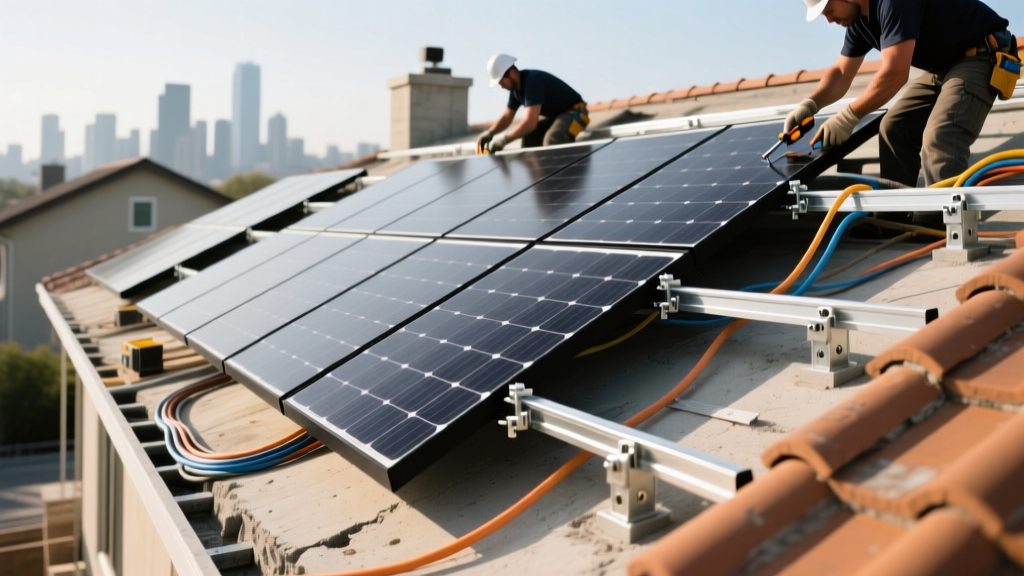
The Terminology: Manufacturing vs. Array Construction
When homeowners ask how much it costs to build solar panels, they are usually referring to the construction and installation of a complete residential solar photovoltaic (PV) array. However, it is vital to distinguish between literally manufacturing a panel from raw silicon cells and building a grid-tied solar system on your roof.
Building a physical solar panel from raw polycrystalline cells, tabbing wire, and EVA encapsulants costs roughly $1.20 to $1.50 per watt in raw materials. However, these DIY panels lack UL 1703 (fire and mechanical) and UL 1741 (inverter safety) certifications. Under the National Electrical Code (NEC), utility companies will deny grid interconnection for uncertified hardware, and building departments will not issue permits. Therefore, 'building solar' in a construction context means procuring Tier 1 commercial modules and engineering the array.
For a standard 8-kilowatt (kW) residential system—sufficient to offset 100% of the average American home's electricity usage—the national average cost to build and install the array in 2026 is $22,800 before incentives, or $2.85 per watt. After applying the 30% Federal Investment Tax Credit (ITC), the net cost drops to $15,960.

2026 Component Cost Matrix: Building an 8kW Array
The cost to build a solar array is not a single line item. It is an aggregation of major hardware, balance of system (BOS) components, and soft costs. Below is the detailed breakdown for an 8kW system utilizing premium tier hardware.
| Component Category | 2026 Spec / Model Example | Cost per Watt | Total Cost (8kW) |
|---|---|---|---|
| Solar Modules | REC Alpha Pure-R 420W (Monocrystalline) | $0.55 | $4,400 |
| Inverters | Enphase IQ8+ Microinverters | $0.28 | $2,240 |
| Racking & Mounts | IronRidge XR100 Rail System | $0.15 | $1,200 |
| BOS (Wire, Conduit, Combiners) | THWN-2 Copper, PVC/EMT Conduit | $0.22 | $1,760 |
| Labor & Installation | Certified Electrician & Roof Crew | $0.85 | $6,800 |
| Soft Costs (Permitting, Design) | Engineering, AHJ Fees, Interconnection | $0.80 | $6,400 |
| Gross System Total | $2.85 / W | $22,800 | |
Hardware Deep Dive: What You Are Paying For
The physical construction of your solar array relies on three primary hardware categories. Cutting corners here leads to premature degradation, micro-cracking, and inverter clipping.
Tier 1 Monocrystalline Modules
In 2026, N-type TOPCon (Tunnel Oxide Passivated Contact) and HJT (Heterojunction) monocrystalline cells dominate the premium residential market. Unlike older P-type PERC cells, N-type cells suffer virtually zero light-induced degradation (LID) and perform better in high-temperature environments. When reviewing quotes, verify that the proposed panels have a temperature coefficient of at least -0.29%/°C or better. Models like the Canadian Solar HiKu6 or REC Alpha Pure-R represent the current benchmark for residential efficiency, yielding 22%+ module efficiency and requiring less roof space per kilowatt.
Inverter Topologies: String vs. Micro vs. Optimizers
The inverter translates DC power from the panels into usable AC power. Your roof's topology dictates which architecture you must build with:
- String Inverters (e.g., SMA Sunny Boy): Best for unshaded, single-plane roofs. Cost-effective ($0.12/W), but if one panel is shaded by a chimney, the entire string's output drops to match the weakest panel.
- Microinverters (e.g., Enphase IQ8+): Mounted under each panel. They provide module-level MPPT (Maximum Power Point Tracking) and inherently satisfy NEC 2020/2023 Section 690.12 rapid shutdown requirements. Essential for complex roofs with multiple azimuths or partial tree shade.
- DC Optimizers (e.g., SolarEdge HD-Wave): A hybrid approach. Optimizers sit on the roof to condition DC power, sending it to a central string inverter. Excellent for mitigating shade without the higher cost of full microinverter systems.
Soft Costs and Permitting: The Hidden Budget Killers
According to the Solar Energy Industries Association (SEIA), soft costs now account for over 50% of the total price to build a residential solar array. These are non-hardware expenses that homeowners frequently underestimate.
- Engineering & Design ($800 - $1,500): Stamped structural engineering letters verifying your roof trusses can handle the 3-5 lbs/sq ft dead load and local wind uplift ratings.
- AHJ Permitting ($300 - $1,200): Fees charged by your local Authority Having Jurisdiction. Cities with strict fire setback codes (requiring 3-foot pathways on the roof ridge) may require more complex, time-consuming design iterations.
- Utility Interconnection ($100 - $500): The administrative fee to install a bi-directional net meter and approve your system for grid-tied operation.
Battery Storage Integration: Do You Need to Build It In?
Adding battery backup fundamentally changes the construction scope and cost. A standard solar array shuts down during a grid blackout to prevent backfeeding electricity to downed power lines (anti-islanding). To maintain power during an outage, you must build a battery-backed system with a critical loads sub-panel.
In 2026, the Tesla Powerwall 3 (13.5 kWh, integrated hybrid inverter) and FranklinWH aPower 2 are market leaders. Expect to add $14,000 to $18,000 to your project cost for a single battery installation, including the sub-panel and automatic transfer switch. The Department of Energy's Homeowner's Guide to Solar recommends battery storage primarily for homeowners subject to aggressive Time-of-Use (TOU) rate plans or those in areas with frequent weather-induced grid failures.
Incentives and ROI Calculation Framework
The financial viability of building a solar array hinges on the intersection of local utility offset rates and available tax incentives. The 30% Federal ITC applies to the gross cost of the system, including battery storage and structural roof upgrades required for the array.
Expert Insight on Payback Periods: 'Homeowners should calculate their simple payback period by dividing the net system cost by their annual electricity savings. In states with high retail electricity rates (above $0.22/kWh) like California, Massachusetts, and Hawaii, payback periods routinely fall between 5 and 7 years. In states with cheap coal-heavy grids (below $0.12/kWh), payback can stretch to 11-14 years unless aggressive state-level rebates are stacked on top of the federal credit.' Always verify local utility net-metering caps via the DSIRE database before signing a contract.
Frequently Asked Questions
Can I build and install my own solar array to save on labor?
DIY solar construction is possible for off-grid cabins or ground-mount systems, but grid-tied residential DIY is highly discouraged. Utilities require interconnection applications signed by a licensed master electrician. Furthermore, improper grounding or failure to meet NEC Article 690 rapid shutdown requirements will result in failed inspections, voided equipment warranties, and severe fire hazards.
How much does it cost to build a solar array on a new build home?
Integrating solar during new home construction is roughly 15% to 20% cheaper than retrofitting an existing home. Builders can coordinate roof penetrations, run conduit through open walls before drywall, and avoid the labor costs of working around existing landscaping and finished interiors. Expect costs to drop to around $2.40 per watt for new construction solar builds.
Written by
Priya KapoorPriya Kapoor is a real estate market analyst and construction economics researcher with expertise in housing affordability, development feasibility, and infrastructure investment. She holds a Master of Regional Planning from Cornell University and previously worked as a senior analyst at CBRE's Investment Properties group, where she modeled returns for $4B in mixed-use development pipelines. Priya now runs an independent research practice advising developers, municipalities, and REITs on construction cost forecasting and market timing. She publishes the quarterly "BuildMat Market Pulse" report tracking material price indices across 12 commodity categories. Based in Austin, TX, Priya serves on the board of Habitat for Humanity Austin and is a marathon runner.
More from Priya Kapoor
View all
Construction Cost
Cost to Build a 1600 Sq Ft Home in 2026: Full Breakdown
Accurate 2026 cost to build a 1600 sq ft home—material, labor, and regional pricing breakdowns included. Plan your budget with real-time estimates.
Aug 11, 2026

Wood & Lumber
Name the Types of Wood for Pressure Treatment and Preservation
Learn how to name the types of wood best suited for pressure treatment. Compare species treatability, chemical retention levels, and 2026 preservation costs.
Aug 4, 2026

Stone & Masonry
Stone Veneer Suppliers Lindenhurst: 2026 Cost Analysis
Analyze 2026 stone veneer costs in Lindenhurst, NY. Compare local supplier pricing, delivery fees, and Suffolk County installation labor rates.
Aug 4, 2026