Cost to Build a Billboard: 2026 Regional Price Analysis
Discover the true cost to build a billboard in 2026. We break down regional pricing, material costs, and hidden fees for static and digital structures.
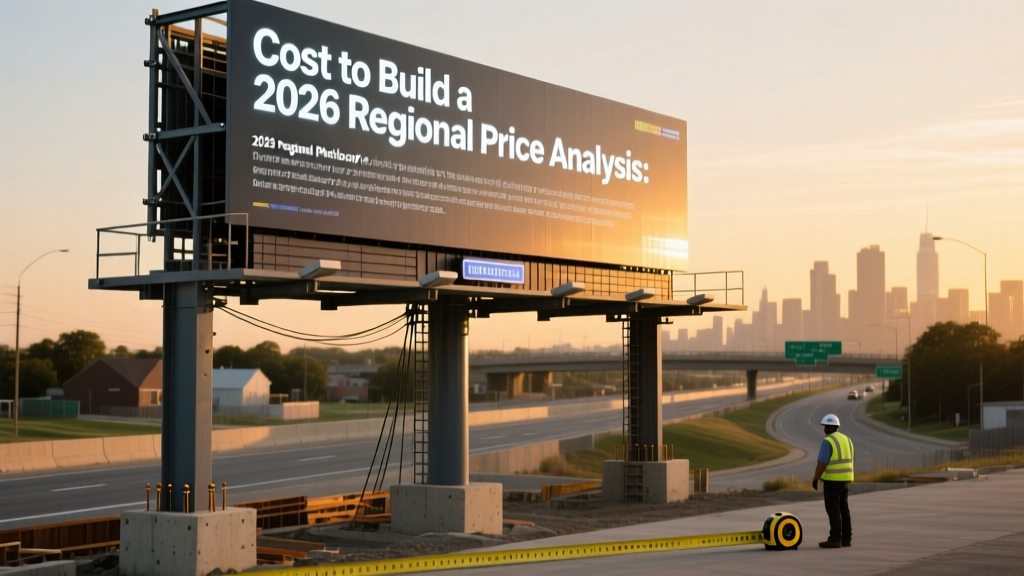
The Capital Reality of Out-of-Home Infrastructure
Estimating the cost to build a billboard requires moving beyond generic national averages. Out-of-Home (OOH) advertising structures are highly engineered commercial real estate assets subject to extreme localized variables. A 50-foot static monopole in Ohio might cost $28,000 to erect, while the exact same structure in coastal Florida or downtown Los Angeles can easily exceed $65,000 due to wind load engineering, seismic retrofitting, and union labor premiums.
This 2026 regional price analysis deconstructs the hard costs, material specifications, and regulatory friction points that dictate your final capital expenditure for both static vinyl and digital LED billboard construction.
Quick National Baseline Averages (2026)
- Static Monopole (14' x 48' Vinyl, 50' Height): $28,000 – $48,000
- Digital Monopole (14' x 48' Dual-Sided LED): $95,000 – $165,000
- Wall-Mounted / Rooftop (Static): $12,000 – $35,000
- Geotechnical & Permitting Soft Costs: $4,500 – $15,000+
Regional Cost Matrix: Static vs. Digital Structures
The following matrix illustrates how regional geology, weather patterns, and labor markets impact the total cost to build a billboard. These figures assume standard 14'x48' bulletin-sized structures on leased land with standard highway access.
| Region | Static Monopole Cost | Digital Monopole Cost | Primary Cost Drivers |
|---|---|---|---|
| Northeast | $42,000 - $58,000 | $135,000 - $175,000 | Bedrock excavation, high union labor rates, strict zoning. |
| Southeast | $34,000 - $52,000 | $110,000 - $150,000 | Hurricane wind loads (ASCE 7-22), deep helical piling in sand. |
| Midwest | $26,000 - $38,000 | $95,000 - $125,000 | Deep frost-line foundations, favorable non-union labor markets. |
| West Coast | $48,000 - $75,000 | $145,000 - $210,000 | Seismic structural steel, CEQA environmental reviews, permitting. |
Northeast & Mid-Atlantic: Bedrock and Labor Premiums
In states like New York, Pennsylvania, and Massachusetts, the primary obstacle to affordable billboard construction is subsurface geology. Glacial till and shallow bedrock mean standard auger-cast caissons are often impossible. Contractors must employ rock-socketed drilled shafts or blast through shale, adding $8,000 to $15,000 to the foundation budget. Furthermore, prevailing wage laws and high insurance minimums for crane operators in the Tri-State area inflate erection labor costs by up to 40% compared to the national median.
The South & Sunbelt: Wind Loads and Soil Stability
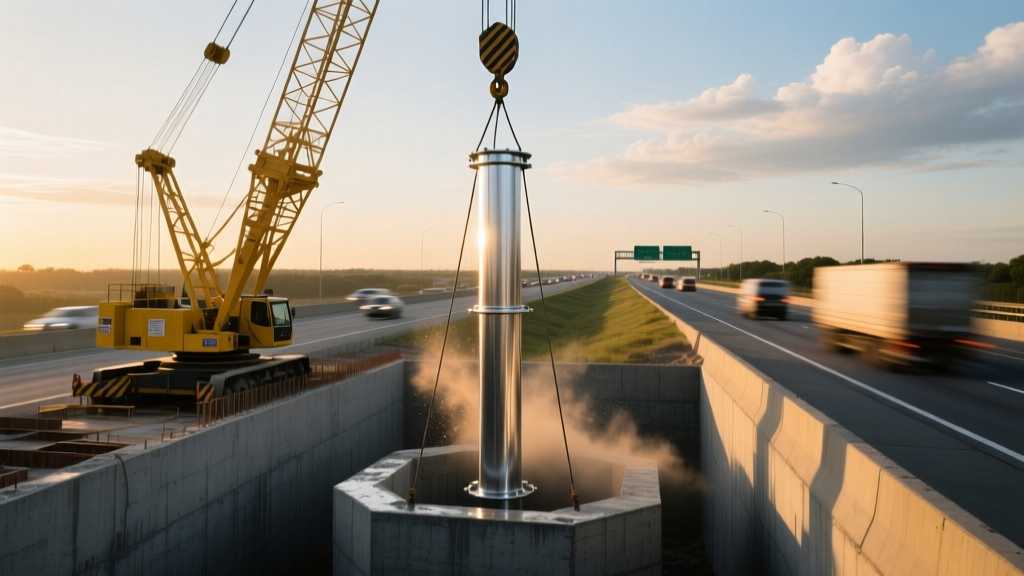
Building in Florida, Georgia, or the Gulf Coast introduces extreme wind shear considerations. Under the ASCE 7-22 standard, coastal counties require structures to withstand 140+ mph ultimate design wind speeds. This necessitates upgrading the monopole shaft from standard 3/8-inch wall thickness to 1/2-inch or 5/8-inch ASTM A572 Grade 50 steel, and increasing the concrete caisson diameter from 48 inches to 72 inches. Additionally, sandy coastal soils often require driven steel H-piles or deep helical anchors to prevent overturning, drastically increasing heavy equipment rental times.
The Midwest: Frost Lines and Favorable Economics
The Midwest offers the most favorable economics for OOH developers. Soil conditions are generally stable clay or loam, allowing for straightforward excavation. However, the hidden cost here is the frost line. In Minnesota or North Dakota, the frost line can reach 60 to 84 inches. A concrete foundation must extend below this line to prevent frost heave from tilting the structure. This requires deeper drilling and significantly more 4,000 PSI concrete and #8 rebar, partially offsetting the region's lower labor rates.
The West Coast: Seismic Codes and Regulatory Friction
California and the Pacific Northwest present the highest barrier to entry. The cost to build a billboard here is heavily skewed by seismic engineering. Structures must feature specialized moment-resisting base plates and flexible anchor bolt configurations to absorb lateral ground acceleration. Beyond materials, the soft costs are immense. Navigating the California Environmental Quality Act (CEQA) and securing local conditional use permits (CUP) can take 12 to 18 months and cost upwards of $20,000 in legal and consulting fees before a single shovel hits the dirt.
Hard Costs: Material and Engineering Specifications
To accurately estimate your budget, you must understand the specific components driving the invoice. Cutting corners on material specs leads to catastrophic structural failure or premature LED degradation.
- Steel Monopole Shaft: Typically galvanized ASTM A36 or A572 steel. A standard 50-foot tapered shaft (36-inch base, 24-inch top) costs between $14,000 and $22,000, depending on regional steel mill indices and freight.
- Concrete Foundation: Requires a minimum of 3,500 to 4,000 PSI compressive strength concrete. A standard 48-inch diameter by 15-foot deep caisson requires roughly 25 cubic yards of concrete, plus a heavy #8 or #9 vertical rebar cage and spiral ties.
- Digital LED Cabinets: For digital billboards, the screens are the largest single expense. Dual-sided 14'x48' LED displays from manufacturers like Daktronics or Watchfire (typically 16mm to 20mm pixel pitch for highway viewing distances) cost between $45,000 and $70,000. This does not include the structural catwalks and wind-load bracing required to mount them.
- Electrical Infrastructure: Digital faces draw significant power. Running new 480V 3-phase utility lines or installing heavy step-down transformers and backup generators can add $10,000 to $25,000 to the site preparation budget.
The Hidden Variables: Geotech, Zoning, and Airspace
Novice developers frequently blow their budgets by ignoring site-specific soft costs. Before signing a land lease or ordering steel, the following expenses must be underwritten:
"Never skip the geotechnical soil boring. A $2,500 soil report can save you from a $30,000 surprise when your excavation rig hits an unmapped underground aquifer or a layer of unstable peat that requires over-excavation and structural backfill." — Senior Geotechnical Engineer, Midwest OOH Development.
Highway Encroachment and Federal Compliance: Billboards adjacent to the interstate system are governed by the Highway Beautification Act. Developers must secure encroachment permits from the state Department of Transportation (DOT), which involve rigorous sight-distance and spacing reviews. Fees range from $500 to $5,000 depending on the state.
FAA Obstruction Lighting: If your billboard exceeds 200 feet in height above ground level (AGL), or if it is situated near an airport approach zone, the FAA requires L-810 obstruction lighting. Wiring and installing these aviation-grade strobes adds $3,000 to $6,000 to the electrical scope.
Digital vs. Static: Regional ROI Thresholds
The decision to build a digital LED face versus a static vinyl face should not be based solely on construction costs, but on regional inventory demand. Digital billboards cost roughly 3x to 4x more to build than static structures. However, a single digital face can rotate 6 to 8 advertisers per minute slot, generating 4x to 6x the gross revenue of a static face.
In high-traffic urban corridors (e.g., I-95 in New Jersey, I-405 in Los Angeles), the premium construction cost of a digital billboard is recouped within 18 to 24 months. In rural or exurban markets with lower daily effective circulation (DEC), the high capital expenditure of LED cabinets and heavy electrical upgrades cannot be supported by local ad rates. In these regions, static vinyl remains the superior, cash-flow-positive choice.
For comprehensive data on digital display performance and industry standards, the Outdoor Advertising Association of America (OAAA) provides vital metrics on digital OOH adoption and revenue modeling.
Frequently Asked Questions
How much does it cost to maintain a digital billboard annually?
Expect to spend between $3,500 and $8,000 annually on maintenance. This includes HVAC filter replacements for the LED cabinet cooling systems, pixel module repairs, software licensing for the content management system (CMS), and increased commercial electricity rates. Digital faces also require specialized screen washing to prevent hard-water staining on the polycarbonate protective louvers.
Can I build a billboard on my own commercial property without a permit?
No. Even if you own the underlying fee-simple real estate, the structure itself is regulated as a land use. You must obtain local zoning approval (often requiring a variance or special exception), structural engineering stamps, and state DOT permits if the property abuts a controlled highway. Building without permits will result in stop-work orders, daily fines, and mandatory demolition at your expense.
What is the lifespan of a steel monopole structure?
A properly engineered and hot-dip galvanized steel monopole has a functional lifespan of 40 to 60 years. The concrete foundation, if poured correctly below the frost line with adequate rebar cover, will last indefinitely. The primary degradation points are the catwalks, access ladders, and bolted connections, which require torque-checking and rust mitigation every 5 to 7 years.
Written by
Elena RodriguezElena Rodriguez is a civil engineer and technical writer specializing in concrete technology, masonry systems, and ASTM/ACI compliance. She earned her B.S. in Civil Engineering from Texas A&M University and spent a decade at a materials testing laboratory, performing over 2,000 concrete compressive strength tests and masonry prism evaluations. Elena is an ACI-certified Field Testing Technician (Grade I) and a member of ASTM Committee C12 on Natural Building Stone. She currently consults on forensic engineering cases involving concrete failures and moisture intrusion. Based in San Antonio, TX, Elena is a proud member of the Society of Women Engineers (SWE) and coaches her daughter's FIRST Robotics team.
More from Elena Rodriguez
View all
Walls & Panels
Cost Analysis: Light Gauge Steel Framing Advantages and Disadvantages
Evaluate light gauge steel framing advantages and disadvantages through a strict cost analysis lens, comparing material, labor, and lifecycle expenses.
Aug 4, 2026

Walls & Panels
Gypsum Board Types: Exact Specifications, Thickness & Dimensions
Compare standard, Type X, and moisture-resistant gypsum board types. Get exact specifications, thicknesses, dimensions, and ASTM standards for your project.
Aug 4, 2026

Fire Resistance
Best Fire-Resistant Outdoor Decking Materials: 2026 Buyer Guide
Discover the best fire-resistant outdoor decking materials for 2026. Compare Class A PVC, aluminum, and hardwood options for WUI compliance and safety.
Aug 4, 2026