How Much Does It Cost to Build a Driveway? 2026 Pricing
Discover how much it costs to build a driveway in 2026. Compare concrete, asphalt, gravel, and paver pricing per square foot with expert installation tips.
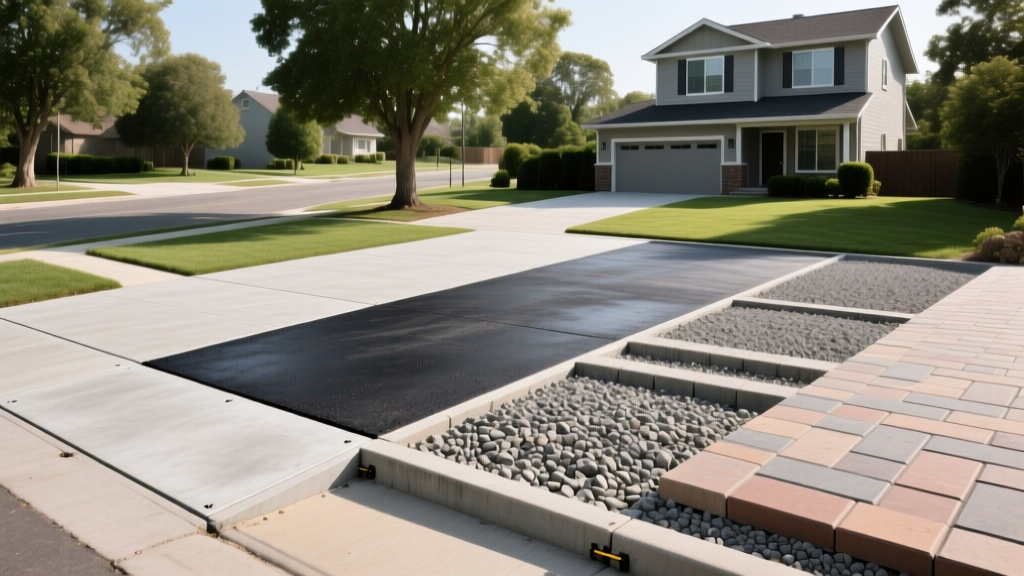
The True Cost to Build a Driveway: Beyond the Surface
When calculating how much does it cost to build a driveway, homeowners often fixate on the surface material while ignoring the structural foundation beneath it. In 2026, the national average for a standard 600-square-foot, two-car driveway ranges from $2,800 to $8,500. However, this $4.50 to $14.00+ per square foot spread is entirely dictated by your choice of material, local labor rates, and the condition of your existing soil. A driveway is not merely a cosmetic slab; it is a flexible or rigid pavement system designed to distribute vehicular loads into the subgrade. Choosing the wrong system for your climate or soil type will result in premature failure, turning a $5,000 investment into a $12,000 replacement project within five years.
- Gravel: $900 - $2,100 ($1.50 - $3.50 / sq. ft.)
- Asphalt: $2,700 - $5,400 ($4.50 - $9.00 / sq. ft.)
- Plain Concrete: $4,800 - $7,200 ($8.00 - $12.00 / sq. ft.)
- Permeable Pavers: $9,000 - $16,500 ($15.00 - $27.50 / sq. ft.)
Material-by-Material Cost Comparison Matrix
The table below breaks down the 2026 installed costs, expected lifespans, and structural requirements for the four most common residential driveway materials. These figures assume a standard 4-to-6-inch compacted aggregate base on stable, well-draining soil.
| Material | Installed Cost (Per Sq. Ft.) | Expected Lifespan | Maintenance Cycle | Load Capacity |
|---|---|---|---|---|
| Crushed Gravel (3/4" Minus) | $1.50 - $3.50 | 10 - 15 Years | Re-grade every 2-3 years | Moderate (Prone to rutting) |
| Hot Mix Asphalt (HMA) | $4.50 - $9.00 | 20 - 25 Years | Sealcoat every 3-4 years | High (Flexible load dist.) |
| Plain Poured Concrete | $8.00 - $12.00 | 30 - 40 Years | Clean & seal every 5 years | Very High (Rigid slab) |
| Stamped/Stained Concrete | $13.00 - $22.00 | 25 - 35 Years | Reseal every 2-3 years | High (Surface can wear) |
| Permeable Pavers | $15.00 - $27.50 | 40+ Years | Vacuum joints annually | Very High (Interlocking) |
Deep Dive: Concrete vs. Asphalt Driveways
Concrete and asphalt account for over 85% of new driveway installations. Understanding the engineering differences between these two materials is critical for long-term cost efficiency.
Concrete: The 4,000 PSI Rigid Standard
Concrete operates as a rigid pavement, meaning it bridges over minor subgrade weaknesses by distributing loads across the entire slab via beam action. For residential driveways in 2026, the minimum specification should be a 4,000 PSI (pounds per square inch) compressive strength mix with a 3/4-inch maximum aggregate size. If you live in a region with freeze-thaw cycles, the mix must include 5% to 7% air entrainment—microscopic bubbles that give expanding freezing water room to expand without spalling the surface.
Structural reinforcement is non-negotiable for heavy loads. Specify #4 (1/2-inch) epoxy-coated rebar placed on 24-inch centers, or a 6x6 W1.4xW1.4 welded wire mesh (WWM) elevated into the upper third of the slab using plastic chairs. Control joints must be saw-cut or tooled to a depth of 1 inch (exactly 25% of a 4-inch slab's thickness) every 10 feet to dictate where shrinkage cracking occurs. According to guidelines published by the Federal Highway Administration (FHWA) regarding rigid pavement design, proper joint spacing is the single most important factor in preventing random transverse cracking.
Asphalt: The Flexible Alternative
Asphalt is a flexible pavement system. It relies entirely on the strength of the underlying base layers; if the base fails, the asphalt surface fails. A standard residential asphalt driveway requires a 2-inch binder course (base lift) and a 1-inch surface course (wearing lift) of Hot Mix Asphalt (HMA). The binder used should be Performance Graded (PG) to match your local climate, such as PG 64-22 for moderate climates, ensuring it resists rutting in summer heat and thermal cracking in winter.
The base must consist of 4 to 8 inches of compacted Class II Road Base or crushed angular aggregate, compacted to 95% Standard Proctor density. The National Asphalt Pavement Association (NAPA) emphasizes that over 90% of premature asphalt failures are due to inadequate base compaction or poor drainage, not the asphalt mix itself. Asphalt must cure for 72 hours before vehicle traffic and should receive its first coal-tar or asphalt-based sealcoat after 90 days of oxidation.
Hidden Cost Drivers: Excavation, Base Prep, and Permits
Contractor quotes often separate site preparation from the paving material. When budgeting, allocate 25% to 40% of your total project cost to these hidden drivers:
- Demolition and Haul-Away: Removing an existing concrete driveway costs $1.50 to $3.00 per square foot. Asphalt tear-out is slightly cheaper at $1.00 to $2.00 per square foot due to lower weight and easier milling.
- Subgrade Stabilization: If your soil is expansive clay, the contractor must over-excavate by 12 inches and install a non-woven geotextile separation fabric (e.g., Mirafi 500X) before adding the aggregate base. This adds $0.75 to $1.25 per square foot but prevents catastrophic base contamination.
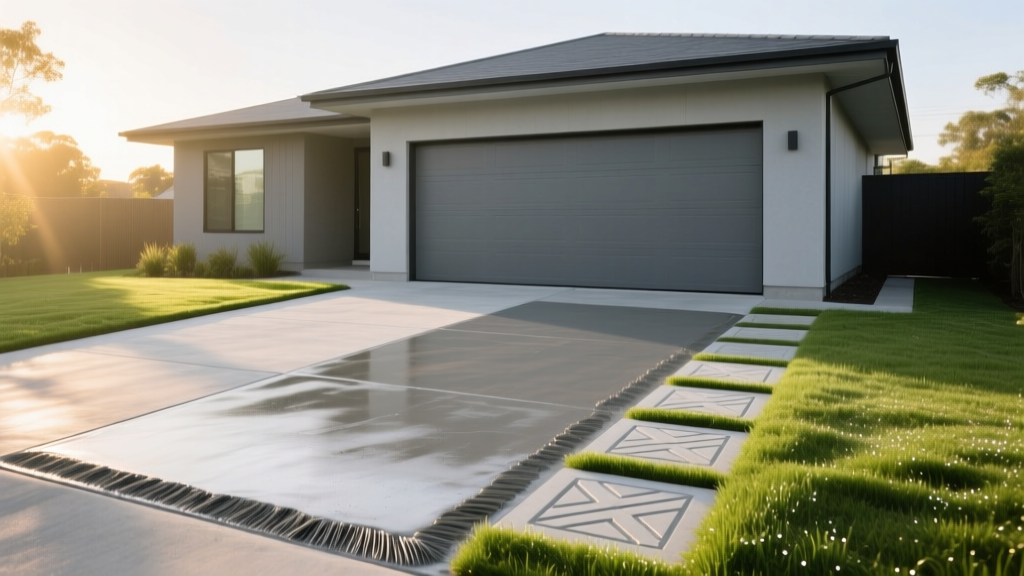
- Drainage Integration: Trench drains across the garage threshold or channel drains along the driveway apron cost $40 to $80 per linear foot installed. Proper slope (minimum 1/4-inch per foot) must be engineered to shed water away from the garage foundation.
- Municipal Permits and Apron Regulations: Most municipalities charge $50 to $250 for a right-of-way or driveway permit. Furthermore, the 'apron' (the section between the sidewalk and street) often requires specific municipal-approved concrete mixes or thicknesses, which can carry a premium over the private property paving.
Climate and Soil Decision Framework
If you experience severe freeze-thaw cycles: Avoid standard brick or stone set in mortar. Choose air-entrained concrete or flexible asphalt. If using pavers, they must be installed on a bed of coarse, angular chip stone, not sand, to prevent frost heave.
If your property has mature tree roots: Do not pour rigid concrete. Tree roots will inevitably lift and crack the slab. Choose asphalt (which can flex slightly and be patched) or interlocking pavers, which can be individually lifted, the root trimmed, and the paver replaced.
If you park heavy RVs or dual-axle trailers: Upgrade concrete thickness to 5 inches with a 5,000 PSI mix and #5 rebar. For asphalt, increase the binder course to 3 inches and the aggregate base to 10 inches.
Permeable Options and Stormwater Regulations
In many urban and suburban jurisdictions, 2026 stormwater management codes now restrict the total allowable impervious surface area on residential lots. If you are expanding your driveway or building in a strict drainage zone, permeable pavers or pervious concrete may be legally required or incentivized.
Permeable pavers comply with EPA Green Infrastructure guidelines by allowing rainwater to infiltrate the subgrade through 3/8-inch open joints filled with ASTM No. 8 or No. 9 crushed stone. While the upfront cost is 30% to 50% higher than standard concrete, permeable systems can eliminate the need for separate retention ponds or underground cisterns, offsetting the initial material premium. Pervious concrete is a cheaper alternative ($10 to $16 per sq. ft.) but requires rigorous maintenance, including annual vacuuming, to prevent the pore structure from clogging with silt and organic debris.
Frequently Asked Questions
Can I pour concrete over my existing asphalt driveway?
Yes, this is known as a 'white-topping' overlay. However, the existing asphalt must be structurally sound, heavily milled or scarified for mechanical bonding, and a minimum of 2 inches thick. You must still use a 4-inch layer of new concrete with a bond-breaking membrane or isolation joints to prevent reflective cracking from the asphalt's thermal expansion.
How long should I wait before parking on a new concrete driveway?
Standard 4,000 PSI concrete reaches roughly 65% of its design strength at 7 days, which is sufficient for standard passenger vehicles. However, heavy trucks, RVs, or dumpsters should be kept off the slab for a full 28 days to allow the hydration process to reach maximum compressive strength and prevent micro-fracturing.
Is gravel a viable long-term driveway solution?
Gravel is only viable if you commit to annual maintenance. To prevent potholes and washboarding, you must use 'minus' gravel (which contains stone dust that binds the rocks together) rather than clean, washed stone. You will need to drag and re-grade the surface every spring and add a 1-inch top dressing every 2 to 3 years.
Written by
Elena RodriguezElena Rodriguez is a civil engineer and technical writer specializing in concrete technology, masonry systems, and ASTM/ACI compliance. She earned her B.S. in Civil Engineering from Texas A&M University and spent a decade at a materials testing laboratory, performing over 2,000 concrete compressive strength tests and masonry prism evaluations. Elena is an ACI-certified Field Testing Technician (Grade I) and a member of ASTM Committee C12 on Natural Building Stone. She currently consults on forensic engineering cases involving concrete failures and moisture intrusion. Based in San Antonio, TX, Elena is a proud member of the Society of Women Engineers (SWE) and coaches her daughter's FIRST Robotics team.
More from Elena Rodriguez
View all
Walls & Panels
Cost Analysis: Light Gauge Steel Framing Advantages and Disadvantages
Evaluate light gauge steel framing advantages and disadvantages through a strict cost analysis lens, comparing material, labor, and lifecycle expenses.
Aug 4, 2026

Walls & Panels
Gypsum Board Types: Exact Specifications, Thickness & Dimensions
Compare standard, Type X, and moisture-resistant gypsum board types. Get exact specifications, thicknesses, dimensions, and ASTM standards for your project.
Aug 4, 2026

Fire Resistance
Best Fire-Resistant Outdoor Decking Materials: 2026 Buyer Guide
Discover the best fire-resistant outdoor decking materials for 2026. Compare Class A PVC, aluminum, and hardwood options for WUI compliance and safety.
Aug 4, 2026