What Does It Cost to Build a House? A 2026 Financing Guide
Discover what it costs to build a house in 2026. This financing guide breaks down construction loan rates, hard costs, and budget strategies.
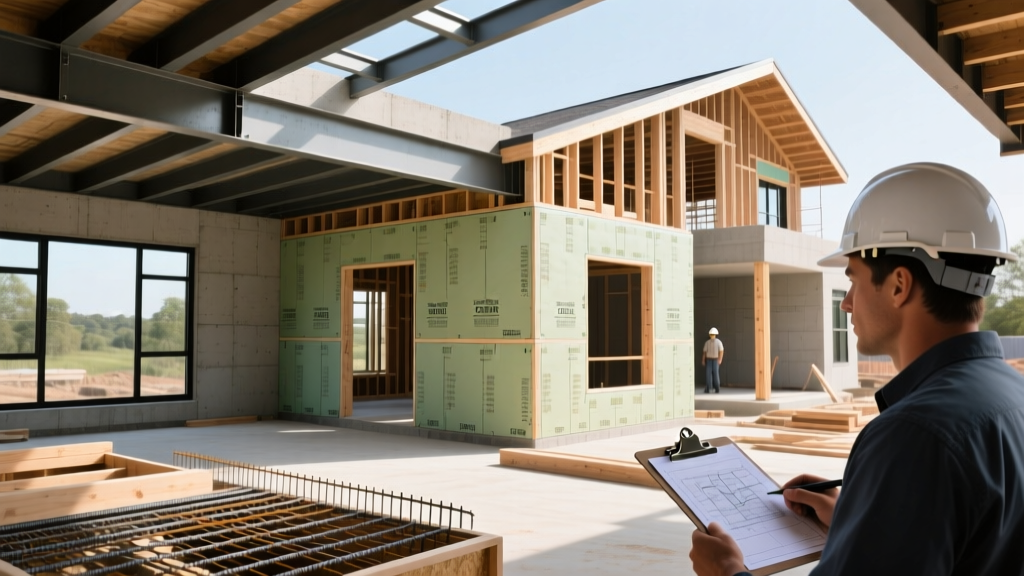
The True Price Tag: What Does It Cost to Build a House?
Answering the question of what it costs to build a house requires separating national averages from localized custom build realities. In 2026, the baseline cost to construct a 2,500-square-foot custom home ranges from $625,000 to $1,125,000, translating to $250 to $450 per square foot. Production or tract homes built on developer-owned lots operate on a tighter margin, typically ranging from $150 to $220 per square foot.
- National Average (Custom): $345 per sq. ft.
- High-Cost Coastal Markets (CA, NY, MA): $550 - $800+ per sq. ft.
- Low-Cost Rural Markets (Midwest, South): $180 - $240 per sq. ft.
- Average Construction Timeline: 9 to 14 months for custom builds.
According to HomeAdvisor's construction cost database, material volatility has stabilized compared to the early 2020s, but skilled labor shortages continue to push framing and MEP (mechanical, electrical, plumbing) costs upward. Financing a build of this magnitude requires a specialized lending product, not a standard mortgage.
Hard Costs vs. Soft Costs: Where Your Money Actually Goes
Lenders require a granular breakdown of your budget before approving a construction loan. Understanding the split between hard costs (physical construction) and soft costs (design, permits, financing) is critical for preventing mid-build capital shortfalls.
| Cost Category | Percentage of Budget | Dollar Amount (Based on $800k Build) | Specific Line Items |
|---|---|---|---|
| Hard Costs | 70% - 75% | $560,000 - $600,000 | Foundation, framing, roofing, exterior finishes, MEP rough-ins and trim, drywall, flooring. |
| Land & Site Work | 10% - 15% | $80,000 - $120,000 | Lot purchase, clearing, grading, well/septic or municipal tap fees, driveway installation. |
| Soft Costs | 8% - 12% | $64,000 - $96,000 | Architectural plans, engineering, permits, impact fees, surveying, builder overhead and profit. |
| Financing & Reserves | 5% - 8% | $40,000 - $64,000 | Loan origination, appraisal, interest reserve, contingency fund. |
Construction-to-Permanent Loans: The Financing Engine
Standard mortgages cannot fund a house that does not yet exist. Instead, borrowers utilize a Construction-to-Permanent (C2P) loan, often called a single-close loan. As detailed in Investopedia's guide to construction loans, this product finances the build phase and automatically converts to a traditional 30-year or 15-year mortgage upon completion, requiring only one set of closing costs.
The Mechanics of the Draw Schedule
Unlike a standard mortgage where you receive the full loan amount on day one, construction funds are disbursed in tranches, known as draws. A typical custom home build utilizes a 5-to-7 draw schedule:
- Draw 1 (15%): Site prep, excavation, and foundation pouring.
- Draw 2 (20%): Framing, roof dry-in, and exterior sheathing.
- Draw 3 (20%): MEP rough-ins, insulation, and drywall hanging.
- Draw 4 (20%): Interior trim, cabinets, flooring, and MEP trim-outs.
- Draw 5 (15%): Paint, fixtures, appliances, and final grading.
- Draw 6 (10%): Final walkthrough, punch list completion, and Certificate of Occupancy (CO).
The Interest Reserve Trap and Draw Schedule Math
During the construction phase, you do not pay principal. You only pay interest on the funds that have actually been drawn. Lenders typically roll an "interest reserve" into the total loan amount to cover these payments during the build.
If your 12-month build stalls due to supply chain delays, weather, or contractor disputes, your interest reserve will deplete. Once the reserve hits zero, you must pay the monthly interest out-of-pocket. If you fail to make these payments, the lender can halt future draws and freeze the project. Always negotiate an interest reserve calculated at 130% of the projected timeline.
Interest Calculation Example:
Assume an $800,000 construction loan at a 7.5% annual interest rate. In Month 1, the builder completes the foundation and requests a $120,000 draw. Your interest payment for Month 1 is calculated only on that $120,000, resulting in a $750 payment ($120,000 x 0.075 / 12). By Month 8, when $640,000 has been drawn, your monthly interest payment jumps to $4,000.
Hidden Financing Fees Most Borrowers Miss
When calculating what it costs to build a house, borrowers frequently overlook the administrative fees tied to the draw process. Budget for the following line items:
- Fund Control / Inspection Fees: Lenders hire third-party inspectors to verify work completion before releasing draws. Expect to pay $150 to $300 per inspection.
- Title Updates (Date-Downs): Every time a draw is funded, the title company must update the lender's title insurance policy to ensure no new mechanic's liens have been filed by subcontractors. This costs $100 to $250 per draw.
- Construction Appraisal: Appraising a house that doesn't exist requires a specialized "subject-to-completion" appraisal, which costs $800 to $1,500—significantly more than a standard $500 home appraisal.
- Origination Points: Construction loans carry higher risk for lenders. Expect to pay 1.0 to 2.0 origination points (1% to 2% of the total loan amount) upfront.
Contingency Budgeting: The 15% Rule for Custom Builds
The National Association of Home Builders (NAHB) consistently highlights cost overruns as the primary cause of custom build failures. A contingency fund is not optional; it is a structural requirement of your financing. Size your contingency based on site complexity:
- 10% Contingency: Production homes or custom builds on flat, fully developed lots with standard soil conditions.
- 15% Contingency: Custom builds on undeveloped lots requiring well/septic, extensive tree clearing, or minor grading.
- 20% to 25% Contingency: Builds on steep slopes, coastal zones requiring specialized engineering, or sites with known bedrock or high water tables that complicate excavation.
Strategic Draw Schedules to Minimize Interest Payments
Because interest accrues only on drawn funds, the sequencing of your builder's invoice schedule directly impacts your total financing cost. Work with your builder to back-load high-cost material purchases where possible. For example, if custom European cabinetry costs $85,000, do not allow the builder to draw those funds when the cabinets are merely ordered. Negotiate the draw schedule so that the cabinet funds are released only upon delivery to the site or installation. This prevents you from paying 7.5% interest on $85,000 for three months while the cabinets sit in a shipping container overseas. Aligning capital deployment strictly with physical progress is the most effective method to control the ultimate cost of your construction loan.
Written by
David NakamuraDavid Nakamura is a licensed architect (AIA) and construction technology writer focused on sustainable building methods, mass timber engineering, and high-performance building envelopes. He holds a Master of Architecture from the University of Washington and is a certified Passive House Consultant (CPHC). David spent eight years at the Seattle firm Mithun, where he led the design of three LEED Platinum projects, before founding his own practice specializing in net-zero residential design. He serves on the editorial advisory board of GreenBuilder Magazine and has authored peer-reviewed papers on cross-laminated timber (CLT) connections for the Journal of Structural Engineering. In his spare time, David teaches woodworking at Pratt Fine Arts Center and kayaks the Puget Sound.
More from David Nakamura
View all
Construction Cost
Labor Cost to Build a Deck Per Sq Ft: 2026 Installation Guide
Discover the exact labor cost to build a deck per sq ft in 2026. This installation guide breaks down contractor rates, complexity factors, and hidden fees.
Aug 4, 2026

Construction Cost
How Much Does It Cost to Build a 3 Bedroom House? Financing Guide
Learn exactly how much it costs to build a 3 bedroom house and explore 2026 financing options, construction loan types, and budget frameworks for your build.
Aug 4, 2026

Construction Cost
Cost to Build a Tennis Court: 2026 Guide
How much does it cost to build a tennis court in 2026? Breakdowns for asphalt, concrete, and synthetic surfaces plus fencing and lighting.
Jul 30, 2026