Cost to Build a Basketball Court: 2026 Complete Pricing Guide
Discover the true cost to build a basketball court in 2026. Breakdowns for indoor hardwood, outdoor concrete, modular tiles, and hidden site prep fees.
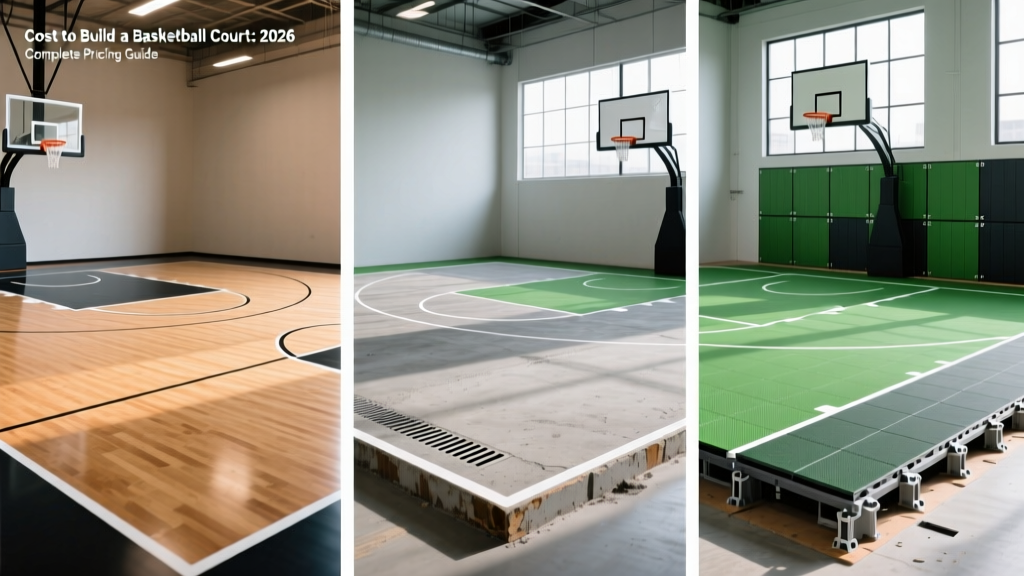
The Real Cost to Build a Basketball Court in 2026
Constructing a dedicated basketball court is a significant property upgrade that blends recreational utility with long-term landscaping value. However, the cost to build a basketball court varies wildly based on subsurface engineering, surfacing materials, and footprint dimensions. In 2026, homeowners and facility managers must navigate fluctuating material costs, particularly in concrete and structural steel, making precise upfront estimating critical.
A standard residential full-size outdoor court (84 ft. x 50 ft.) typically ranges from $18,500 to $32,000 when built with a post-tensioned concrete base and acrylic surfacing. Indoor hardwood courts demand a completely different structural approach, often exceeding $95,000 due to specialized subfloor systems and climate control requirements. This guide dissects the exact pricing tiers, material specifications, and hidden site-prep variables that dictate your final investment.
Quick Cost Snapshot: 2026 National Averages
- Half-Court Outdoor (Asphalt Base): $4,500 – $8,200
- Full-Court Outdoor (Concrete Base): $18,500 – $32,000
- Full-Court Outdoor (Modular Tile): $24,000 – $41,000
- Full-Court Indoor (Hardwood Maple): $95,000 – $145,000+
- Average Cost Per Square Foot (Outdoor): $4.50 – $8.00
Source data aggregated from HomeGuide and industry contractor bids.
Outdoor Base Materials: Asphalt vs. Post-Tensioned Concrete
The longevity of an outdoor court is entirely dependent on its base. Surface coatings will fail prematurely if the substrate shifts, heaves, or cracks. You have two primary options for outdoor subsurfaces, each with distinct structural profiles and price points.
Hot-Mix Asphalt (The Budget Option)
Asphalt remains the most common base for residential driveway courts due to its lower initial cost. A proper asphalt installation requires 4 to 6 inches of compacted angular aggregate base (ASTM D2940) topped with 2 inches of hot-mix asphalt.
Cost: $4.00 – $6.50 per square foot.
The Catch: Asphalt is a flexible pavement. It oxidizes under UV exposure and becomes brittle over time. Expect hairline cracking within 3 to 5 years, which will telegraph through acrylic surface coatings. Asphalt also requires a 30-day curing period before any surfacing can be applied, as trapped oils and moisture must fully off-gas.
Post-Tensioned Concrete (The Premium Standard)
For a permanent, tournament-grade outdoor surface, post-tensioned concrete is the undisputed standard recommended by the American Sports Builders Association (ASBA). This method uses high-strength steel cables tensioned after the concrete cures, compressing the slab and preventing structural cracks even in expansive clay soils or freeze-thaw climates.
Cost: $7.50 – $11.00 per square foot.
Specifications: Minimum 5-inch slab thickness, 3,000 to 4,000 PSI mix, with a broom-finish texture for optimal acrylic adhesion. While the upfront cost is roughly 40% higher than asphalt, the lifespan exceeds 25 years with minimal maintenance.
Surfacing Options: Acrylic Coatings vs. Modular Polypropylene
Once the base is cured and structurally sound, the playing surface must be applied. This layer dictates ball bounce, traction, and player joint impact.
Acrylic Resurfacing Systems
Acrylic systems are multi-layer applications troweled directly onto asphalt or concrete. A professional application includes a crack-isolation membrane, two coats of acrylic resurfacer (mixed with 60-80 mesh silica sand for texture), two coats of pigmented color, and thermoplastic line striping.
Cost: $2.50 – $4.50 per square foot.
Performance: Excellent UV resistance and customizable friction levels. However, acrylic provides zero shock absorption, making it less ideal for older players or high-impact competitive training.
Modular Polypropylene Tiles
Suspension tile systems (such as Mateflex or SportCourt) snap together over the concrete or asphalt base. These 5/8-inch thick copolymer tiles feature an open-grid design for instant water drainage and built-in shock-absorption pads on the underside.
Cost: $5.50 – $9.00 per square foot (materials only).
Performance: Superior shock absorption (reducing shin splints and joint fatigue) and immediate playability after rain. The primary drawback is the acoustic echo generated when a heavy basketball strikes the hollow grid structure, which can be a nuisance in dense residential neighborhoods.
Indoor Courts: The MFMA Hardwood Standard
Building an indoor basketball court inside a barndominium, pole barn, or dedicated gymnasium requires strict climate control and specialized flooring. The gold standard is Northern Hard Maple (Acer saccharum), governed by the Maple Flooring Manufacturers Association (MFMA).
Critical Indoor Subfloor Requirement
Never install maple flooring directly onto a concrete slab. Indoor courts require a DIN-certified sleeper subfloor system with elastomeric pads to provide vertical deflection (shock absorption). Failing to include a moisture barrier and sleeper system will result in catastrophic cupping and buckling within the first heating season.
Indoor Maple Flooring Cost: $14.00 – $22.00 per square foot (materials and specialized installation). This includes the 25/32-inch thick maple strips, subfloor sleepers, sanding, sealing, and water-based polyurethane finishes with custom painted game lines.
Court Dimensions and Size Multipliers
The footprint you choose directly impacts not just the base and surfacing costs, but also the fencing perimeter and lighting requirements. Below are the standard dimensions and their corresponding base material cost estimates for 2026.
| Court Type | Dimensions | Square Footage | Est. Base Cost (Concrete) |
|---|---|---|---|
| NBA / NCAA Full | 94 ft. x 50 ft. | 4,700 sq. ft. | $35,250 – $51,700 |
| High School Full | 84 ft. x 50 ft. | 4,200 sq. ft. | $31,500 – $46,200 |
| Residential Half | 47 ft. x 50 ft. | 2,350 sq. ft. | $17,625 – $25,850 |
| Driveway Pad | 30 ft. x 30 ft. | 900 sq. ft. | $6,750 – $9,900 |
Hidden Costs: Site Prep, Fencing, and Lighting
The base and surface only account for roughly 60% of the total project cost. The remaining budget is consumed by site engineering and peripheral structures.
1. Excavation and Grading ($3.00 – $6.00 per sq. ft.)
A basketball court must be perfectly level, yet it requires a 1% to 2% slope for surface water runoff. If your property has a significant grade, retaining walls or extensive cut-and-fill engineering will be required. Removing large tree stumps or blasting through bedrock can easily add $5,000 to $15,000 to the site prep phase.
2. Perimeter Fencing ($25 – $45 per linear foot)
To prevent endless ball retrieval, a 10-foot high chain-link fence is standard. For a full high-school-sized court, the perimeter is roughly 268 linear feet. Upgrading to black vinyl-coated chain-link (which blends into landscaping and reduces glare) adds about 20% to the fencing budget but significantly improves aesthetic appeal.
3. LED Sports Lighting ($8,000 – $22,000)
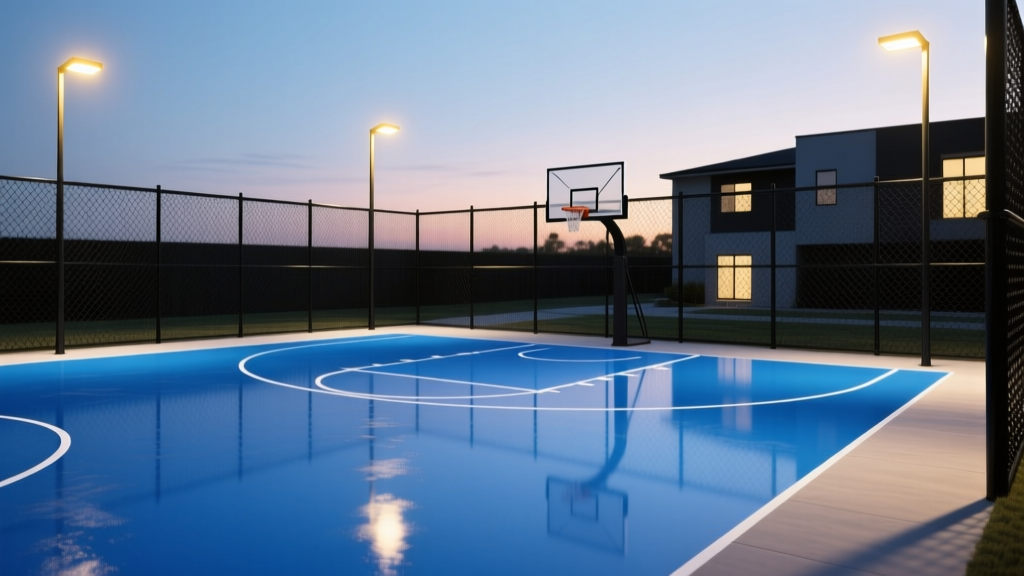
Nighttime play requires specialized illumination. Recreational outdoor courts require a minimum of 50 foot-candles of light evenly distributed across the playing surface to prevent dangerous shadows. A standard 4-pole LED system with photocell controls and concrete footings typically costs between $12,000 and $18,000 installed. Ensure the fixtures feature asymmetric optics to minimize light spill onto neighboring properties.
Equipment: Selecting the Right Hoop System
The anchor system for your backboard must be integrated during the concrete pouring phase. Retrofitting an in-ground hoop into cured concrete compromises the slab's structural integrity.
- In-Ground Steel Goals ($1,800 – $3,500): Features a 4-inch to 6-inch steel pole cemented directly into a dedicated footer. Offers zero vibration and professional-grade rebounding. Requires a minimum 48-inch deep concrete footer.
- Portable Systems ($400 – $1,200): Filled with water or sand. Suitable only for casual driveway play. High winds can tip these units, and the large base footprint interferes with baseline drive paths.
- Wall-Mounted ($600 – $1,500): Ideal if the court abuts a garage or barn. Must be anchored into structural studs or masonry, never just siding or drywall.
Step-by-Step Decision Framework
To finalize your budget and scope, follow this sequential decision matrix:
- Define the Primary User: If the court is for young children or casual shooting, a 30x30 asphalt pad with a portable hoop ($5,000 total) is sufficient. For competitive high-school athletes, mandate a full-size post-tensioned concrete slab with acrylic surfacing ($25,000+).
- Assess Soil and Drainage: Order a percolation test. If you have heavy clay soil, abandon asphalt entirely and invest in post-tensioned concrete with a perimeter French drain system.
- Verify Zoning and Setbacks: Check municipal codes regarding impervious surface limits and fence height restrictions. Many HOAs restrict fence heights to 6 feet, which is inadequate for a basketball court.
- Bid the Base Separately: Hire a specialized concrete contractor for the slab, and a dedicated sports-surfacing company for the acrylic or tile installation. General contractors often mark up specialized sports surfacing by 30% or more.
Written by
Marcus ChenMarcus Chen is a licensed structural engineer (PE) and building materials analyst with over 12 years of experience across residential, commercial, and industrial construction. He holds a Master of Science in Civil Engineering from UC Berkeley and spent six years at Thornton Tomasetti before transitioning to independent consulting and technical writing. Marcus specializes in material selection for seismic-prone regions, concrete reinforcement strategies, and lifecycle cost analysis. His work has been cited by the American Concrete Institute (ACI) and the Structural Engineers Association of California (SEAOC). When he is not on a job site or at his desk, you will find him hiking the Sierra Nevada or restoring a 1920s craftsman bungalow in Oakland, CA.
More from Marcus Chen
View all
Construction Cost
How Much Did the Eiffel Tower Cost to Build?
How much did the Eiffel Tower cost to build in 1889? We adjust for inflation and compare its budget to modern skyscraper construction.
Aug 4, 2026

Fire Resistance
What Is a Fire Resistant Material? Testing & Certification Guide
Discover what is a fire resistant material through ASTM and UL testing. Learn how fire ratings, certifications, and assemblies work in construction.
Aug 4, 2026

Construction Cost
How Much Did the Burj Khalifa Cost to Build?
How much did the Burj Khalifa cost to build? We break down the $1.5B project and extract 5 money-saving strategies for your next build.
Jul 30, 2026