Cost to Build The Sphere: 2026 Mega-Project Cost Breakdown
Explore the true cost to build the Sphere, breaking down the $2.3B price tag, structural steel premiums, LED costs, and spherical HVAC engineering.
The $2.3 Billion Blueprint: Deconstructing the Price Tag
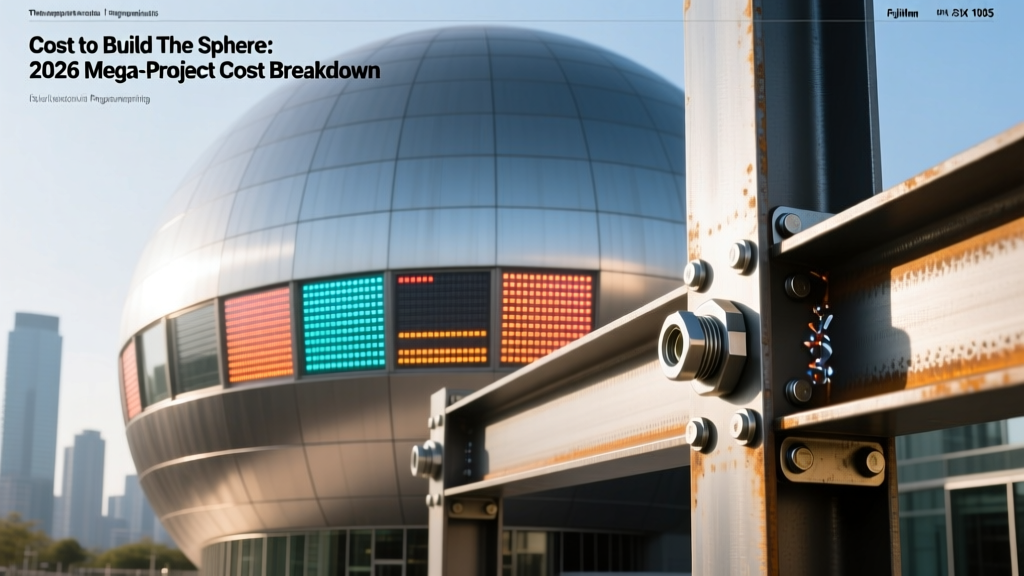
When evaluating the cost to build the Sphere in Las Vegas, traditional commercial construction estimating models fail. The MSG Sphere, which opened to global acclaim and continues to set the benchmark for immersive venues in 2026, carries a finalized price tag of approximately $2.3 billion. This equates to roughly $13,500 per square foot of gross floor area, vastly exceeding the $400 to $800 per square foot typical of modern rectilinear arenas. For construction estimators, architects, and developers, understanding this cost requires deconstructing the extreme engineering premiums associated with spherical geometry, custom optoelectronics, and high-capacity thermal management.
The financial leap from a standard $1.5 billion stadium to a $2.3 billion spherical venue is not driven by sheer square footage, but by the compounding complexity of curved structural nodes, bespoke audiovisual hardware, and the mitigation of acoustic anomalies inherent to spherical volumes.
The Geometry Premium: Structural Steel and Node Engineering
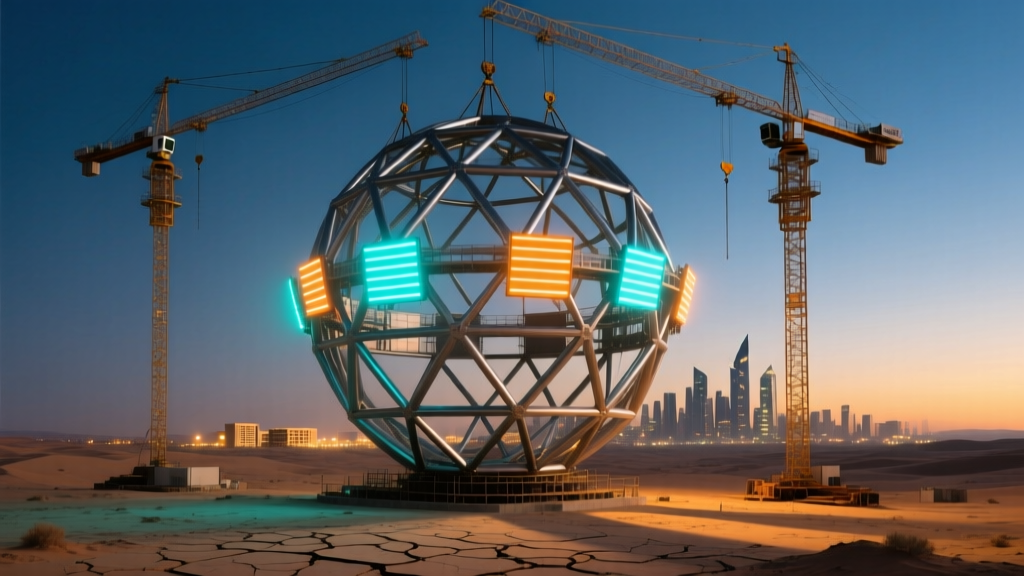
The roof of the Sphere is the heaviest spherical steel structure ever constructed, weighing in at 13,000 tons. In standard commercial construction, structural steel packages (fabricated and erected) typically range from $2,500 to $3,500 per ton. However, the Sphere’s geometry eliminates the use of standard W-shapes and orthogonal HSS (Hollow Structural Sections) in favor of complex, multi-directional curved trusses.
Every intersection in a spherical truss network requires custom cast steel nodes. These nodes must be 3D-modeled, CNC-machined, and stress-tested to handle multidirectional sheer forces. This fabrication complexity pushes the installed cost of the steel package to an estimated $7,500 to $9,000 per ton. Furthermore, erecting a 366-foot-tall spherical roof requires massive temporary shoring and heavy-lift crawler cranes (such as the Demag CC 8800-1), adding a 15% to 20% erection premium over conventional steel framing.
Material Cost Matrix: Sphere vs. Traditional Arena
| Cost Category | Traditional Rectilinear Arena | Spherical Mega-Venue (The Sphere) | Cost Variance Driver |
|---|---|---|---|
| Structural Steel (Installed) | $2,800 - $3,500 / ton | $7,500 - $9,000 / ton | Custom cast nodes, curved HSS, heavy-lift crane rentals |
| Exterior Cladding / Skin | $40 - $80 / sq ft (Metal/Glass) | $200 - $250 / sq ft (Custom LED) | IP68-rated outdoor pucks, custom wiring harnesses, wind-load bracing |
| HVAC Systems | $15 - $25 / sq ft | $45 - $60 / sq ft | Displacement ventilation, massive chilled water plants for LED heat |
| Acoustic Treatment | $8 - $12 / sq ft | $35 - $50 / sq ft | Convex diffusers to eliminate focal points, beam-forming audio arrays |
The Exosphere and Interior LED: Pricing the Pixel Pitch
The exterior of the venue, known as the Exosphere, encompasses 580,000 square feet of programmable lighting. This is not off-the-shelf digital signage. The skin consists of 1.2 million custom-manufactured, IP68-rated LED pucks designed to withstand extreme desert UV exposure and high wind loads. According to The Verge, the sheer scale of this optoelectronic manufacturing required dedicated supply chains. Estimators should budget $200 to $250 per square foot for exterior architectural LED skins of this magnitude, factoring in the specialized structural armatures required to mount the pucks to the curved steel exoskeleton while maintaining precise pixel alignment.
Inside, the 160,000-square-foot wraparound interior screen boasts a 16K resolution. High-resolution indoor fine-pitch LED (typically 1.5mm to 2.5mm pixel pitch) costs between $800 and $1,500 per square foot installed. The interior screen alone represents a $150 million to $200 million material and labor investment, requiring thousands of miles of internal data cabling and localized power distribution units (PDUs) to prevent voltage drop across the massive curved surface.
Estimator's Note: When pricing large-scale LED integrations, always account for a 10% to 15% contingency for pixel dead-on-arrival (DOA) replacements and the cost of redundant data processing servers required to render and map 16K resolution content in real-time without latency.
Thermal Stratification and HVAC Engineering
Spherical volumes present a nightmare for traditional HVAC design. Heat naturally rises, leading to severe thermal stratification where the upper apex of the sphere can be 20°F to 30°F hotter than the floor level. Furthermore, the interior LED screen and 10,000 haptic seats generate a massive, continuous internal heat load.
To combat this, the Sphere utilizes an advanced displacement ventilation system. Rather than blowing cold air from the ceiling (which would immediately stratify), conditioned air is delivered at low velocities from the floor and seat pedestals, pushing heat upward where it is exhausted at the apex. Estimating this system requires pricing massive chilled water plants, under-floor air distribution (UFAD) plenums, and custom displacement columns. Expect HVAC costs to exceed $50 per square foot, more than double the cost of standard arena air handling units (AHUs).
Acoustic Engineering in Spherical Volumes
The most notorious flaw of spherical architecture is the "whispering gallery" effect. Sound waves traveling along a curved surface continuously reflect and converge at focal points, creating severe acoustic distortion and chaotic reverberation times (RT60). To achieve pristine audio, the interior requires aggressive acoustic mitigation.
The Sphere relies on a combination of convex acoustic diffusers to scatter sound waves and a revolutionary beam-forming audio system (Holoplot). Instead of flooding the room with omnidirectional sound, the Holoplot X1 Matrix drivers use digital signal processing to steer audio beams directly to specific seating zones. Estimating acoustic treatments for spherical venues requires budgeting for custom-fabricated, non-repeating convex baffles, which can cost $40 to $60 per square foot to manufacture and install due to the lack of standardized, repeatable geometries.
Scaling Down: Estimating Residential and Commercial Domes
While the $2.3 billion Las Vegas venue is an outlier, the principles of spherical construction apply to smaller-scale projects like residential domes, glamping spheres, and agricultural storage. According to data from the Monolithic Dome Institute, the cost to build spherical structures at a residential scale varies heavily by the chosen structural methodology.
- Monolithic Domes (Shotcrete over Airforms): Ranging from $100 to $160 per square foot. This method involves inflating a massive fabric airform, spraying polyurethane foam, and applying steel-reinforced shotcrete. It offers superior energy efficiency and disaster resistance but requires specialized contractors.
- Geodesic Domes (Timber or Steel Hubs): Ranging from $150 to $300 per square foot. The cost premium here is driven by the complex triangular glazing required for windows, the fabrication of multi-axis hub nodes, and the high waste factor when cutting standard rectilinear building materials (like plywood and drywall) to fit triangular frames.
- Prefabricated Glamping Spheres: Ranging from $40 to $80 per square foot. These utilize lightweight aluminum frames and PVC or ETFE membrane skins, bypassing heavy structural engineering but offering minimal thermal insulation.
Final Estimating Considerations for Curved Geometries
Whether you are pricing a multi-billion-dollar entertainment venue or a 2,000-square-foot eco-home, spherical construction demands a departure from standard unit-cost databases like RSMeans. Estimators must apply a "geometry multiplier" to labor hours. Carpenters, drywallers, and steel ironers lose up to 30% of their standard productivity when forced to measure, cut, and install materials along compound curves. Always factor in custom 3D BIM modeling (LOD 400) to resolve structural clashes before fabrication, as field modifications to curved steel or custom LED armatures are virtually impossible without halting the critical path.
Written by
Sarah WhitfieldSarah Whitfield is a chartered quantity surveyor (MRICS) and construction cost analyst with 15 years of experience in material pricing, procurement strategy, and project budgeting. She earned her degree in Construction Management from the University of Reading (UK) and has worked on projects ranging from $2M custom homes to $180M mixed-use developments across North America and Europe. Sarah currently leads cost estimating for BuildMat Insight, maintaining a proprietary database of 4,000+ material price points updated quarterly. She is a frequent contributor to RSMeans cost data panels and has presented at the International Cost Engineering Council (ICEC) congress. Based in Denver, CO, Sarah is an avid trail runner and volunteer mentor for Women in Construction.
More from Sarah Whitfield
View all
Wood & Lumber
What Are the Different Types of Wood? A Builder's Guide
Compare structural softwoods, finish hardwoods, and engineered lumber. Analyze Janka ratings, MOE values, and 2026 pricing for construction.
Aug 4, 2026

Walls & Panels
Steel Framing vs Wood Framing: Corrosion and Moisture Defense
Compare steel framing vs wood framing for moisture resistance. Learn about galvanized coatings, condensation risks, and corrosion protection strategies.
Jul 21, 2026

Stone & Masonry
How to Cut Stone Veneer: Wet Saw vs Grinder Comparison
Compare the best tools for cutting stone veneer. We review wet saws, angle grinders, and chop saws to help you achieve clean, chip-free cuts.
Jul 21, 2026